



Player behavior data was collected in June 2026; the company ran the survey itself. It covered 5,339 gamers worldwide: in the US, the UK, Germany, France, Japan, Brazil, India, and Saudi Arabia.
The market
The market estimate is built on data from IDC, PwC, Omdia, and S&P Capital IQ. The forecast is as of December 2025 and excludes hardware sales, advertising revenue, and esports.
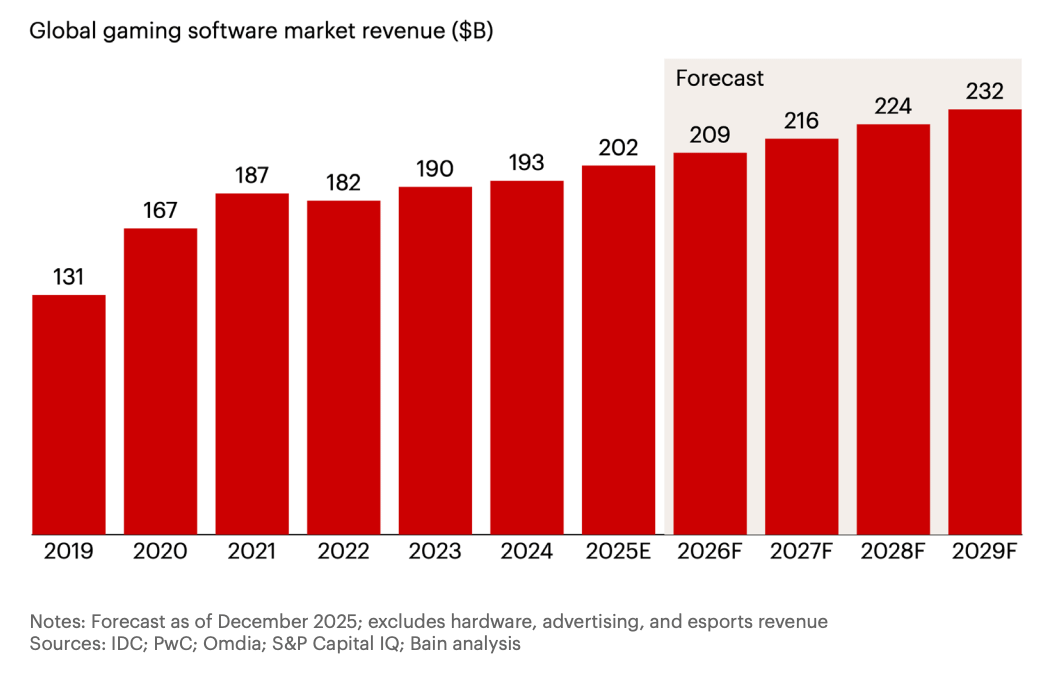
Gaming software revenue was $202 billion in 2025. Over the past four years, by the company’s estimates, the market grew about 3% annually, and Bain & Company assumes the same pace for the next four: by 2029, industry revenue should reach $232 billion.
A word from our sponsor

Game studios run on contractors — artists, composers, QA testers, translators — often spread across a dozen countries. That’s a lot of contracts, tax rules, and IP clauses to track. Mellow handles all of it: compliant contracts, automated payments, and IP protection built in, for contractors in 150+ countries.
In 2026, the forecast puts the market at $209 billion. For comparison, Newzoo expects the market to reach $213.9 billion this year, with 6.1% growth. On growth rates, the two estimates differ by nearly twice.
❗️Bain & Company has noticeably lowered its own forecast. In its 2024 report, the company valued the 2023 market at $196 billion and expected 6% annual growth to $257 billion by 2028. Now 2023 has been restated at $190 billion, and the estimate for 2028 is $224 billion. Over two years, the 2028 forecast has come down by $33 billion.
Gaming’s share of total media consumption has plateaued. Analysts write that the industry has already captured most of the audience, and people have no free time left.
Audience and its preferences
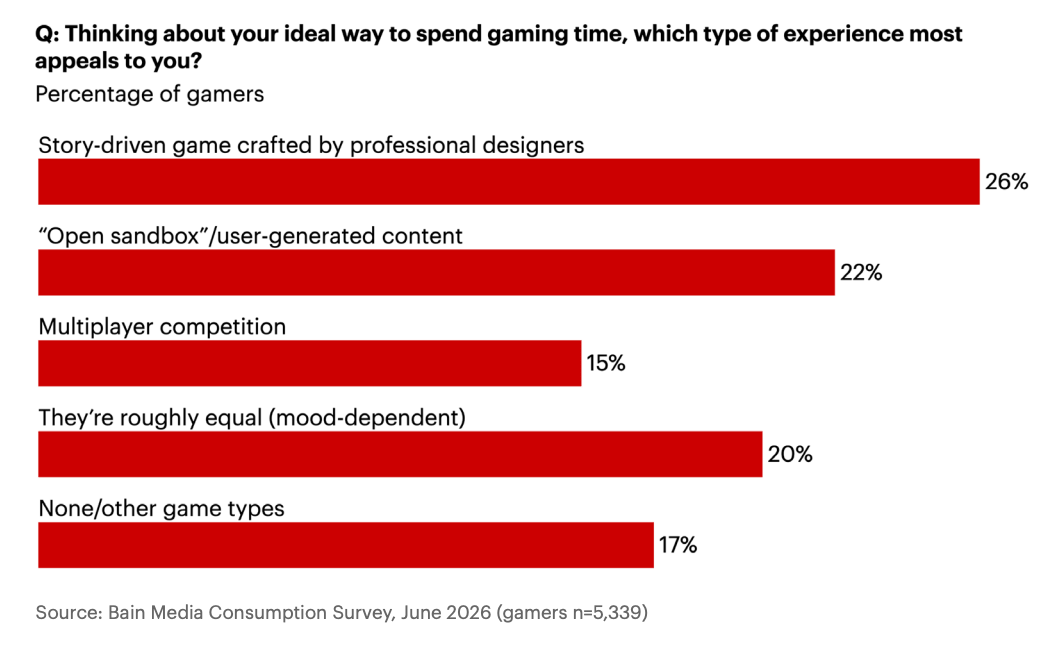
Players like different games. 26% prefer story-driven games from professional studios; 22% like UGC projects and sandboxes; and 15% like competitive multiplayer projects. The market is fragmented.
Three-quarters of gamers were looking for what to play next at the time of the survey. Most of them, though, don’t plan to go beyond their usual genres.
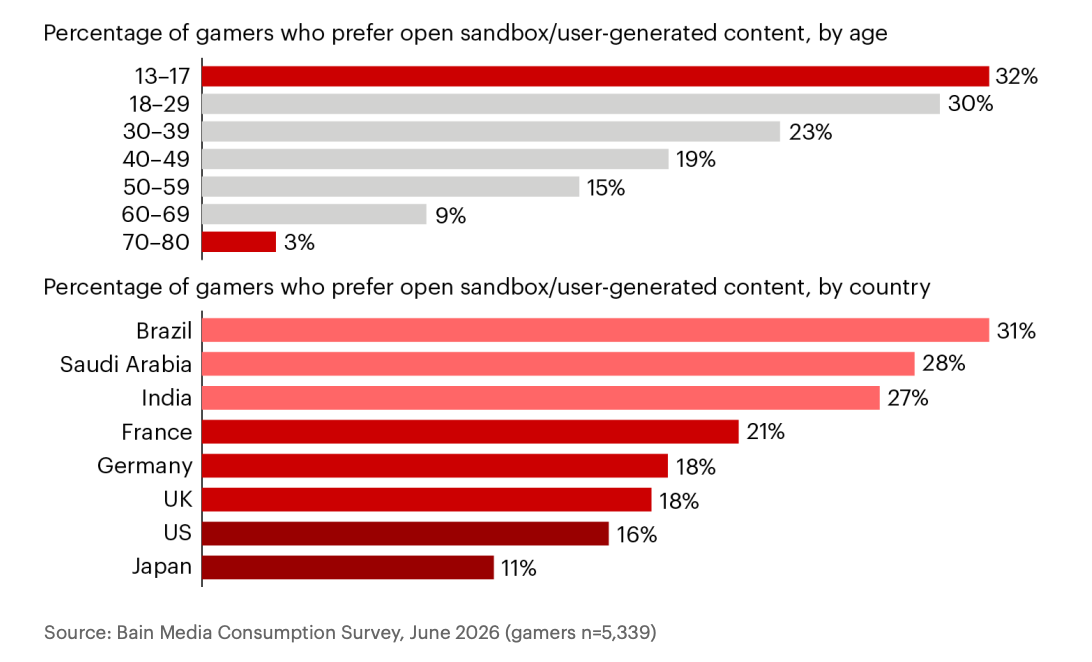
Interest in sandboxes and UGC declines sharply with age. Among teens ages 13 to 17, 32% choose them; among people ages 50 to 59, 15%; and among those over 70, 3%.
By country, sandboxes and UGC are most popular in Brazil (31%), Saudi Arabia (28%), and India (27%). They are least popular in Japan (11%) and the US (16%).
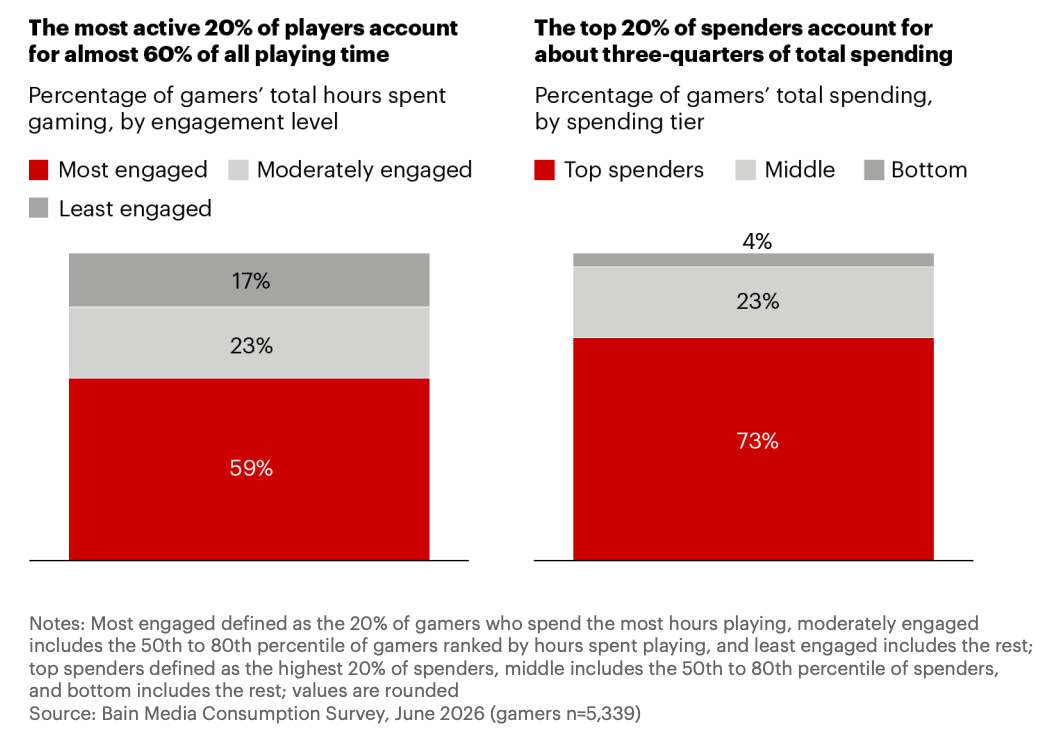
The most active 20% of players account for 59% of all playing time. The top 20% of spenders bring in 73% of all the money.
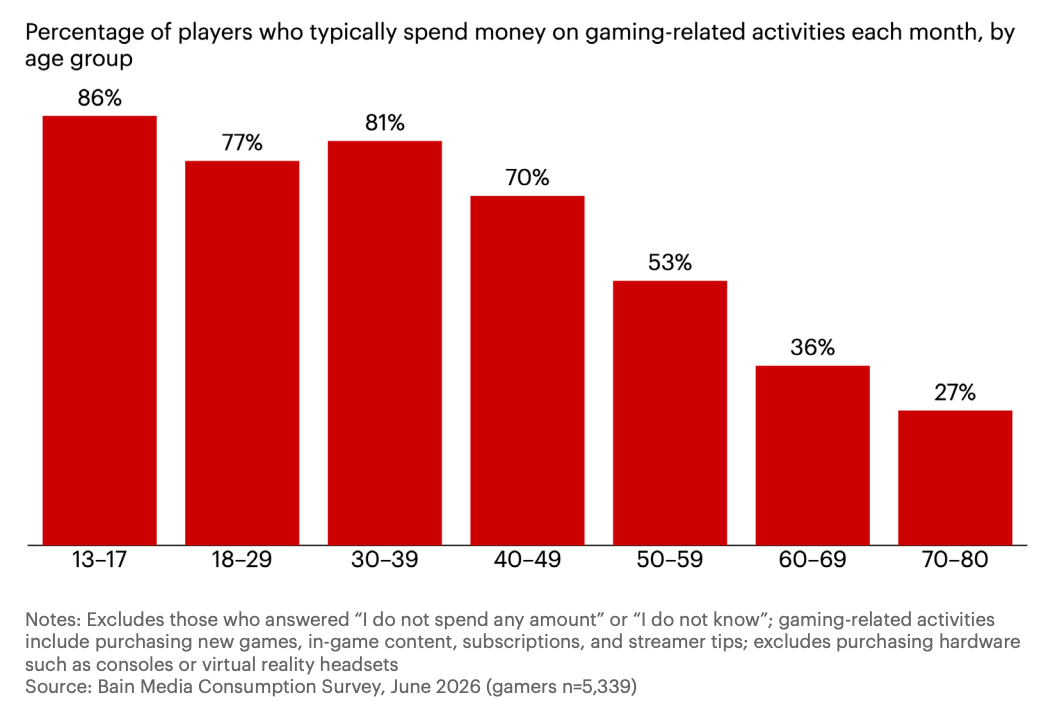
Per the survey, teenagers spend money in games most often: 86% of players ages 13 to 17 spend money on games in a typical month. Among people ages 50 to 59, the share falls to 53%, and among the 60 to 69 audience, to 36%. The relationship isn’t entirely linear, though: players ages 30 to 39 pay more often (81%) than the 18 to 29 audience (77%).
People who create game content for others spend money twice as often as everyone else.
Focus and AI
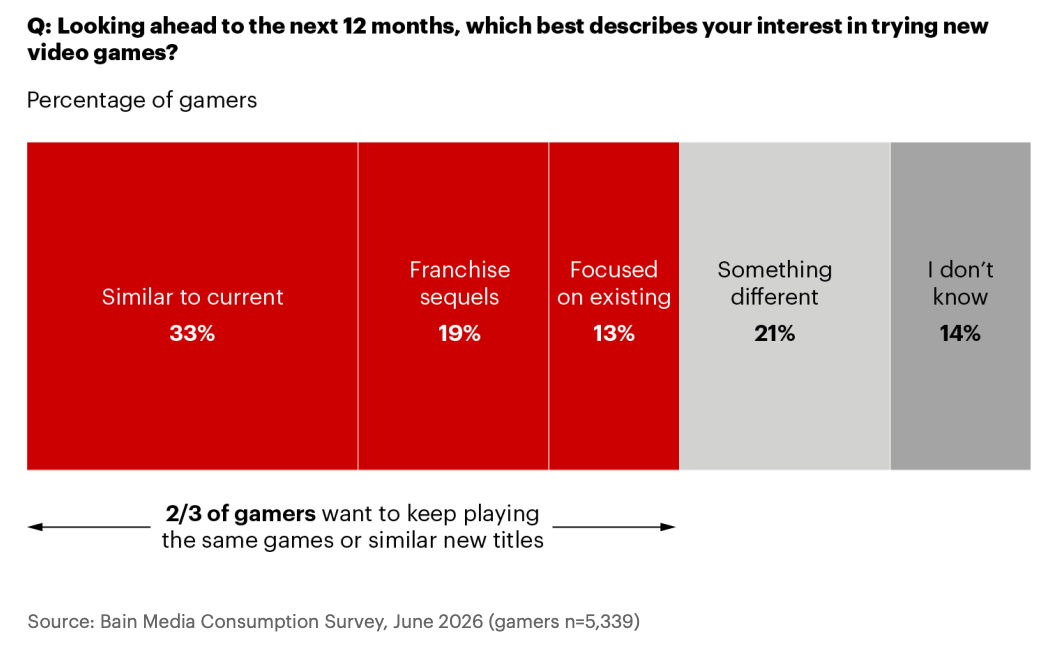
Two-thirds of gamers want roughly the same thing over the next 12 months as they have now: 33% are looking for games similar to their current ones, 19% are waiting for sequels to favorite franchises, and 13% plan to play only what they already play. Only 21% want something fundamentally new.
Bain & Company reviewed 100 games released since 2023. Among projects with a clear target audience, 83% were commercially successful; among projects without one, 50% were.
❗️Bain & Company sorted the games by themselves into those with a clear target audience and those without. The analysts acknowledge that far less publicly available data exists on failures than on successes.
As an example, the analysts point to Baldur’s Gate 3 and Concord: two large bets placed at roughly the same time. The first game sold more than 20 million copies and earned $657 million on Steam in 2023. The second launched into an overheated hero-shooter market and ended in a loud failure.
As another example of successful focus, Bain & Company points to Jagex. The studio sold off some of the teams it had acquired earlier, cut its project slate, and rebranded as Jagex: The RuneScape Company. The company removed RuneScape’s microtransaction system and focused on long-term growth. It also started working with a portfolio of products inside the universe: RuneScape: Dragonwilds sold more than a million copies in its first year.
AI, in the analysts’ view, doesn’t fix these problems. It speeds up production, but unfocused studios fail faster.
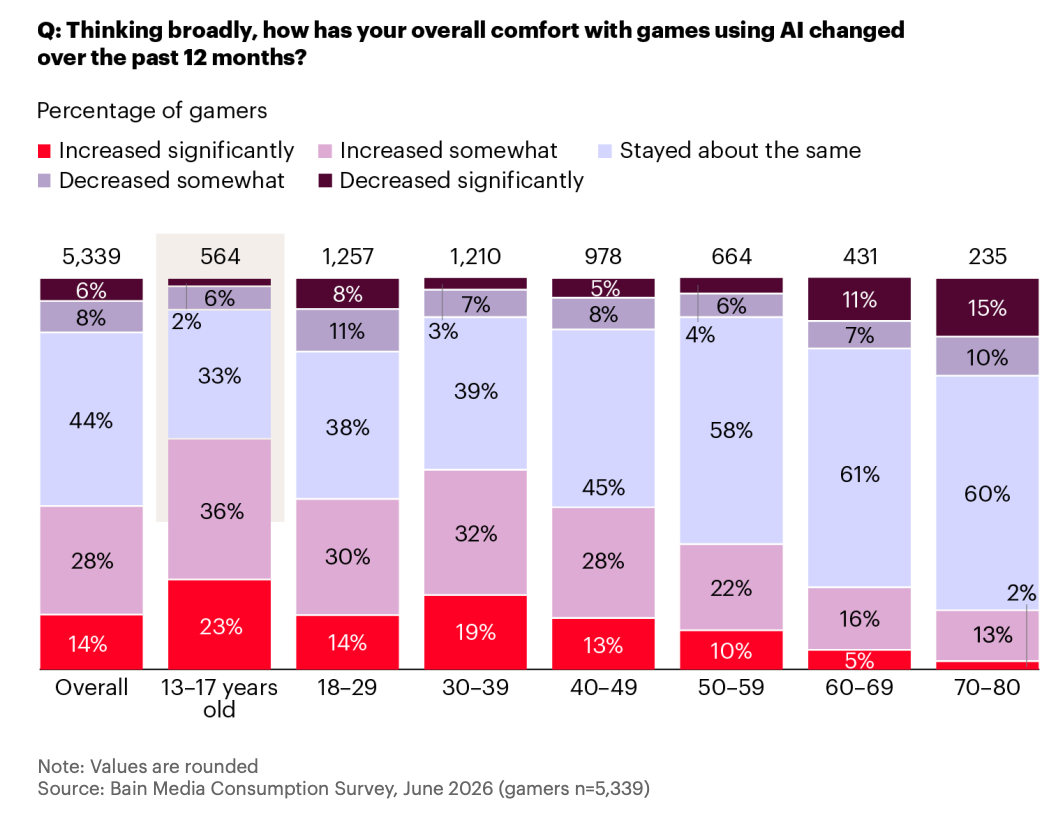
42% of players are more comfortable with the use of AI in games than they were a year ago. 44% did not change their opinion, and only 14% became less comfortable.
Among teens ages 13 to 17, 59% became more comfortable with AI. In the 70 to 80 group, though, 25% became less comfortable.
Personalization
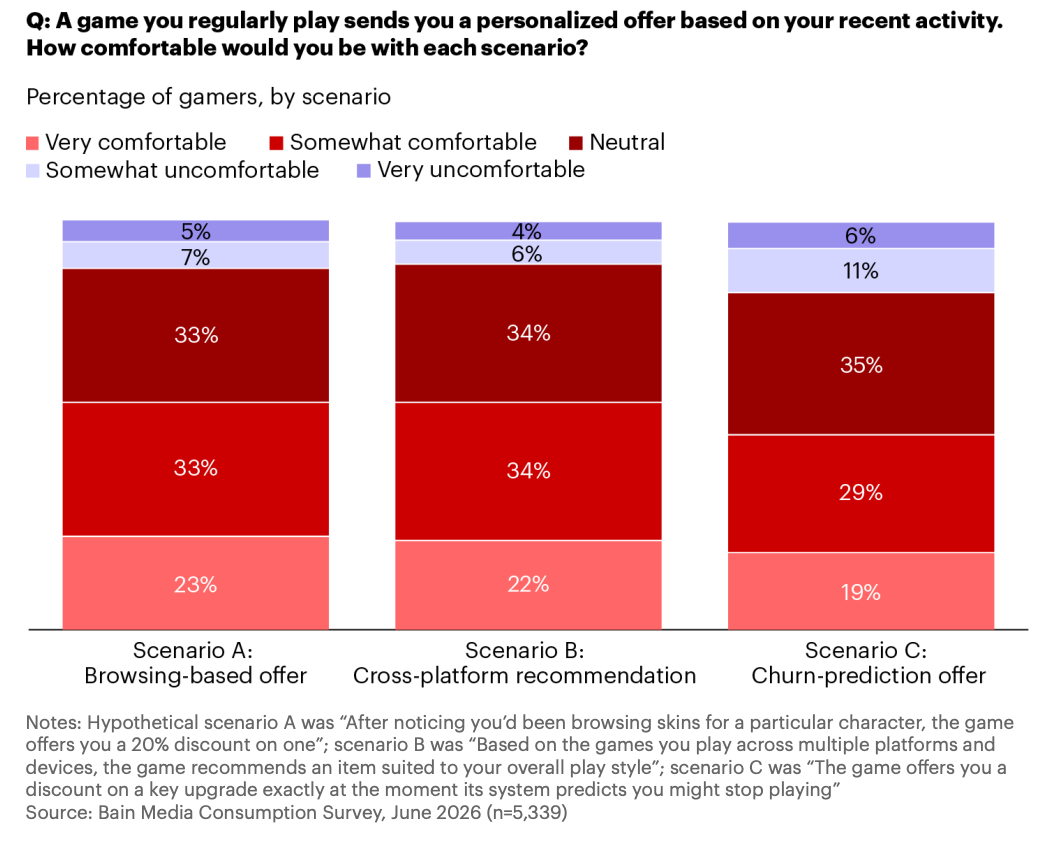
Players aren’t against personalized offers. For a personalized discount on a skin the person recently browsed, 56% feel positive about it, and another 33% are neutral. The worst-received offer is one a game sends when an algorithm predicts the player is about to leave: 17% of respondents said they feel uncomfortable at that moment.
Bain & Company identifies five areas for personalization: the in-game store and offers, lapsed player reengagement, onboarding, in-game content discovery, and cross-promotion between one publisher’s projects.
Distribution and D2C
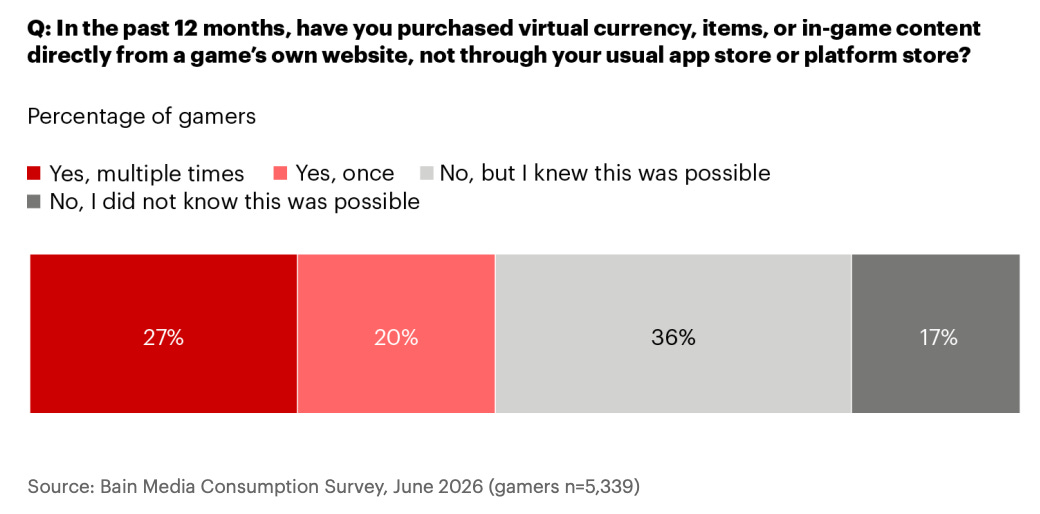
Nearly half of gamers purchased currency, items, or content directly on a game’s website at least once in the past 12 months. 27% did so several times, and 20% did so once.
The share of D2C buyers among mobile players and among PC and console players is roughly the same. Among teens ages 13 to 17, 40% made several direct purchases over the year.
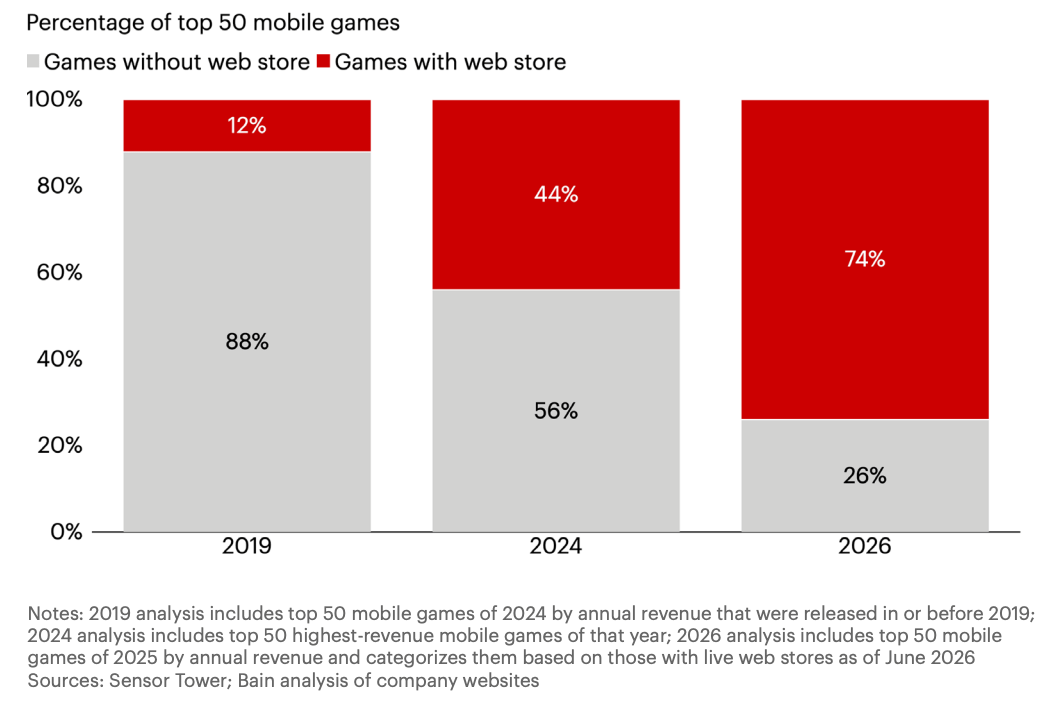
Three-quarters of the top 50 mobile games by revenue have their own web stores. In 2019, 12% did; in 2024, 44% did.
Every transaction moved to direct sales gives the publisher an additional 15% to 30% margin.
A word from our sponsor
Game studios run on contractors — artists, composers, QA testers, translators — often spread across a dozen countries. That’s a lot of contracts, tax rules, and IP clauses to track. Mellow handles all of it: compliant contracts, automated payments, and IP protection built in, for contractors in 150+ countries.
Bain & Company cites a report from GDC and Appcharge, which puts D2C revenue in mobile games at about $17 billion, or roughly 15% of the mobile IAP market. At Modern Times Group and Playtika, the share of direct sales grew from about 25% to 40% of revenue over the year.
❗️The $17 billion estimate is arguable. It is built on assumptions about how incremental D2C revenue really is.
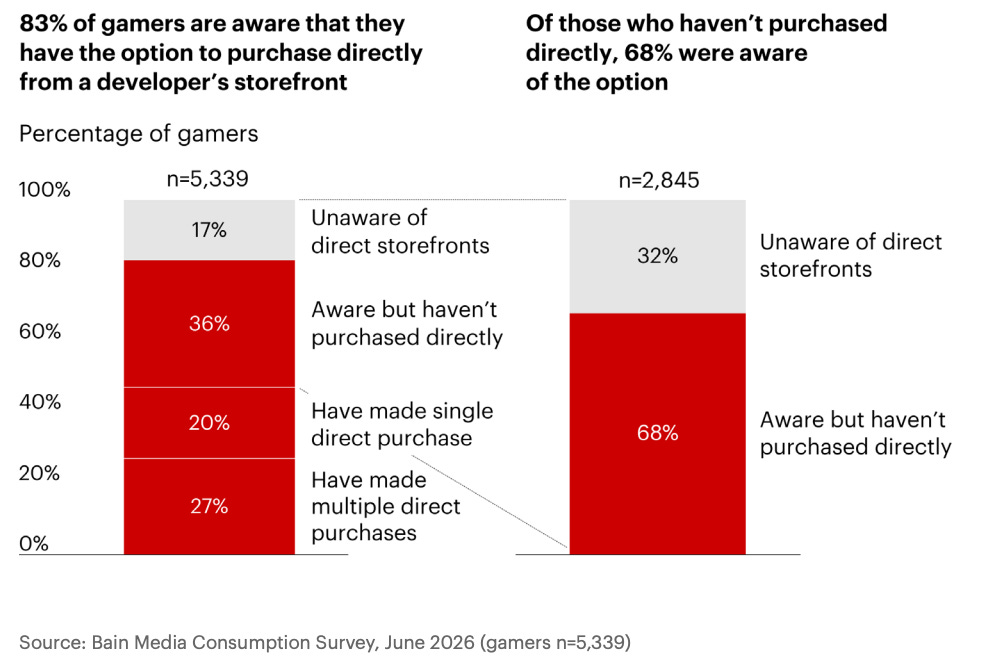
83% of gamers know that buying directly from a developer is even an option. Among those who have never bought that way, 68% knew about it. The problem with web stores, it seems, isn’t awareness but conversion. Buying in-app is simply more convenient.
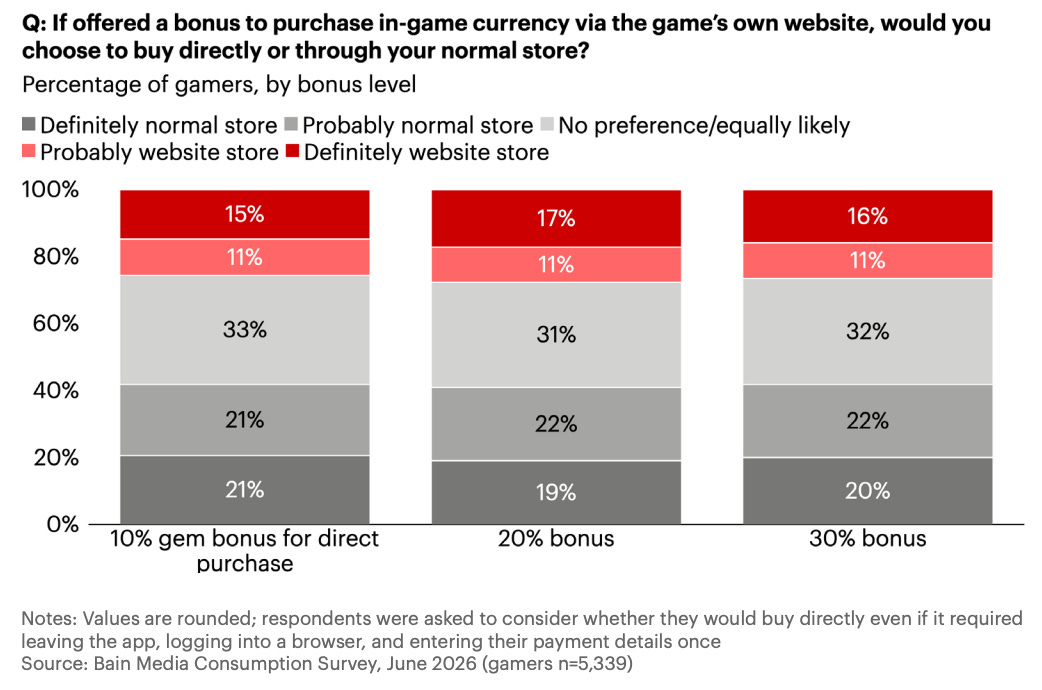
Raising the bonus for a web-store purchase from 10% to 30% has almost no effect on behavior. It moves the share of those who would definitely choose the game’s website by a single percentage point: from 15% to 16%.
Among those who have already bought several times directly, though, 84% say a personalized offer would raise their chances of making a purchase.
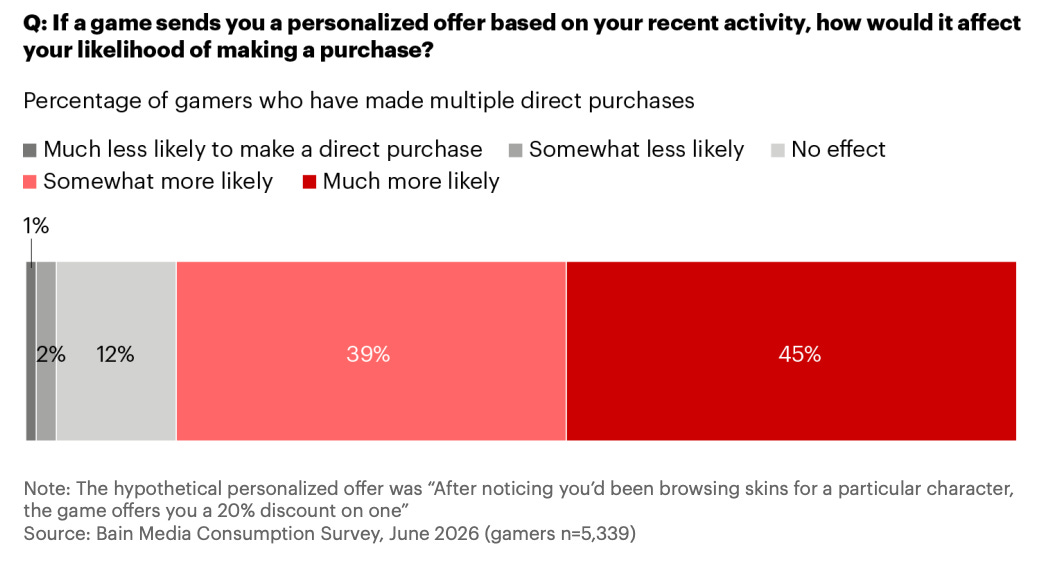
84% of users who buy in web shops noted that personalized offers would increase their likelihood of making a purchase. That is 2.5 times more often than among regular players.
Bain & Company notes that for a midsize developer or publisher, the savings on platform fees pay for building a web store in about a year.