


With support from Video Games Europe, EGDF compiled 2024 data from national trade associations across 28 European countries. In some countries, the figures come from studio surveys; in others, from public registers.
The report was released in August 2026. I already covered its key figures in my recap of Key Facts 2025; this is the full version, with a country-by-country breakdown.
Studios
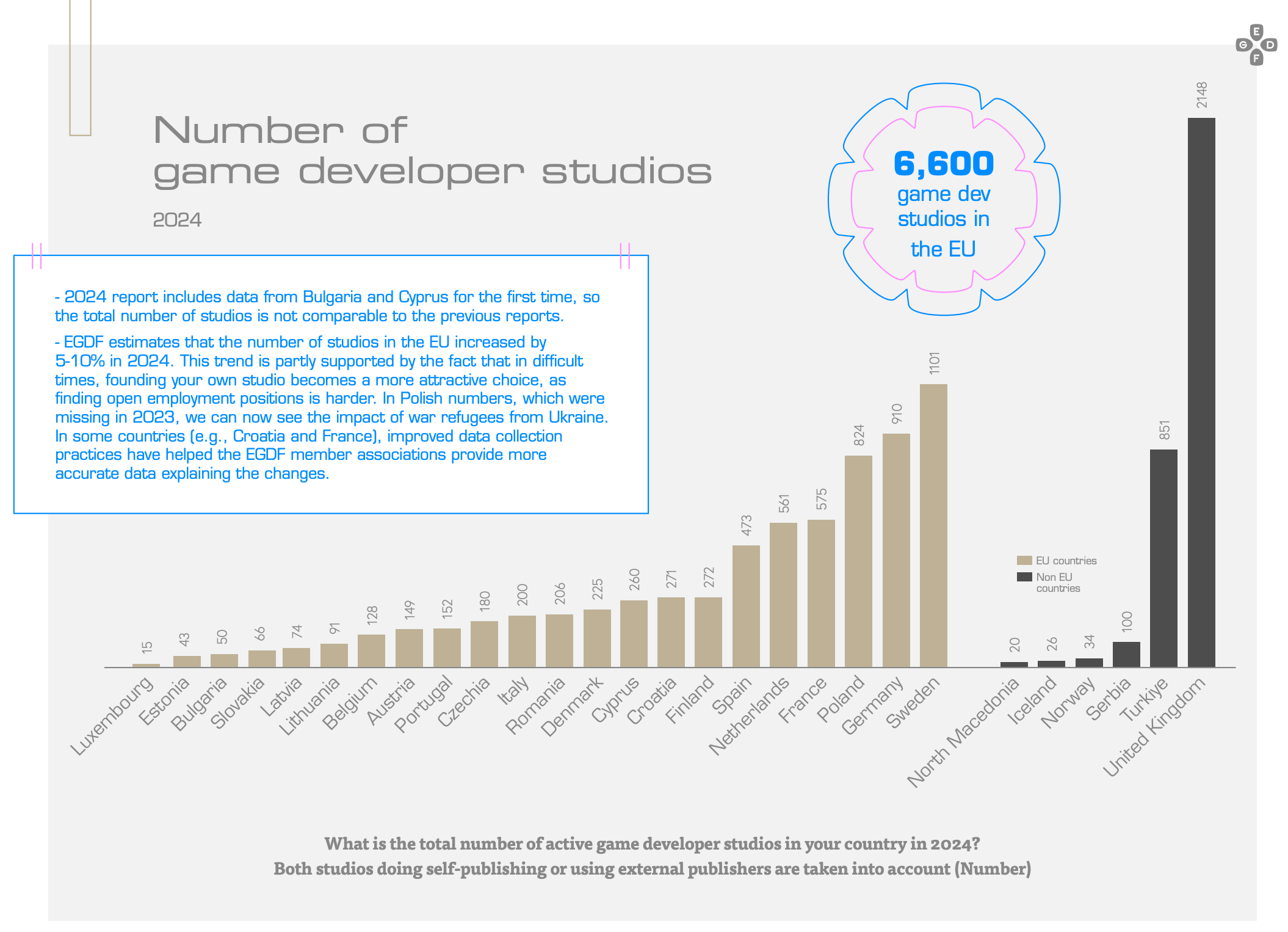
The EU had 6,600 game studios in 2024. EGDF estimates that their number grew by 5-10% over the year.
The UK has 2,148 game studios, far ahead of the rest of Europe. In the EU, Sweden (1,101), Germany (910), and Poland (824) have the most studios. Türkiye has 851.
A word from our sponsor

Need a freelance 3D artist, composer, or QA tester fast? Mellow’s AI Scout finds qualified talent in under 48 hours — free to try, no commitment. Describe the role, get a shortlist, hire when you’re ready.
EGDF explains that in hard times, finding a job is harder, so people are more likely to start their own studios. Geopolitics plays a role too. In Poland, for example, Ukrainians opened many studios.
❗️The PARP report on Poland has the same 824 studios. At least 120 studios counted as active in the 2023 report have closed, suspended operations, or stopped making games.
Cyprus appeared in the report for the first time, with 260 studios. That is more than in Denmark (225), Romania (206), or Italy (200).
Employees
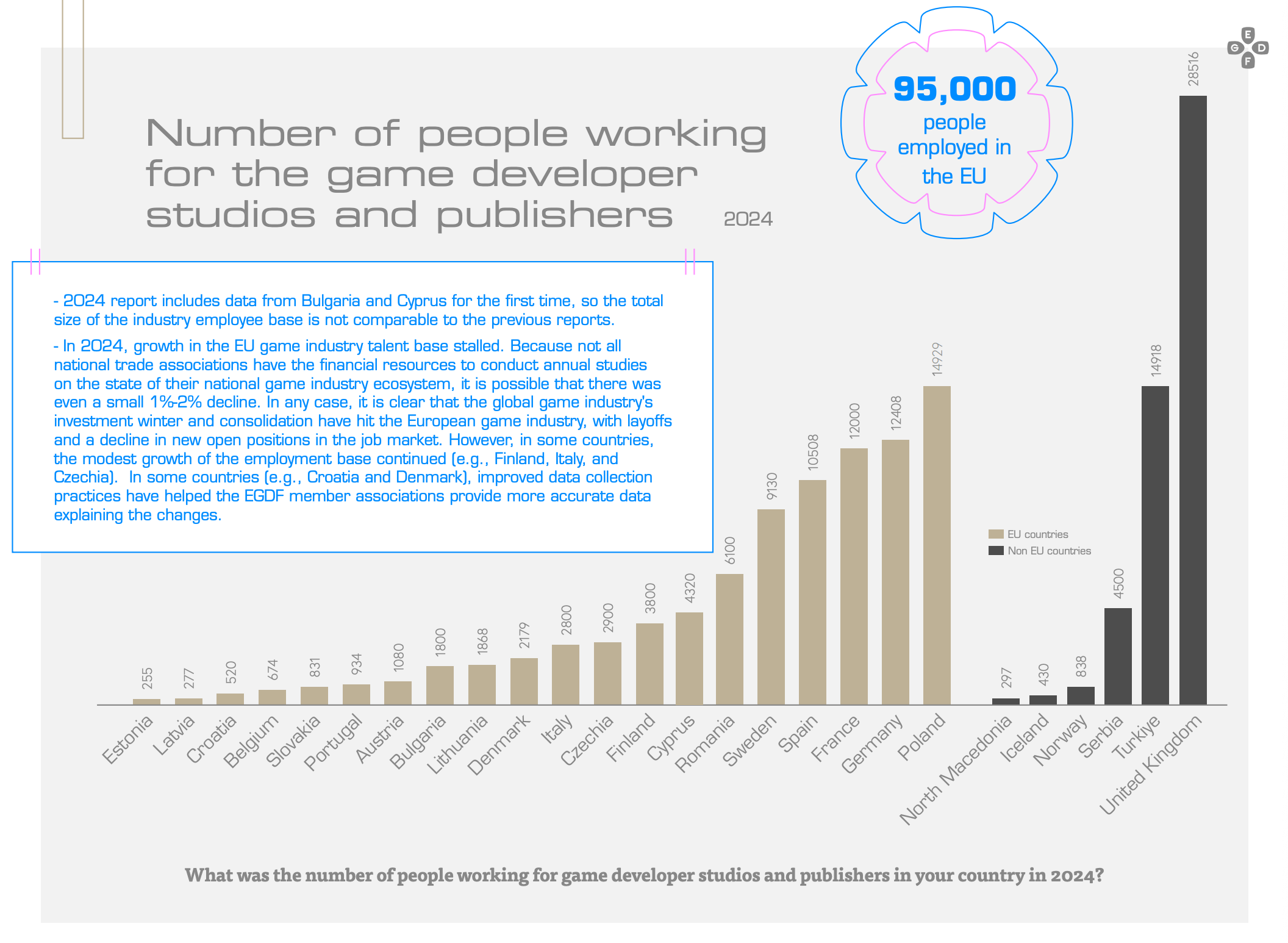
In 2024, 95,000 people worked at game studios and publishers in Europe.
The UK (28,516 people), Poland (14,929), and Türkiye (14,918) employ the most people in the industry.
EGDF writes that employment growth in the EU stalled in 2024. The association doesn’t rule out a small 1-2% decline in 2025. It attributes this to the “investment winter,” consolidation, and layoffs.
For sixteen EU countries, the report has figures for both 2023 and 2024. They employed 68,700 people in 2023 and 69,000 in 2024. So headcount barely changed over the year.
The workforce shrank in Poland (14,929 people vs. 15,290), Romania (6,100 vs. 6,600), and Lithuania (1,868 vs. 2,124). It grew in Germany (12,408 vs. 11,992), Spain (10,508 vs. 10,259), and Finland (3,800 vs. 3,600).
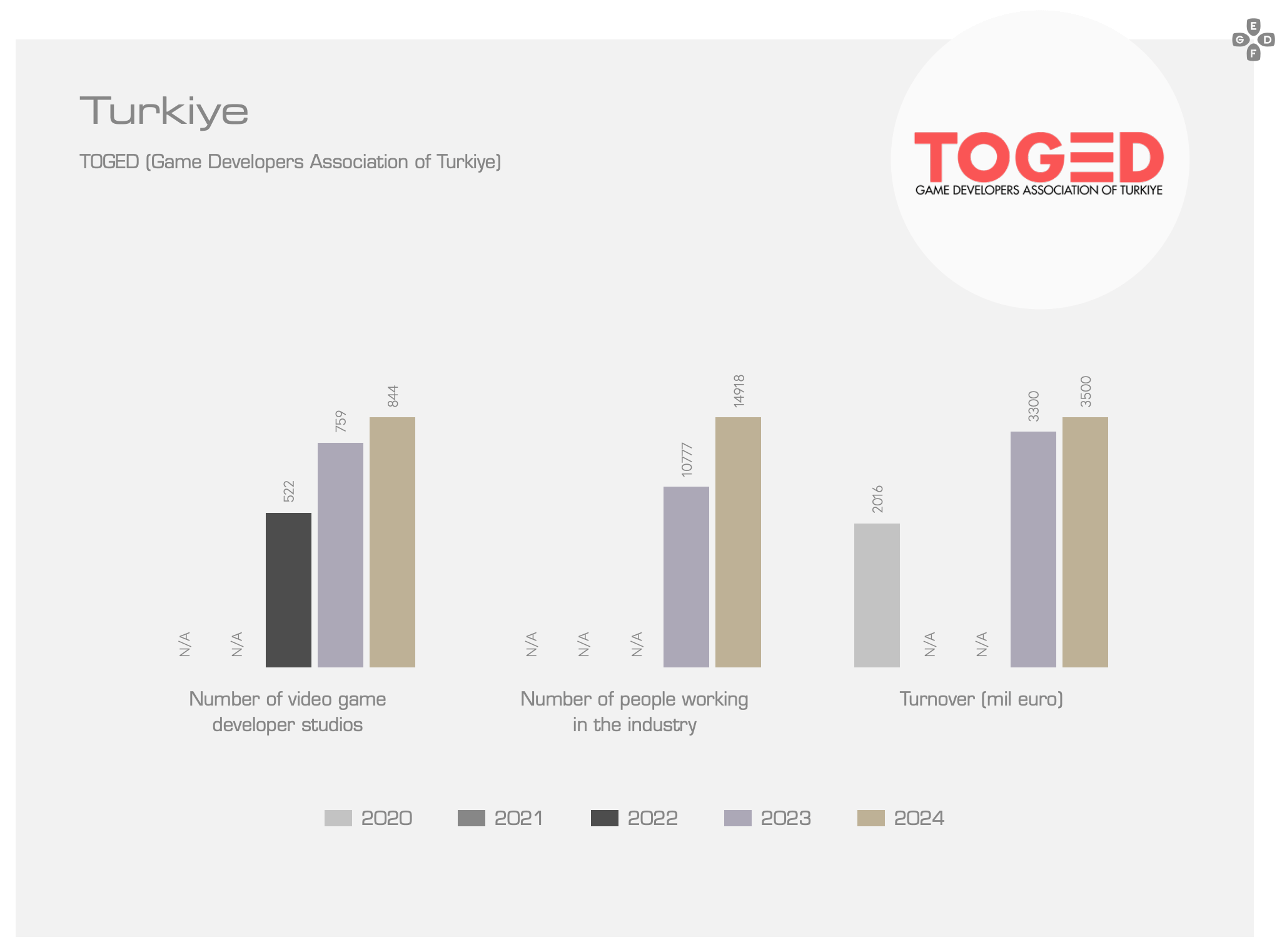
Türkiye, by contrast, added many people over the year: 14,918 vs. 10,777 in 2023 (+38% YoY).
❗️The report covers 2024. More recent national reports show lower figures. In Germany, according to game, 12,235 people worked at studios and publishers in 2026. In Poland, PARP reports 14,568.
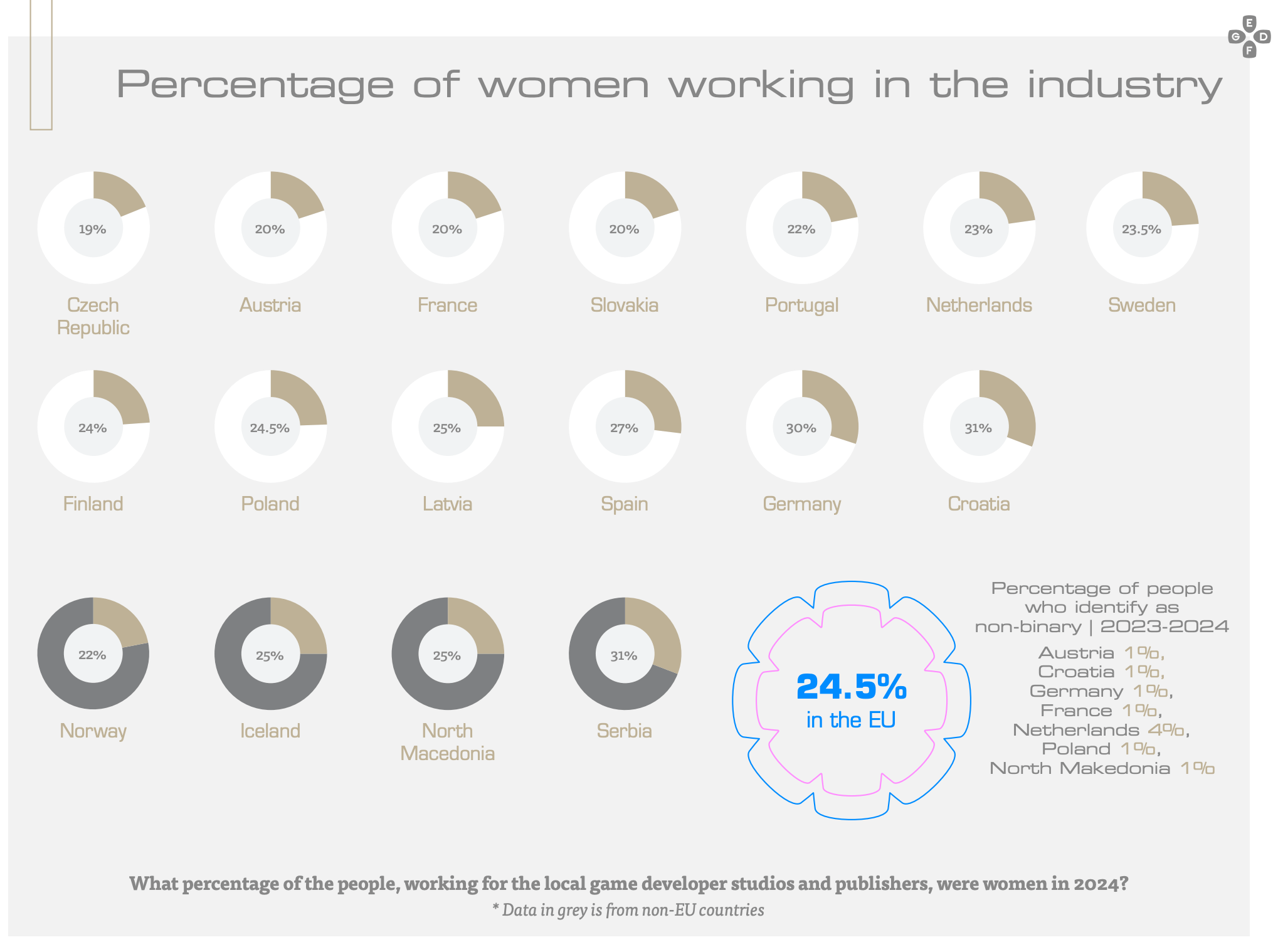
Women make up 24.5% of the EU games industry workforce. Last year’s Key Facts put Europe's number at 24.9%.
Women make up the highest share in Croatia (31%), Serbia (31%), and Germany (30%), and the lowest in Czechia (19%).
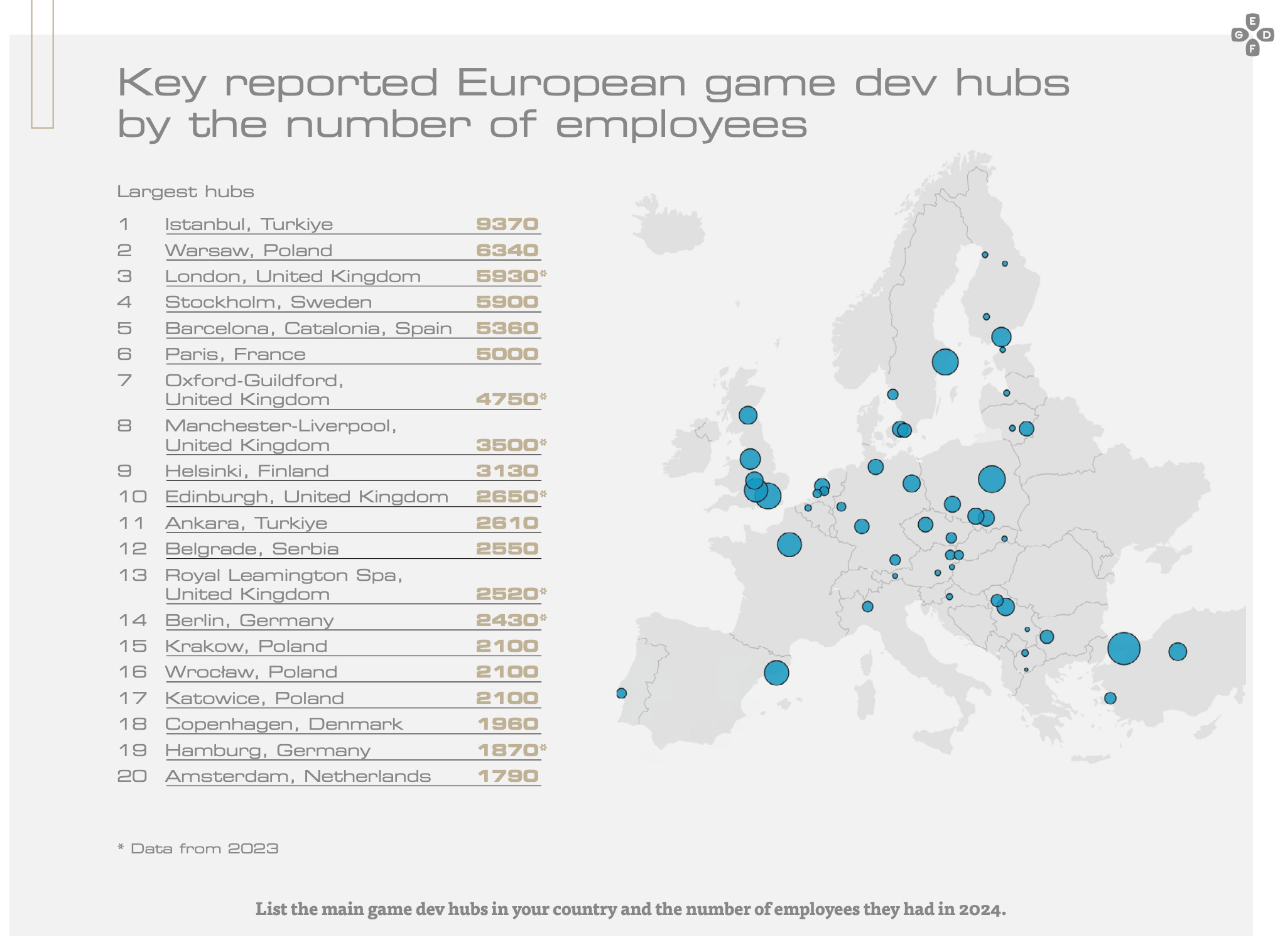
9,370 people work in the games industry in Istanbul, making it Europe’s largest game dev hub. Warsaw is second (6,340 people), and London is third (5,930 people, 2023 data).
The top 20 includes five UK hubs and four Polish ones. Besides Warsaw, those are Kraków, Wrocław, and Katowice, with 2,100 people each.
Turnover
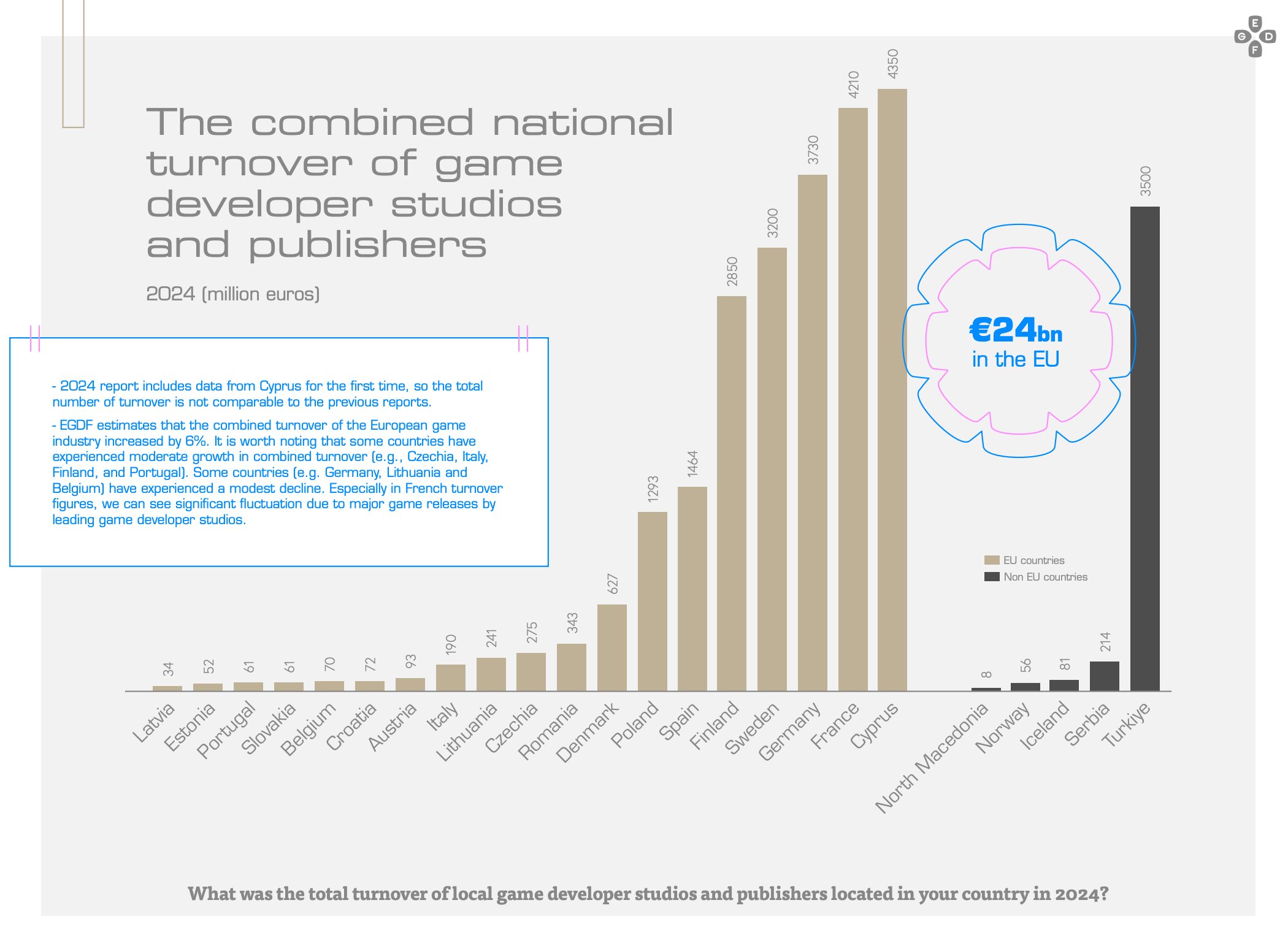
❗️Turnover in the report is the revenue of studios and publishers registered in a country, not what players spend in that country. There is no UK data here.
Combined turnover for game studios and publishers in Europe was €24 billion in 2024. EGDF estimates that the European industry’s turnover grew 6% over the year.
For the sixteen EU countries with figures for both years, growth is more modest: €14 billion vs. €13.7 billion in 2023 (+2.1% YoY).
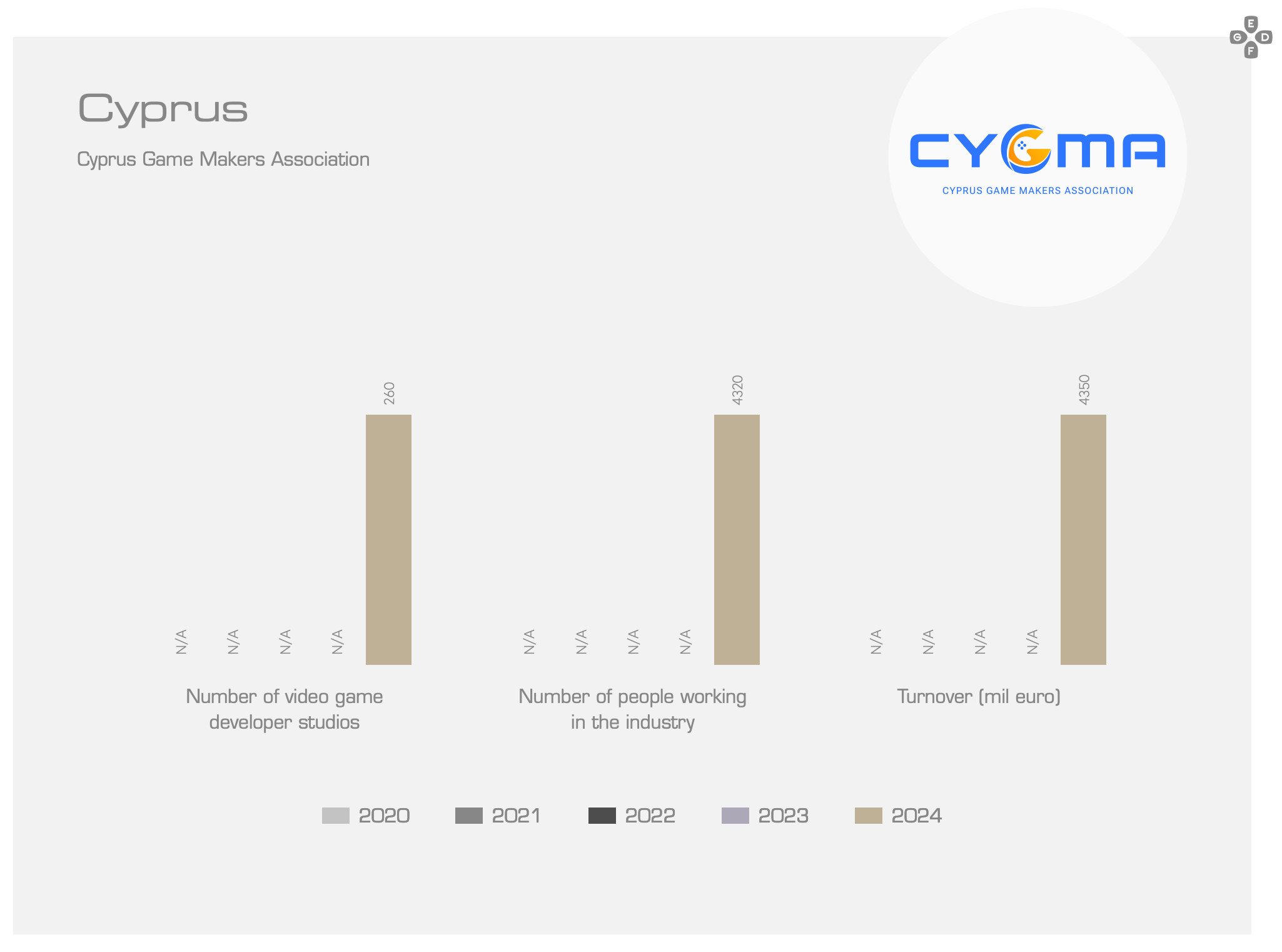
Cyprus led the EU in turnover (€4.35 billion), followed by France (€4.21 billion) and Germany (€3.73 billion). Sweden (€3.2 billion) and Finland (€2.85 billion) come next.
Cyprus accounts for 18% of the EU’s total turnover.
❗️ In its own report, CYGMA estimates Cypriot game companies' revenue in 2025 at more than €3.2 billion.
Poland’s turnover is €1.293 billion. That puts it seventh in the EU, even though the country ranks first by headcount.
Per employee, Poland generates €87,000 in annual turnover. For comparison, Finland generates €750,000, and Cyprus about €1 million.
Turnover grew in Finland (€2.85 billion, +9.6% YoY), Sweden (€3.2 billion, +6.2% YoY), and Czechia (€275 million, +21.7% YoY). It fell in Germany (€3.73 billion, -4.4% YoY) and Poland (-8.8% YoY).
EGDF notes separately that France’s turnover swings a lot year to year because of major studio releases.
Outside the EU, Türkiye stands out with €3.5 billion in turnover (+6.1% YoY). That is more than Sweden.
New games and platforms
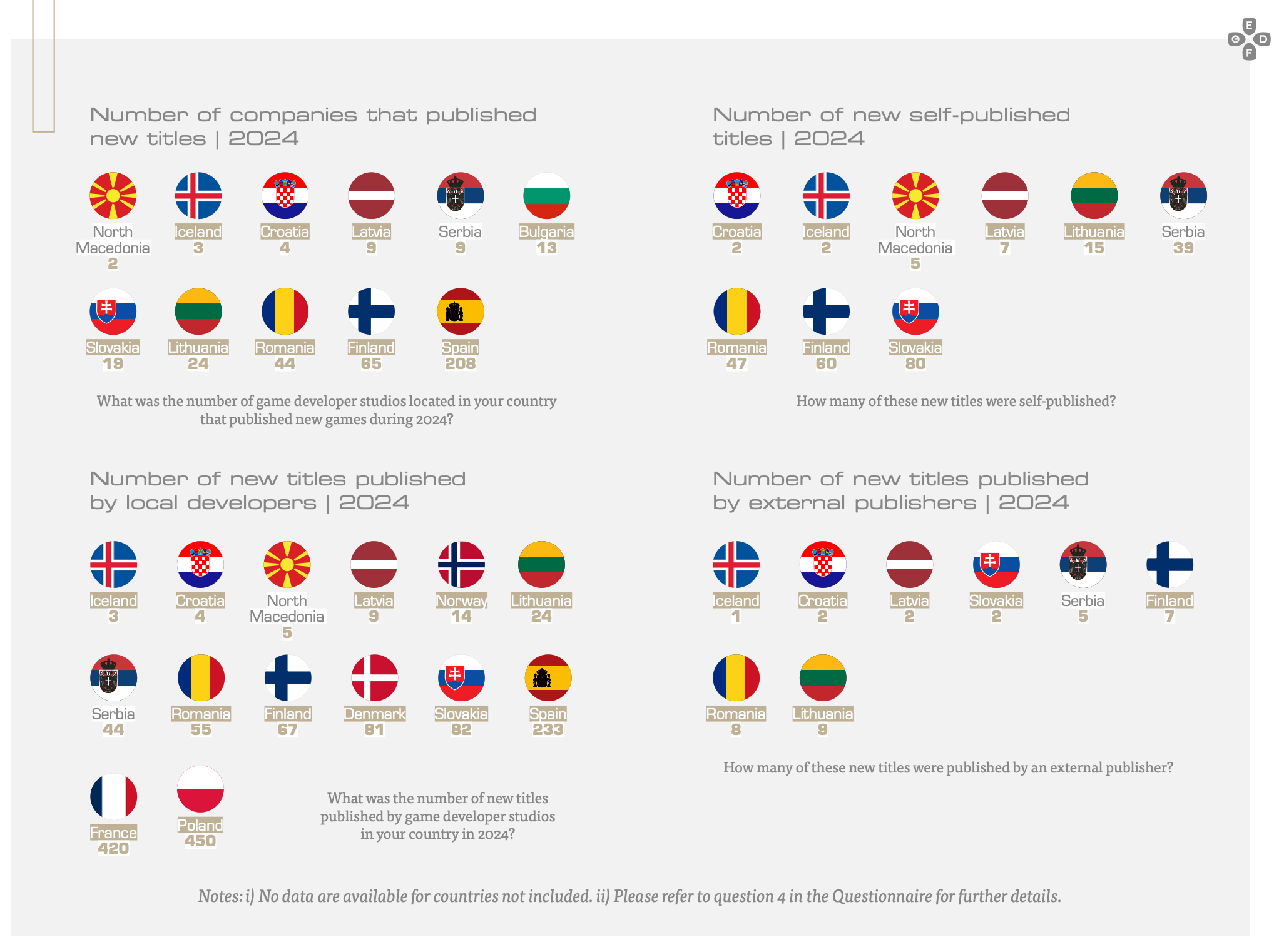
Poland released 450 new games in 2024, France 420, and Spain 233. Data isn’t available for every country.
Most games are self-published. In Finland, 60 of 67 games were self-published; in Romania, 47 of 55; and in Slovakia, 80 of 82.


PC is the main platform for European studios. In 15 of 19 countries, more than 60% of studios make PC games. The share is highest in Croatia (98.5%), Spain (95%), and Latvia (94%). Studios could list several platforms.
In Serbia, studios make mobile games more often than PC games (80% vs. 76%), in North Macedonia (68% vs. 30%), and in Austria (65% vs. 52%). In Finland, it’s even: 61% each.
For comparison, according to CYGMA, 82.7% of studios in Cyprus make mobile games, and 33.4% make PC games. Cyprus isn’t in the EGDF table.
Console games are most common in Spain (63% of studios), Serbia (48%), and Italy (44%, 2023 data).
Education and public support
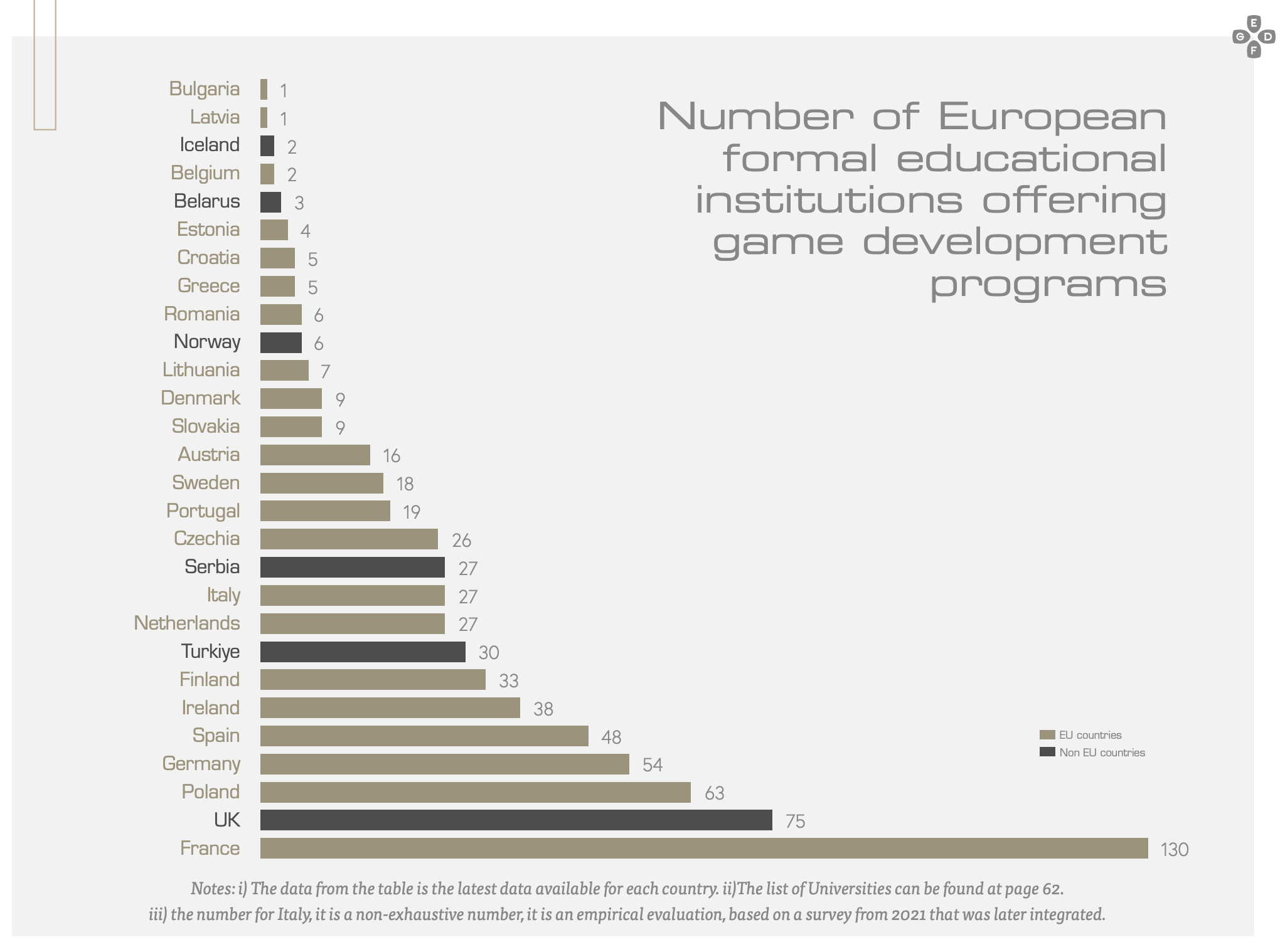
France (130), the UK (75), and Poland (63) have the most educational institutions with game development programs.


11 of 29 countries offer development grants for game studios: Belgium, Croatia, Denmark, France, Germany, Greece, the Netherlands, Norway, Poland, Spain, and the UK.
Four countries offer tax incentives for game developers: Belgium, France, Italy, and the UK.
Belarus, Iceland, Latvia, Portugal, Romania, and Sweden offer no public support for games. Yet Sweden has the most game studios in the EU.
Only Belgium, Czechia, Spain, and Türkiye have dedicated R&D programs for game studios.