



GameDiscoverCo looked at all games released on Steam from July 2023 to July 2025 (so each has at least a year of sales) that sold at least 1,000 copies in their first month. The sample includes ~5,000 games. Revenue is gross.
All games
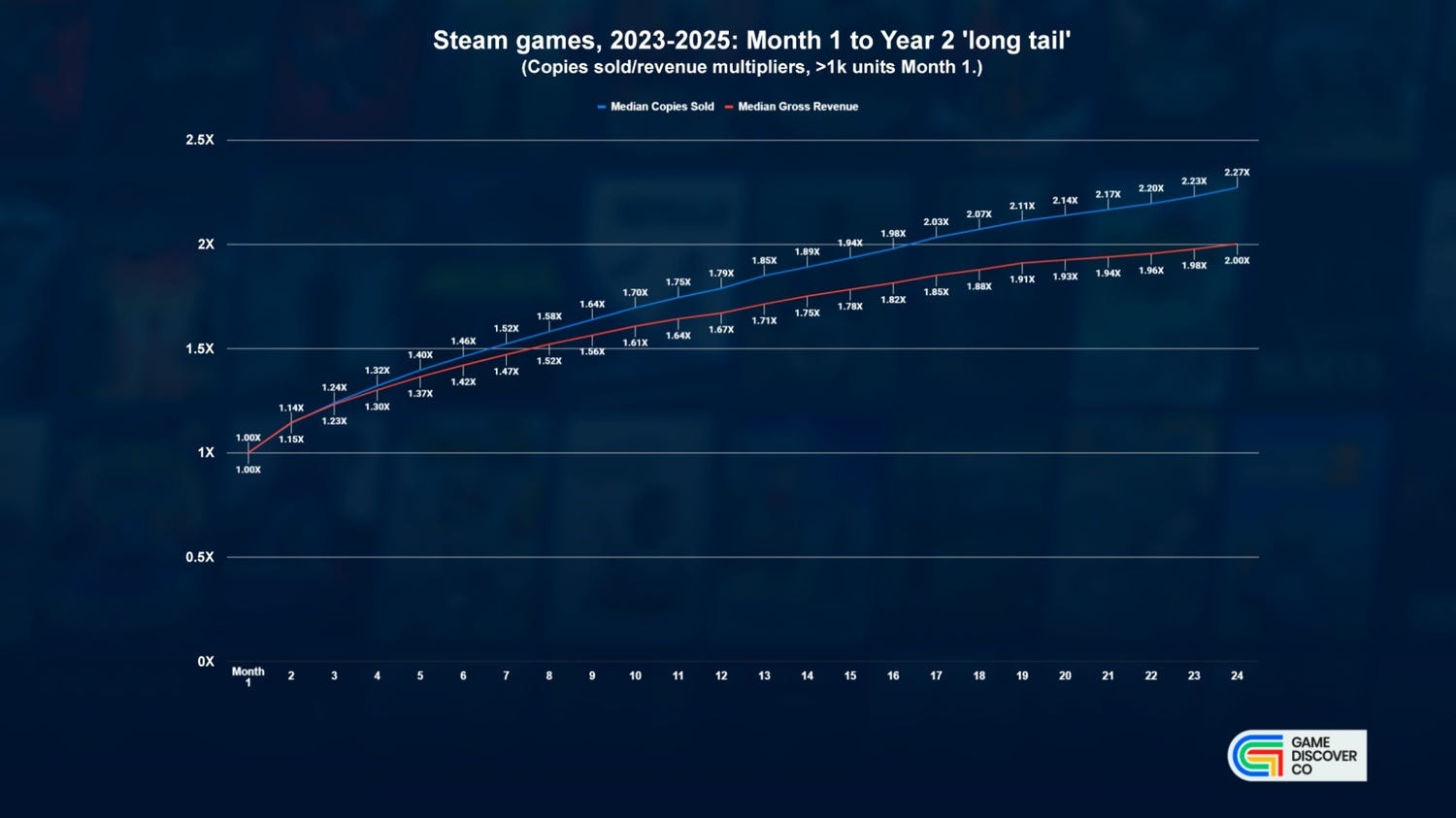
If a game sold 10,000 copies in its first month on Steam, it will sell 14,600 copies by Month 6, 17,900 by Month 12, and 22,700 by the end of Year 2. These figures are based on median multipliers.
Revenue grows more slowly: by the end of Year 1, it is 1.67x first-month revenue, and by the end of Year 2, 2x. GameDiscoverCo attributes the gap to discounts.
A word from our sponsor

Game studios run on contractors — artists, composers, QA testers, translators — often spread across a dozen countries. That’s a lot of contracts, tax rules, and IP clauses to track. Mellow handles all of it: compliant contracts, automated payments, and IP protection built in, for contractors in 150+ countries.
The median hides big swings in individual cases. Lethal Company's first-month sales were 4.14x its first week, and Mouthwashing's were 2.54x. Meanwhile, Fuga: Melodies of Steel 3 and Wargroove 2 made almost all their sales in the first week (1.04x and 1.08x).
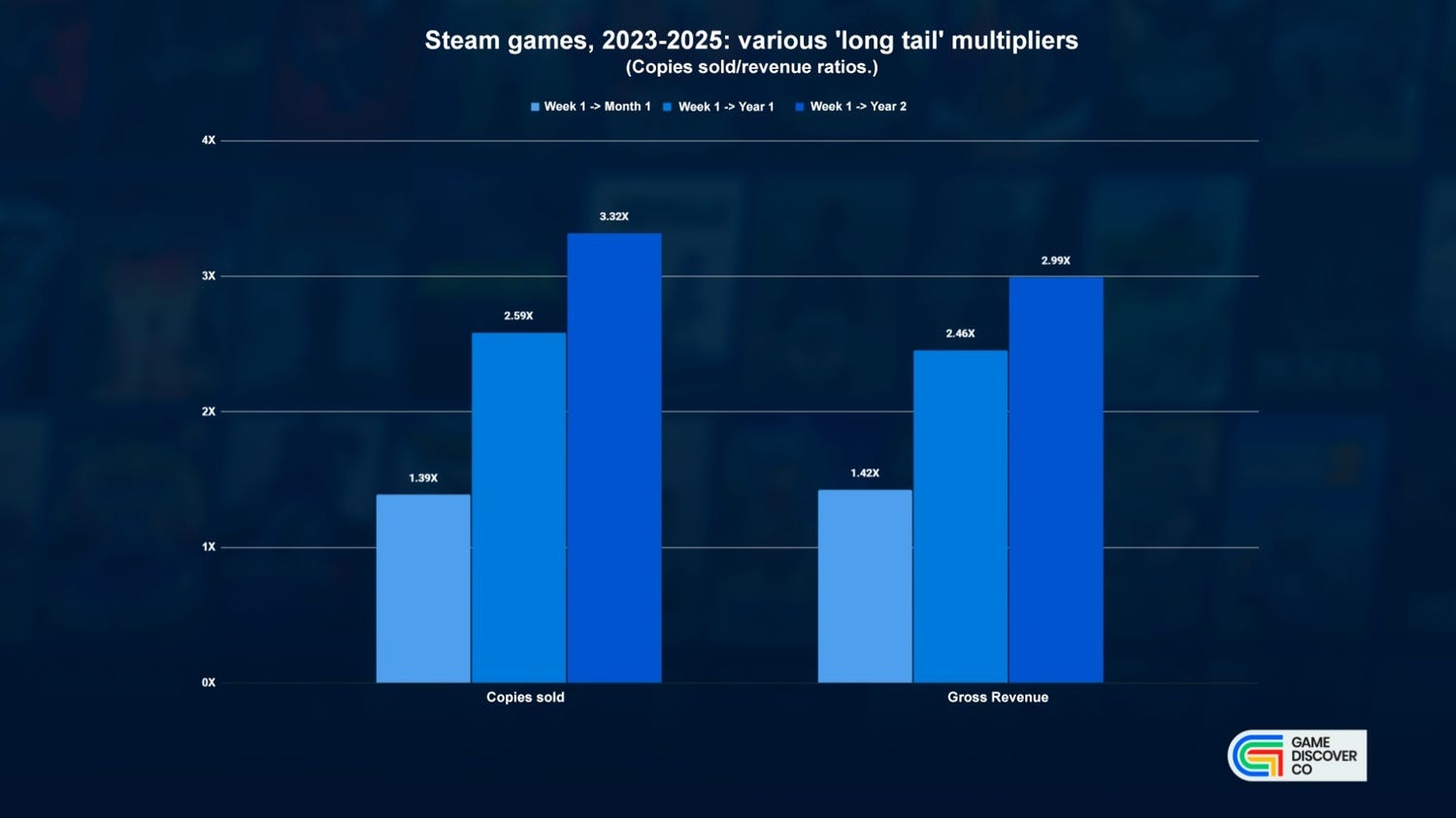
Many people calculate from first-week sales. At the median, a game sells 1.39x its first-week copies by the end of Month 1, 2.59x by the end of Year 1, and 3.32x by the end of Year 2.
By revenue, it's 1.42x by the end of Month 1 (higher than for copies, because launch discounts expire), 2.46x by the end of Year 1, and 2.99x by the end of Year 2.
So if a game earned $1 million in its first week, its revenue will most likely reach ~$3 million within a couple of years, and $4-5 million in the long run.
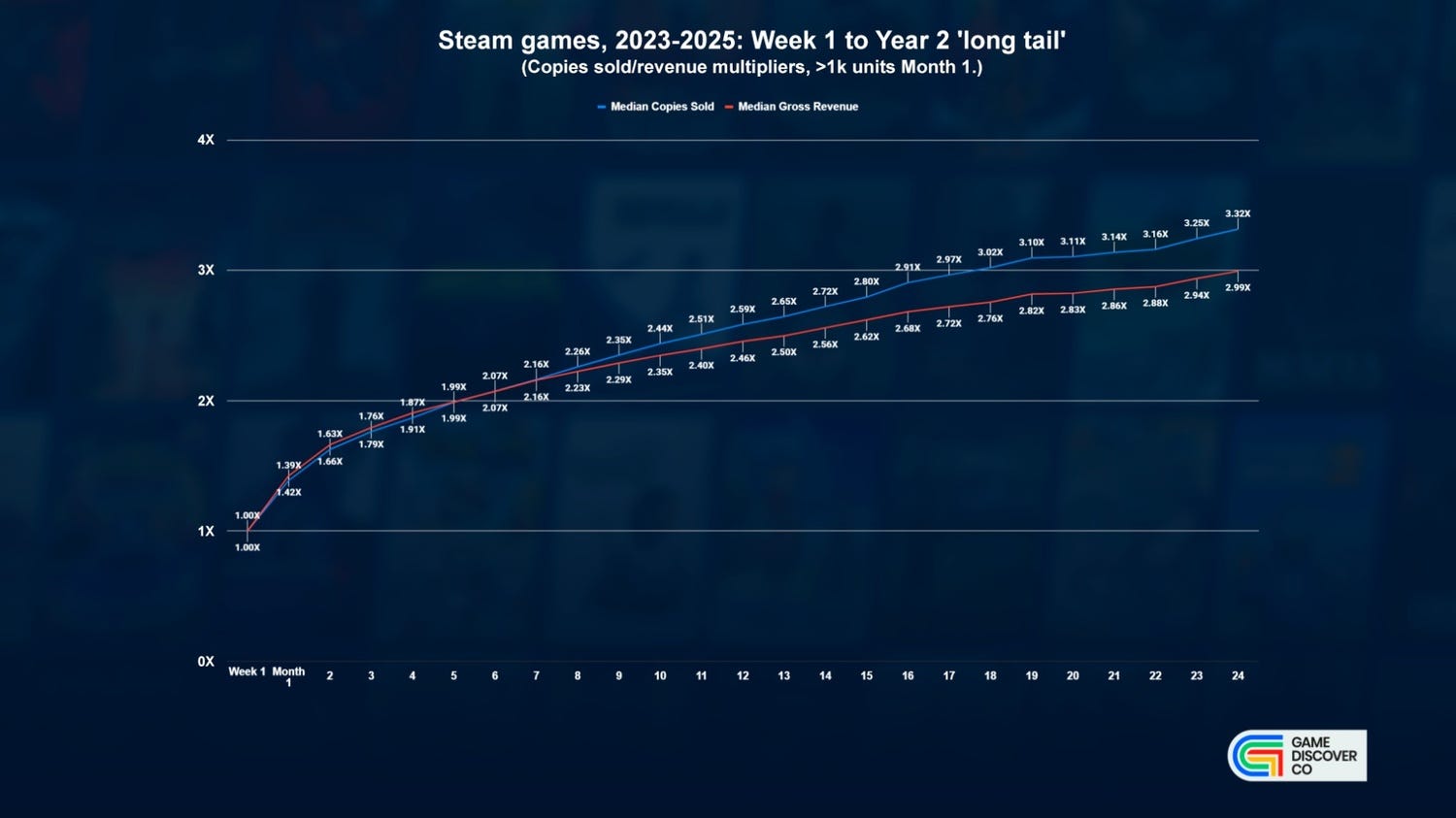
At the same time, the long tail has become shorter. In GameDiscoverCo's 2021 survey, first-year revenue was 3.05x first-week revenue. Now it's 2.46x, about 20% lower. In last year's GameDiscoverCo study, games released in 2023 that sold more than 1,000 copies in their first week had 2.69x.
GameDiscoverCo links this to the number of releases growing faster than Steam revenue. According to the company's estimates, the platform's revenue has almost doubled since 2021, but even more games have been released.
Differences by segment
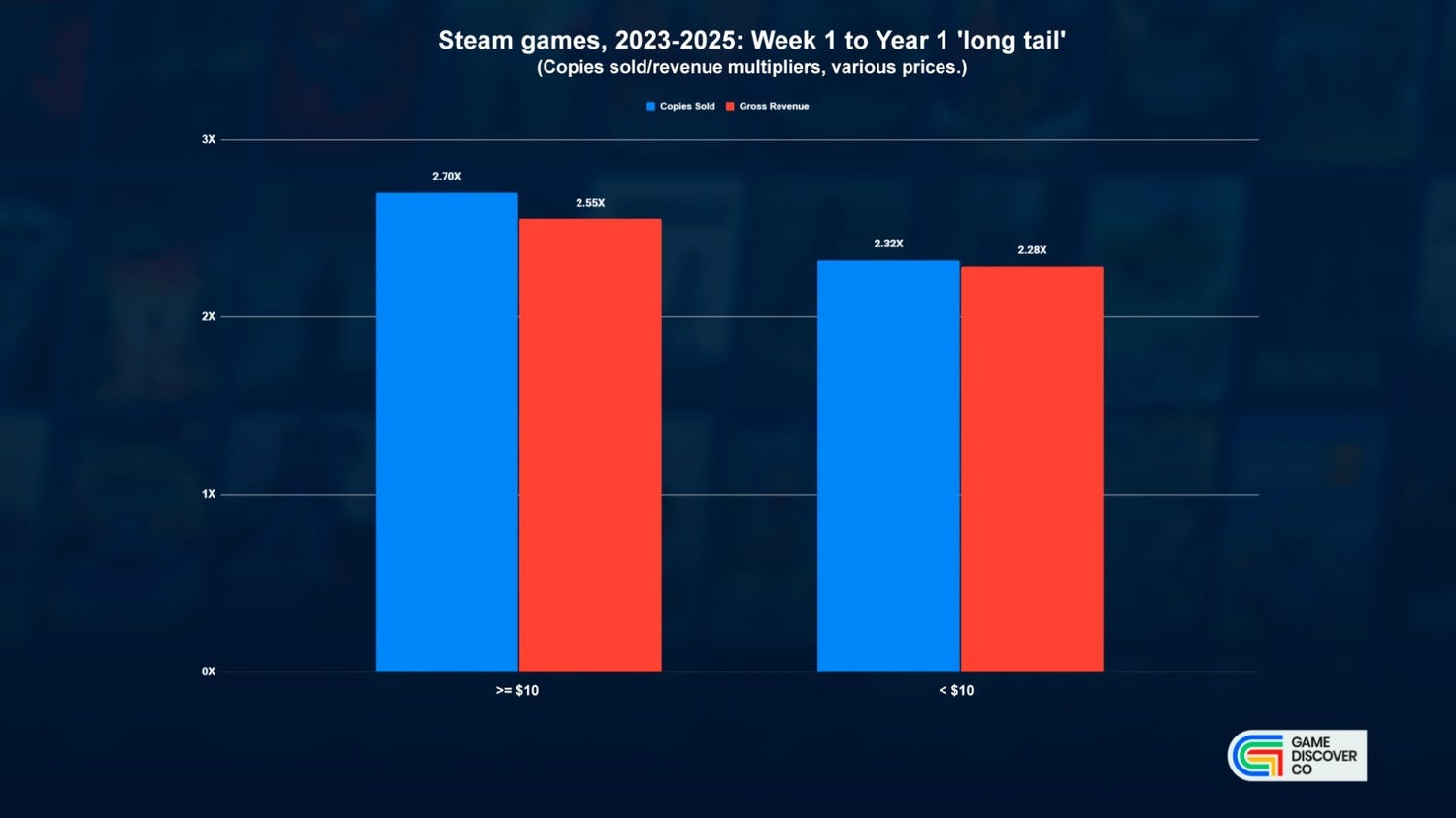
Games priced at $10 or more have a slightly longer tail: in Year 1, they sell 2.7x their first-week copies (4% above the median). Games under $10 sell 2.32x as many copies (10% below the median). By revenue, it's 2.55x and 2.28x, respectively.
GameDiscoverCo explains this by saying cheaper games are more often made by semi-professional teams. They also respond less to sales, since their base price is already low.
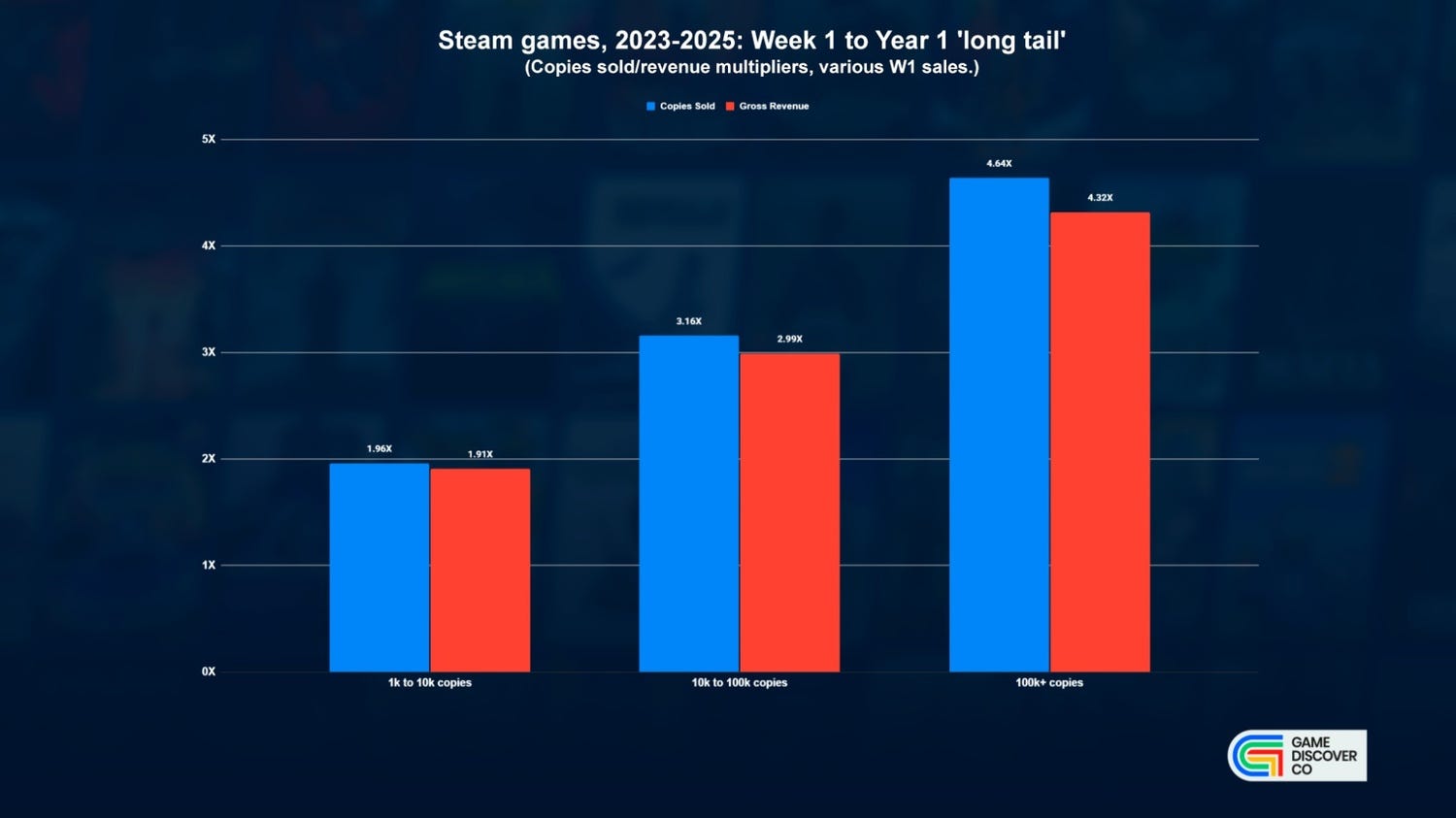
The better a game sells in its first week, the longer its tail. Games with 1,000-10,000 first-week copies have a Year 1 multiplier of 1.96x.
With 10,000-100,000 first-week copies, it's 3.16x (22% above the median), and with 100,000+, it's 4.64x. Viral hits heavily affect the last figure, though.
❗️In last year's GameDiscoverCo study, the market picture was the opposite: games that sold more than 100,000 copies in their first week had the lowest revenue multiplier (2.61x), and projects with 10,000-50,000 copies had the highest (3.6x). Back then, the company linked this to pre-orders. Maybe the methodology changed.
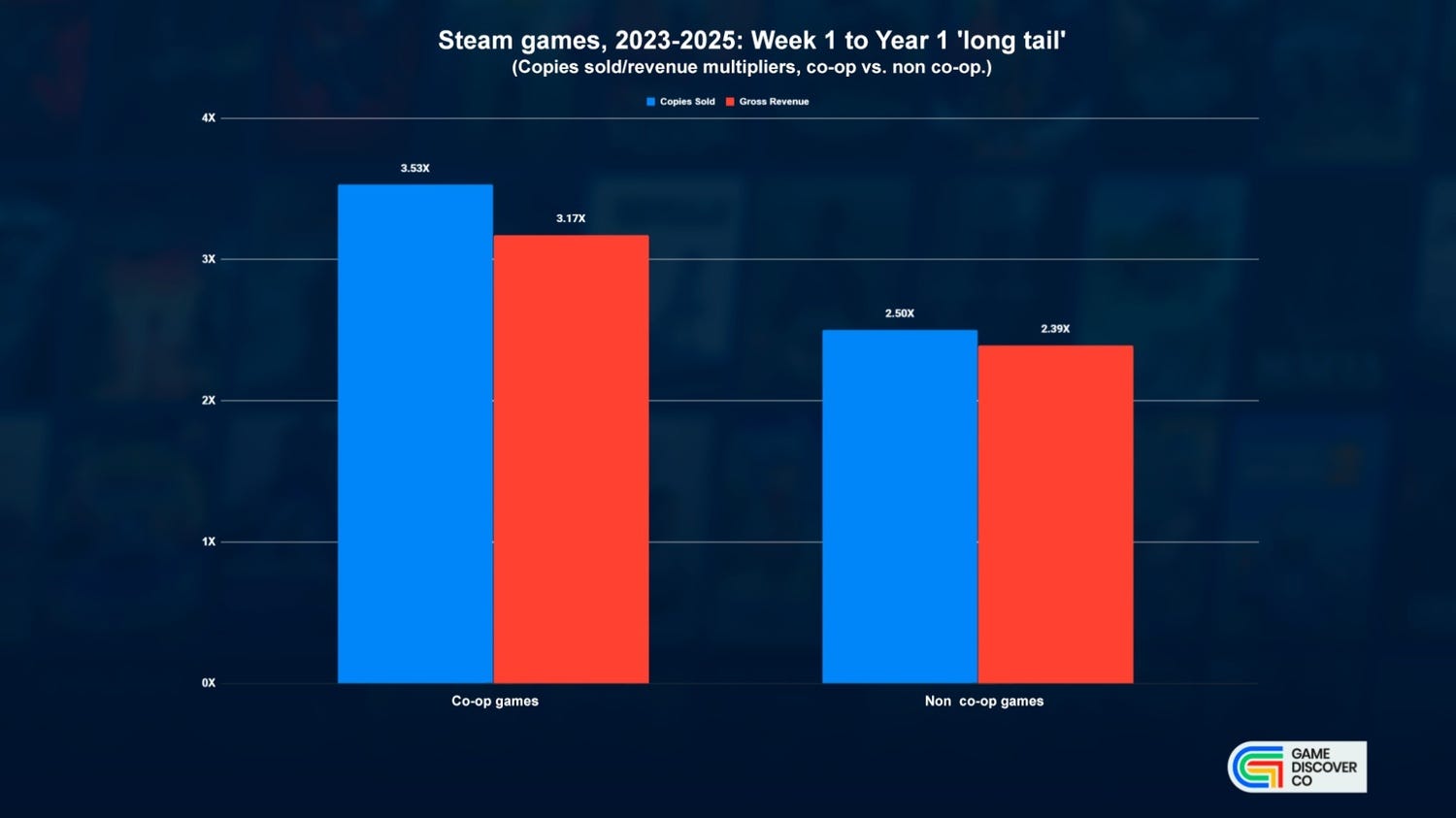
Co-op games (tagged co-op, online co-op, and similar on Steam) sell 3.53x their first-week copies in Year 1. That's 35% above the median. Non-co-op games sell 2.5x. By revenue, it's 3.17x and 2.39x.
GameDiscoverCo links this to friends recommending these games to each other, and to co-op games being easier to stream. Co-op is the first thing worth adding to a game if the idea looks promising.