



Newzoo surveyed ~7,500 people aged 13-55 who play H5 games (browser-based games) at least once a month. The survey ran in February 2026 in the US and Canada, Brazil, the UK, Germany, South Korea, Japan, and India. In Brazil and India, the sample reflects urban residents with reliable internet access.
❗️In the introduction, Google and Newzoo write that H5 gaming is growing fast. However, according to Sensor Tower, visits to browser game sites grew only slightly in H1’26 (to 9.45 billion). All of that growth came from Asia, while traffic in Europe is declining.
The Audience
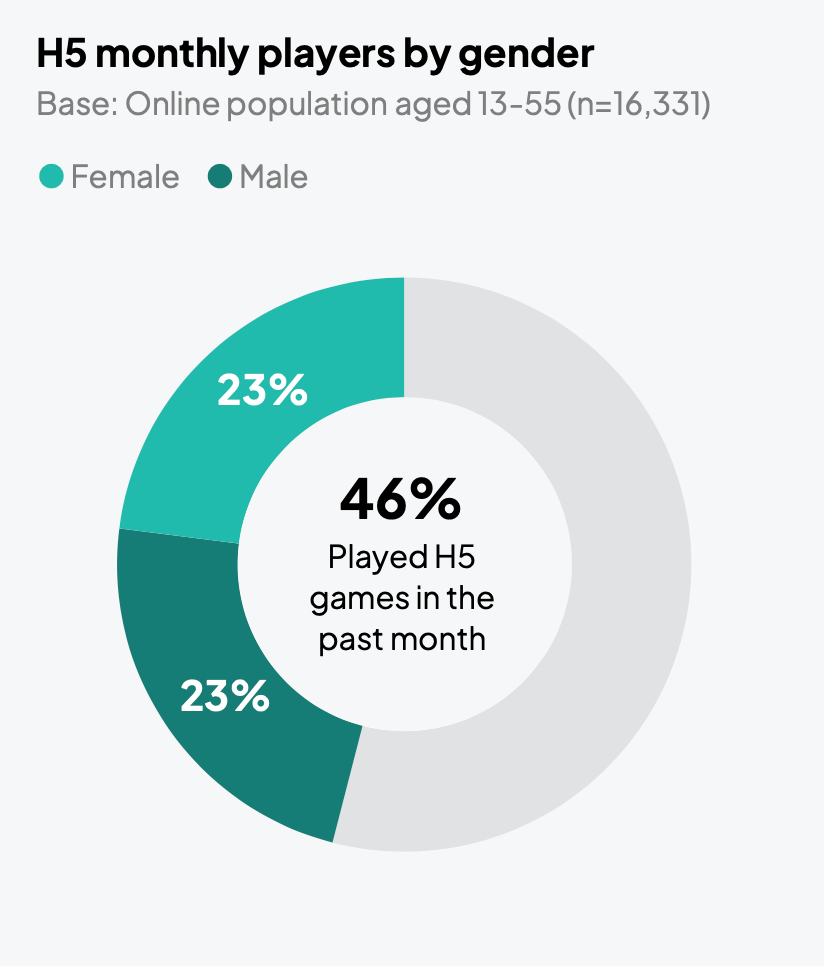
46% of internet users aged 13-55 in the surveyed countries played H5 games in the month before the survey. The share is highest in South Korea (54%), India (53%), and Brazil (52%), and lowest in Japan (34%).
A word from our sponsor

Need a freelance 3D artist, composer, or QA tester fast? Mellow’s AI Scout finds qualified talent in under 48 hours — free to try, no commitment. Describe the role, get a shortlist, hire when you’re ready.
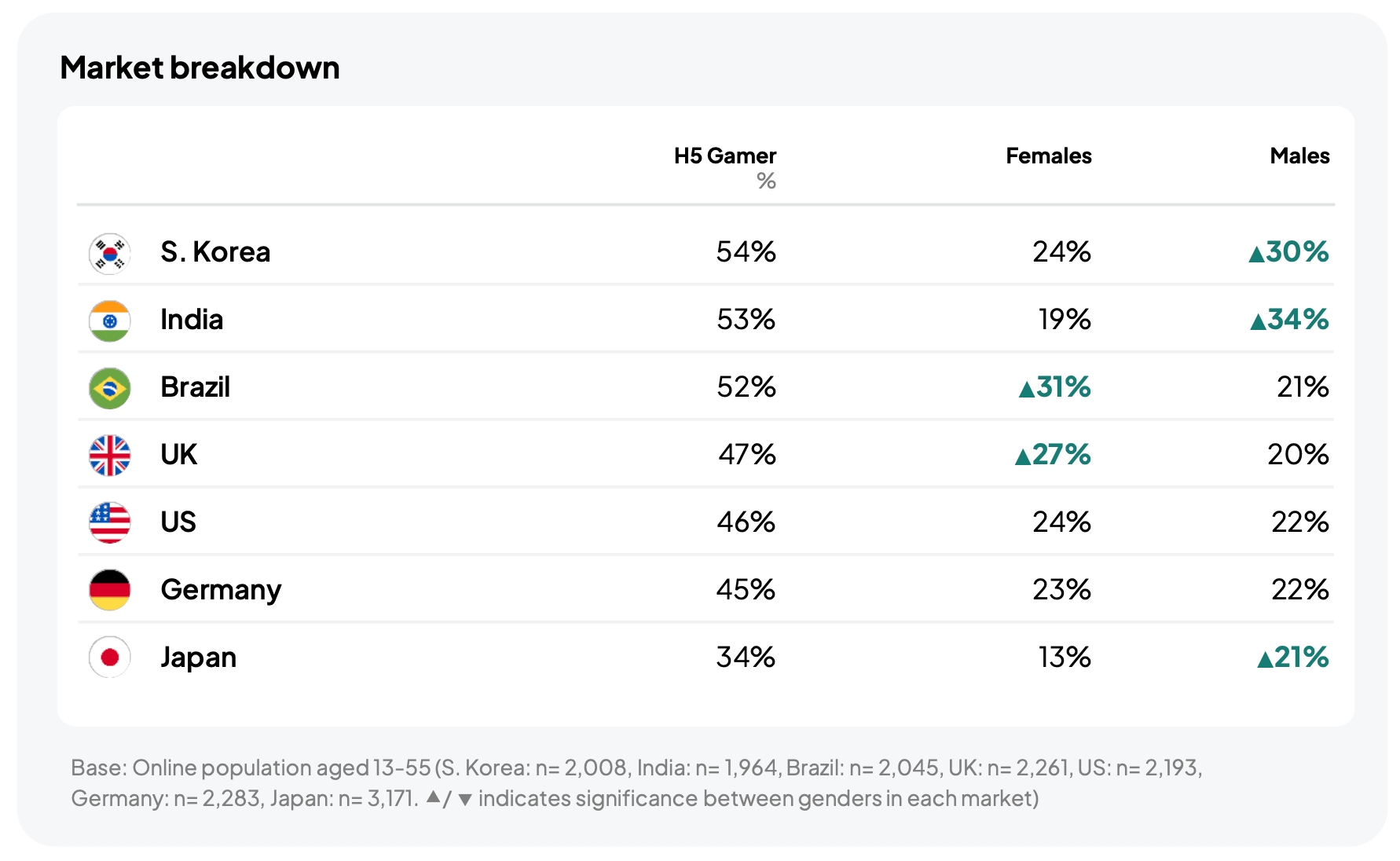
Browser game players are split evenly between men and women. Western countries skew slightly female, and Asian countries skew male.
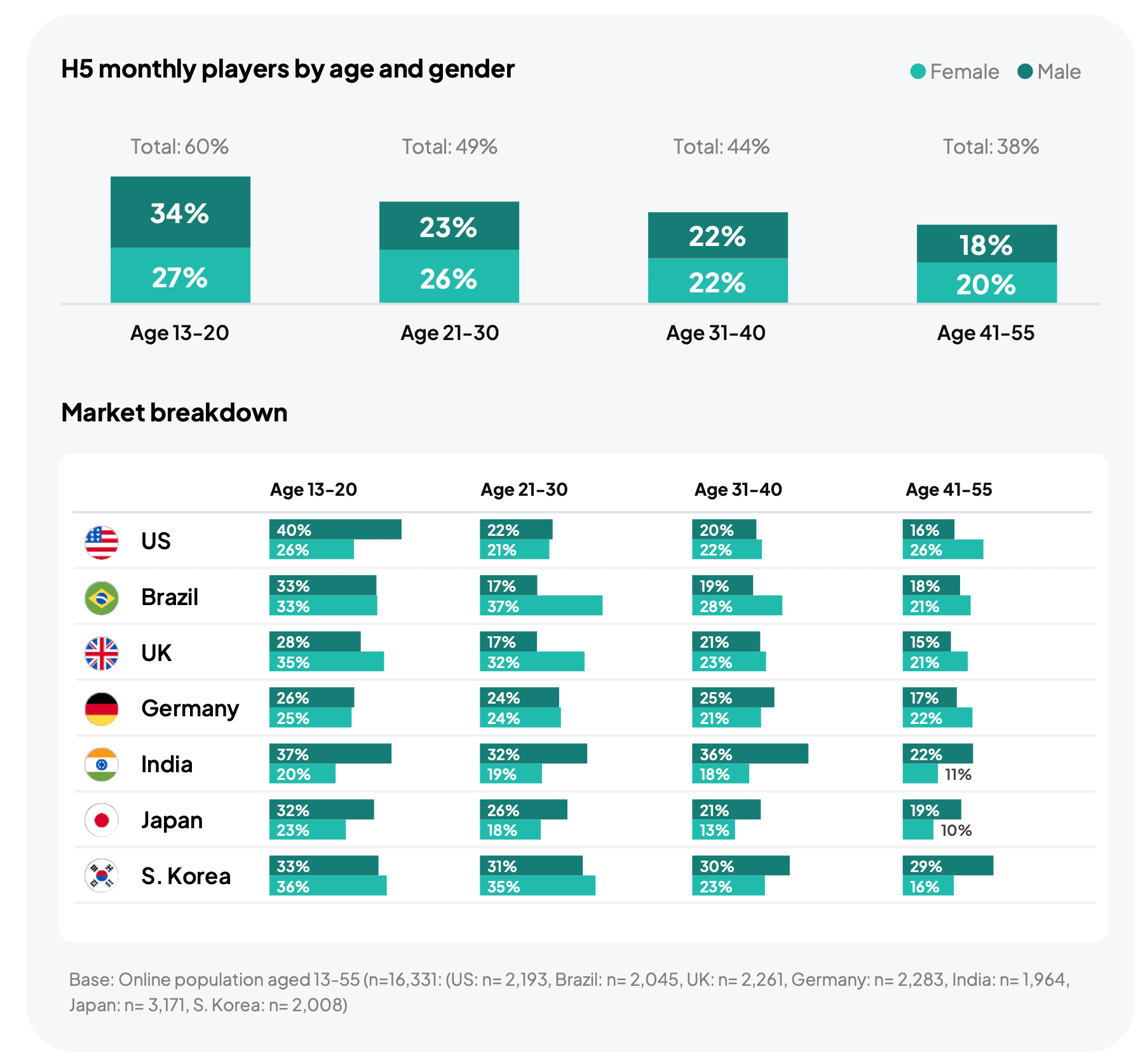
The younger the audience, the more often it plays browser games: 60% of people aged 13-20 play, compared with 38% of those aged 41-55.
In the 13-20 segment, noticeably more men play (34% vs. 27%). This is largely driven by the US, where 40% of young men and 26% of young women play H5 games. In the 41-55 group in the US, it is the other way around: there are more women (26%) than men (16%).
In Brazil, more than twice as many female gamers as male gamers are aged 21-30 (37% vs. 17%). In the UK, women play more in every age group. In India and Japan, by contrast, men play more.
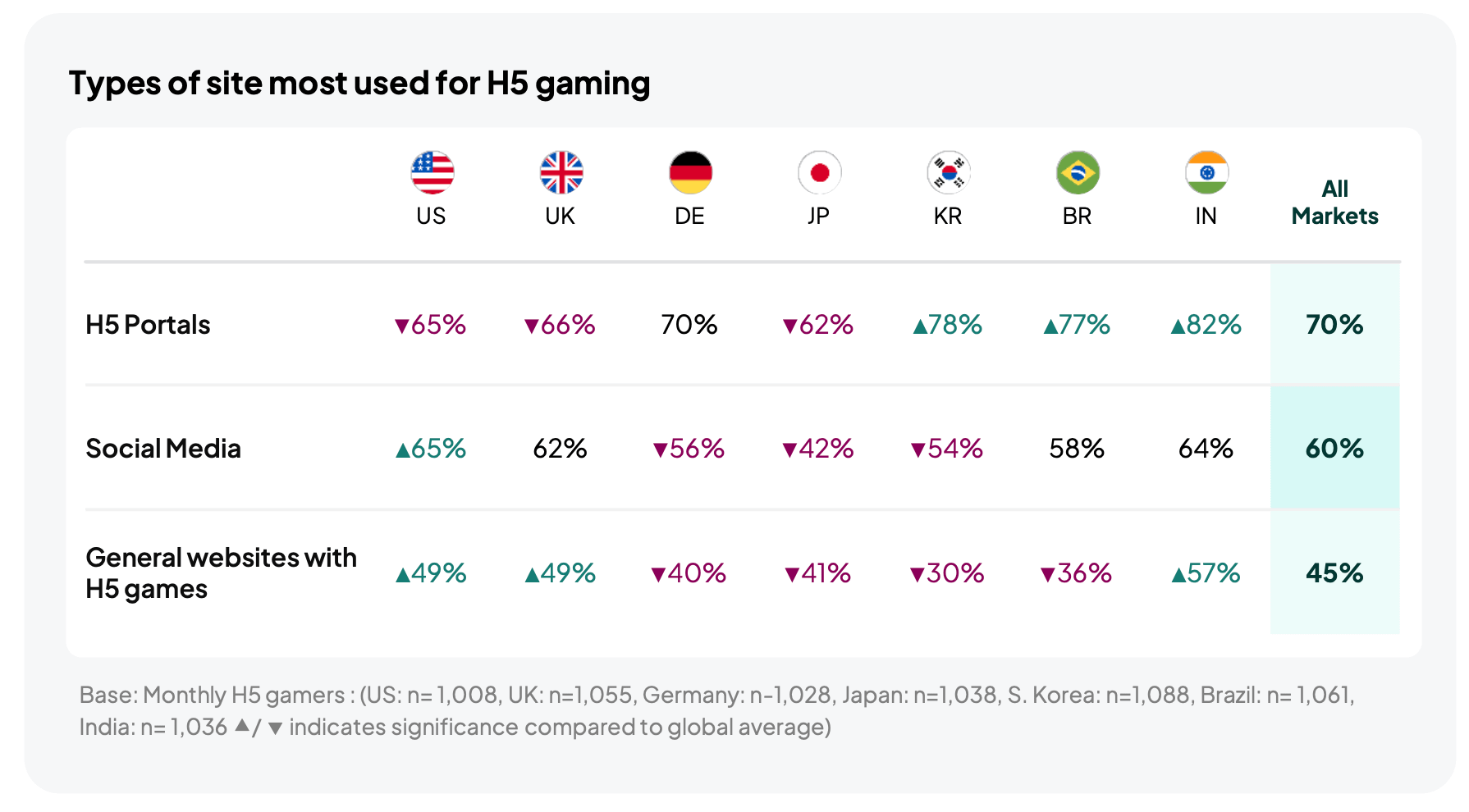
Most people play H5 games on dedicated platforms (70%). Social media is second (60%), and regular websites (news, education, etc.) that host games are third (45%).
In the US, social media and H5 portals are equally popular (65% each). Dedicated web gaming platforms are most popular in India (82%), South Korea (78%), and Brazil (77%).
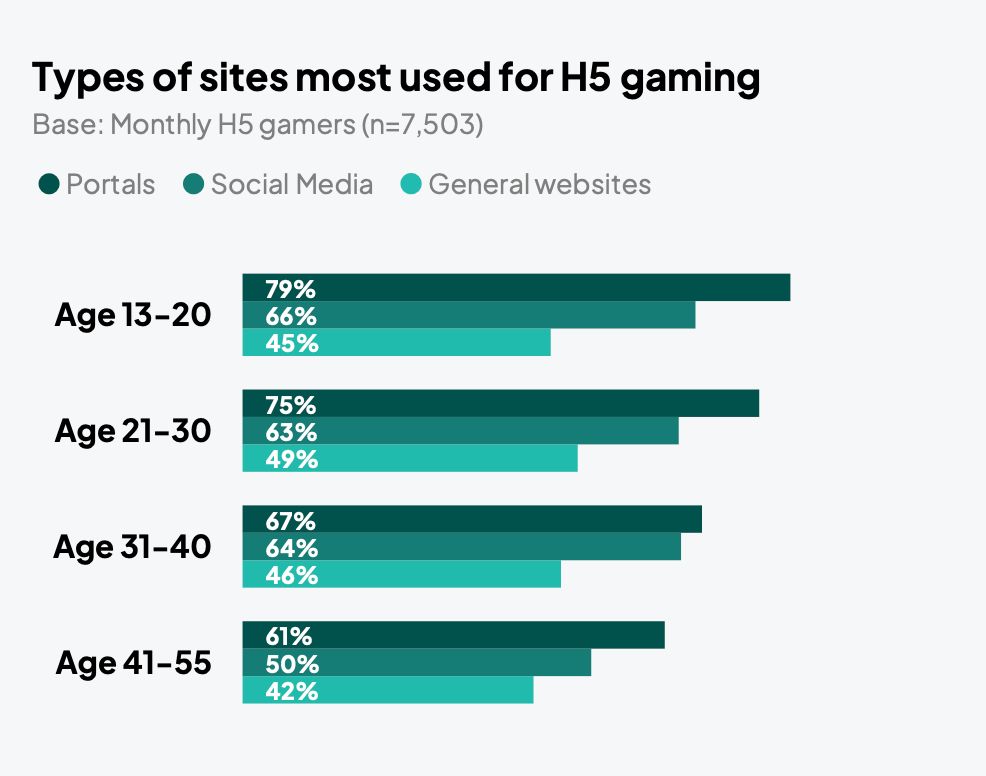
Web game sites are especially popular with younger players: 79% of players aged 13-20 use them, compared with 61% of those aged 41-55.
Social media, however, is visited more often. 36% of players play there daily, 25% on platforms, and 22% on regular websites.
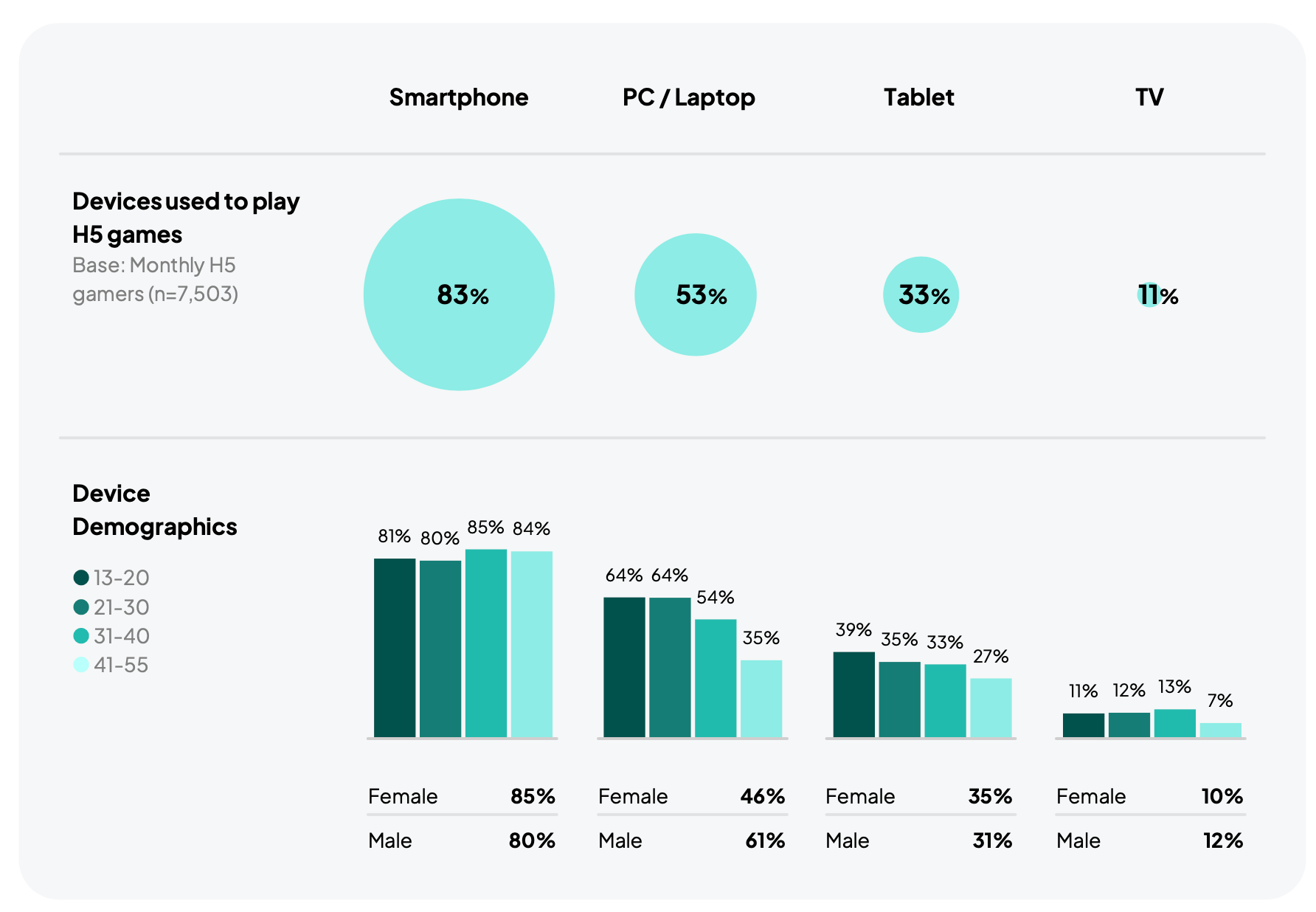
83% play H5 games on a smartphone, 53% on a PC or laptop, 33% on a tablet, and 11% on a TV.
Younger players are more likely to use multiple devices. Only 35% of players aged 13-30 stick to a single device, compared with 60% of those aged 41-55.
In Japan, 88% play on a smartphone, and other devices are used less than anywhere else. In Brazil and India, by contrast, the share of PC players is higher (72% and 68%).
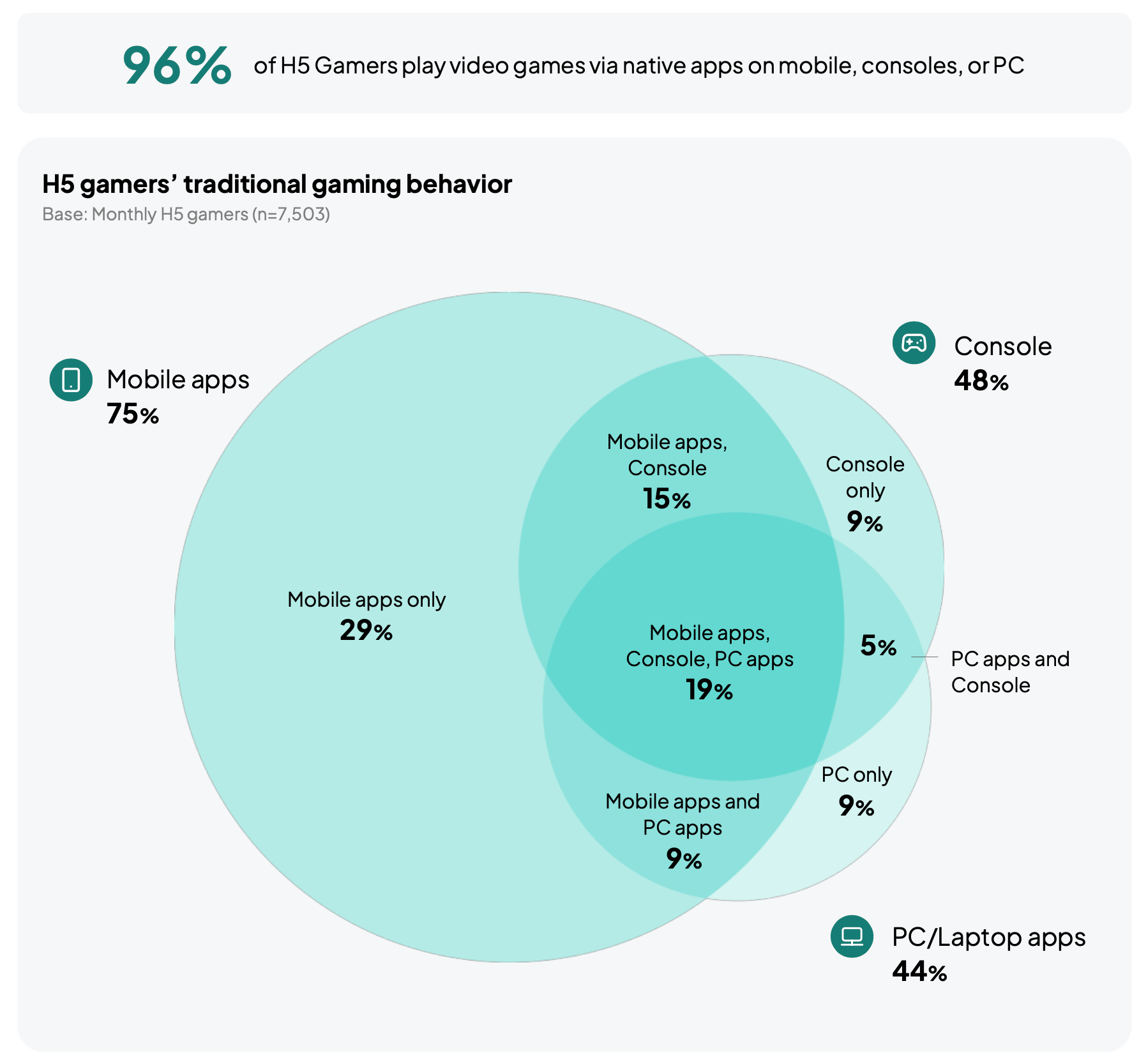
Almost all browser gamers also play traditional games. 96% play native games on mobile, console, or PC, and only 4% play browser games exclusively.
75% of browser gamers play mobile games, 48% play on consoles, and 44% play PC games.
❗️The console and PC numbers look very high. Their audience base is much smaller than mobile's, so such numbers might be an error.
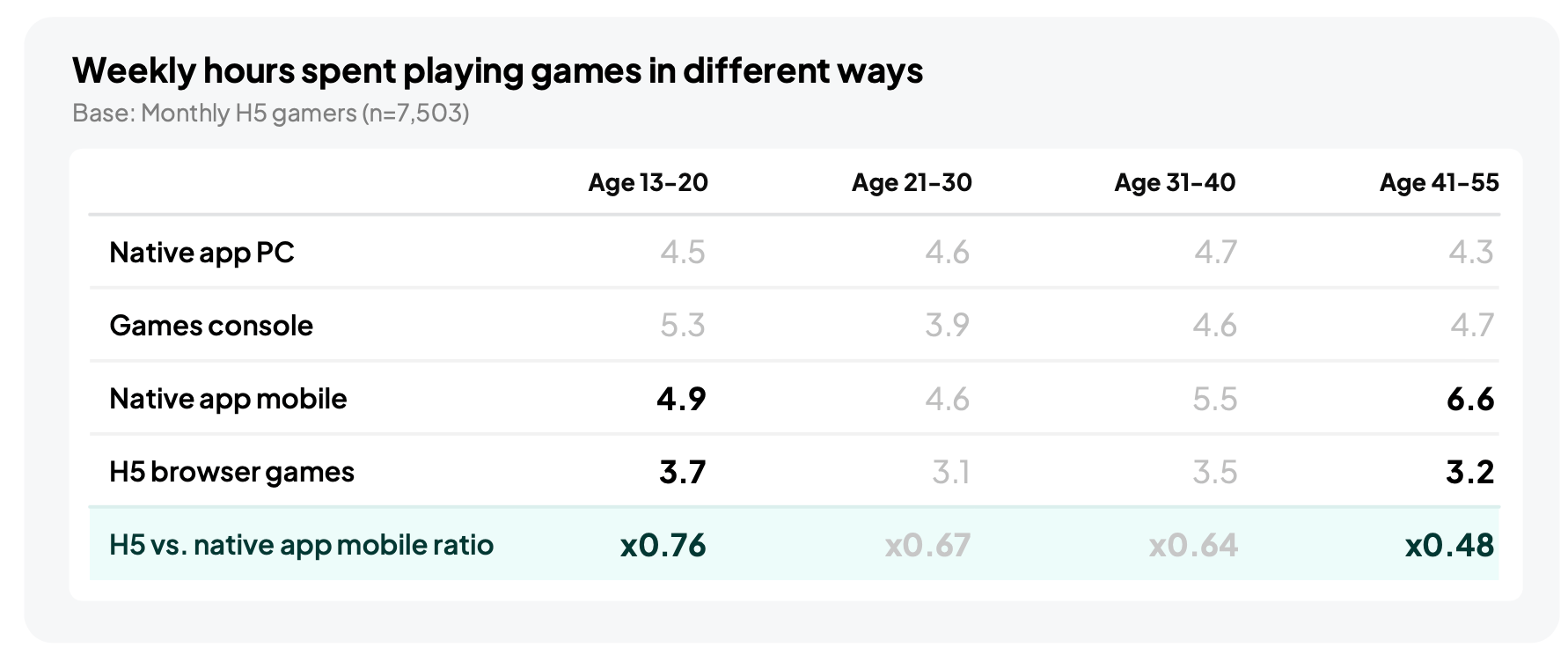
In terms of time spent, browser games lose to every other platform. Users aged 13-20 spend 3.7 hours a week on them vs. 4.9 hours on mobile apps. For the 41-55 segment, the gap is even wider: 3.2 hours vs. 6.6 hours.
Newzoo concludes that browser games will grow organically: younger players split their time between H5 and mobile almost evenly, and the habit may stick as they get older.
What Players Want from H5 Games
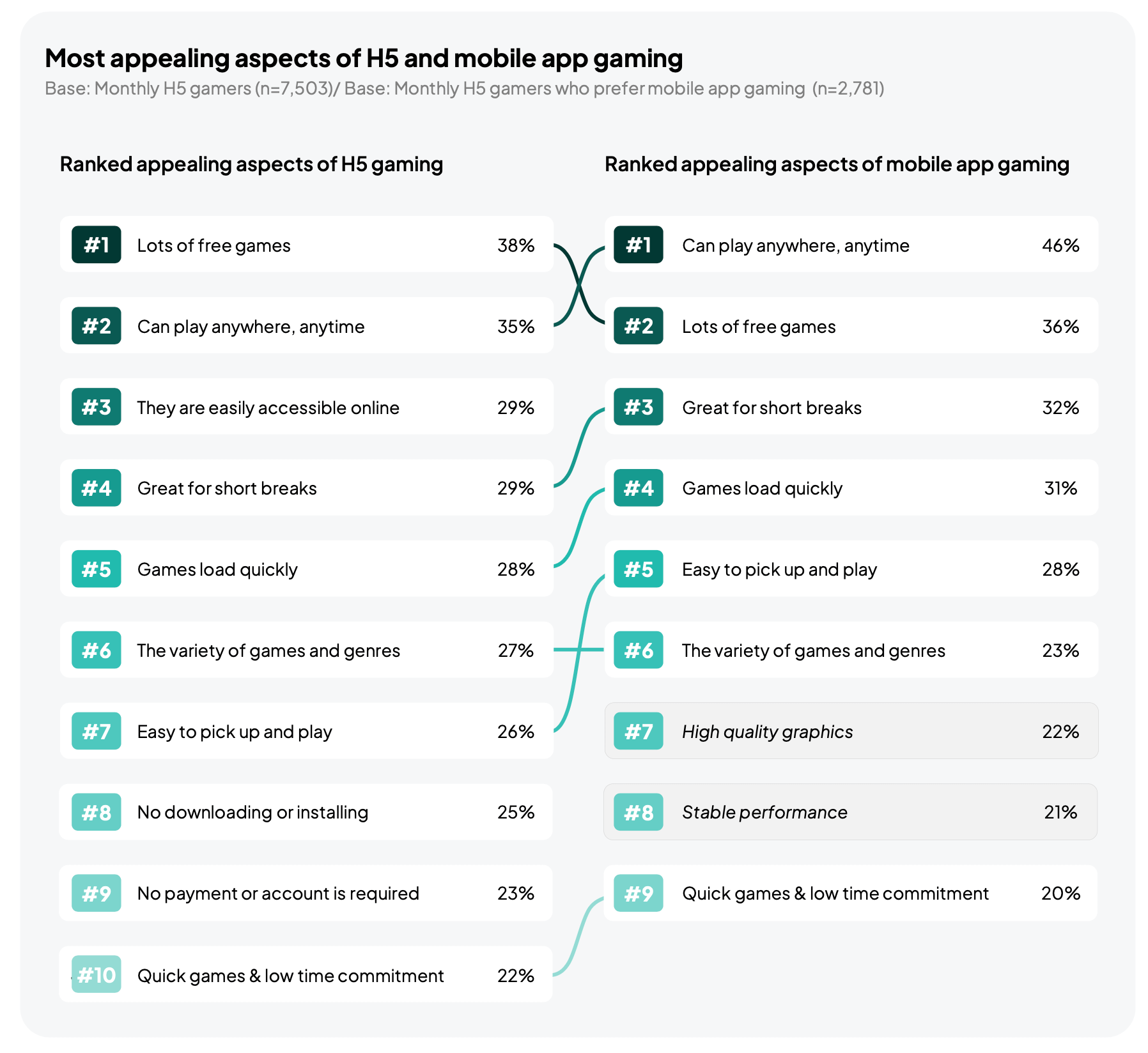
H5 players like the large number of free games most (38%), being able to play anywhere, anytime (35%), and how easy the games are to find online (29%). In mobile games, the top two swap places (46% and 36%), and third place goes to “great for short breaks” (32%).
In terms of motivation, seven of the top ten reasons are the same for both platforms. In web games, players also value not having to download anything (25%) and not having to pay or register (23%). In mobile games, people like high-quality graphics (22%) and stable performance (21%).
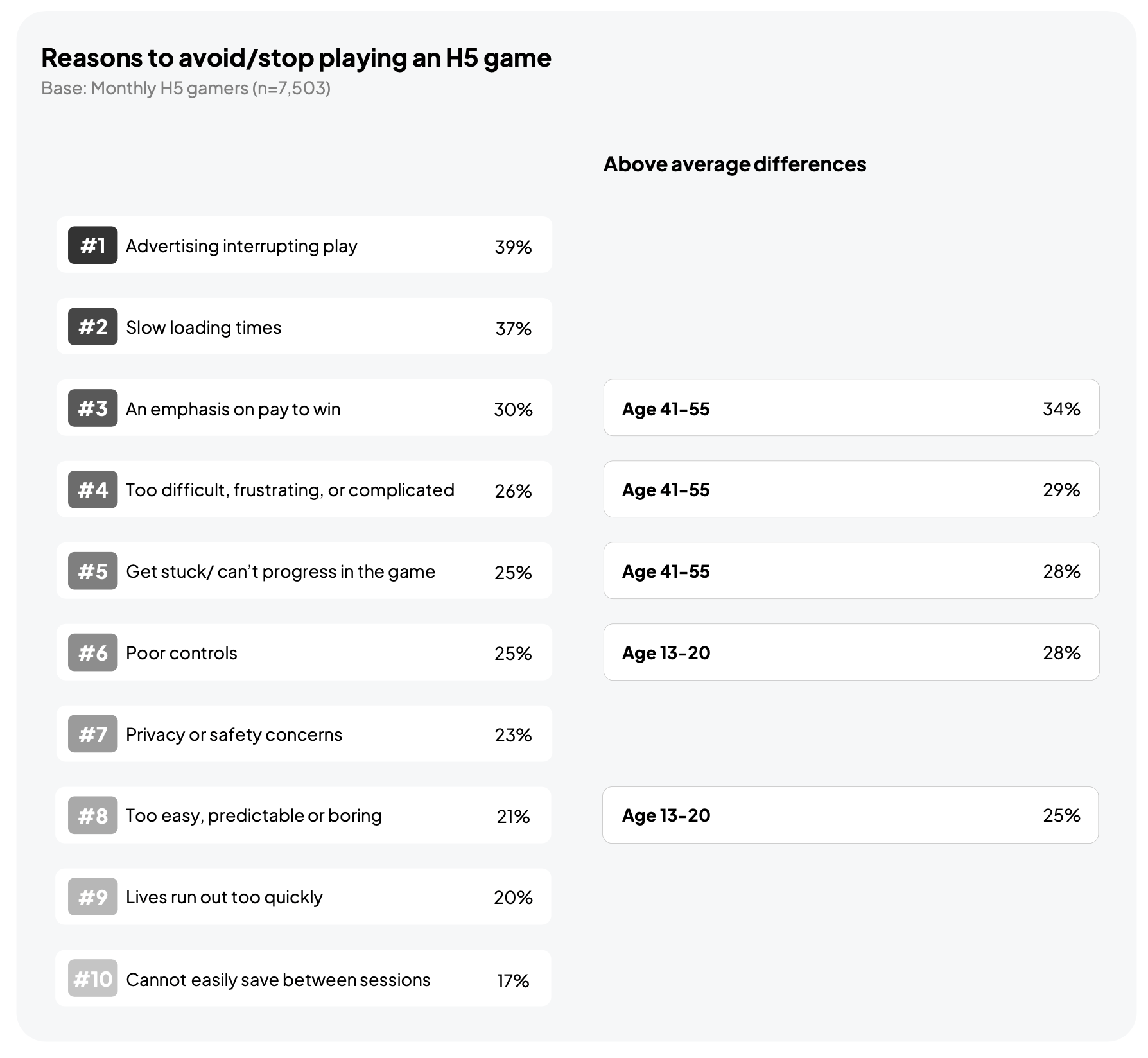
The most common reasons for quitting a browser game are ads that interrupt play (39%), slow loading (37%), and a focus on pay-to-win (30%).
Players aged 41-55 are more likely than others to quit over pay-to-win (34%), difficulty (29%), or getting stuck (28%). Players aged 13-20 quit over poor controls (28%) or when a game is too easy (25%).
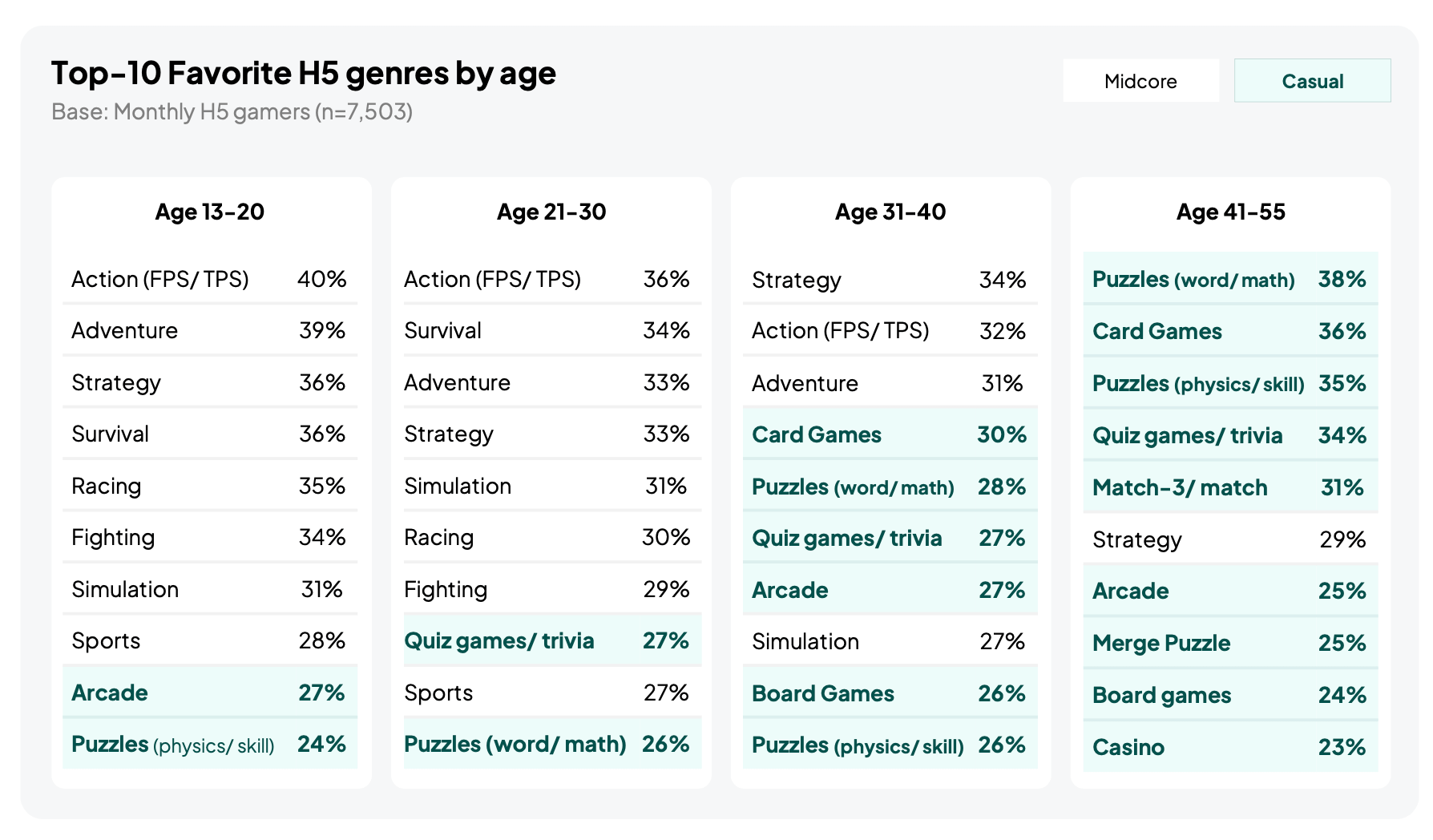
Younger players more often choose mid-core genres. In the 13-20 segment, action (FPS/TPS, 40%), adventure (39%), and strategy (36%) lead. In the 41-55 group, word and math puzzles (38%), card games (36%), and physics and skill puzzles (35%) lead.
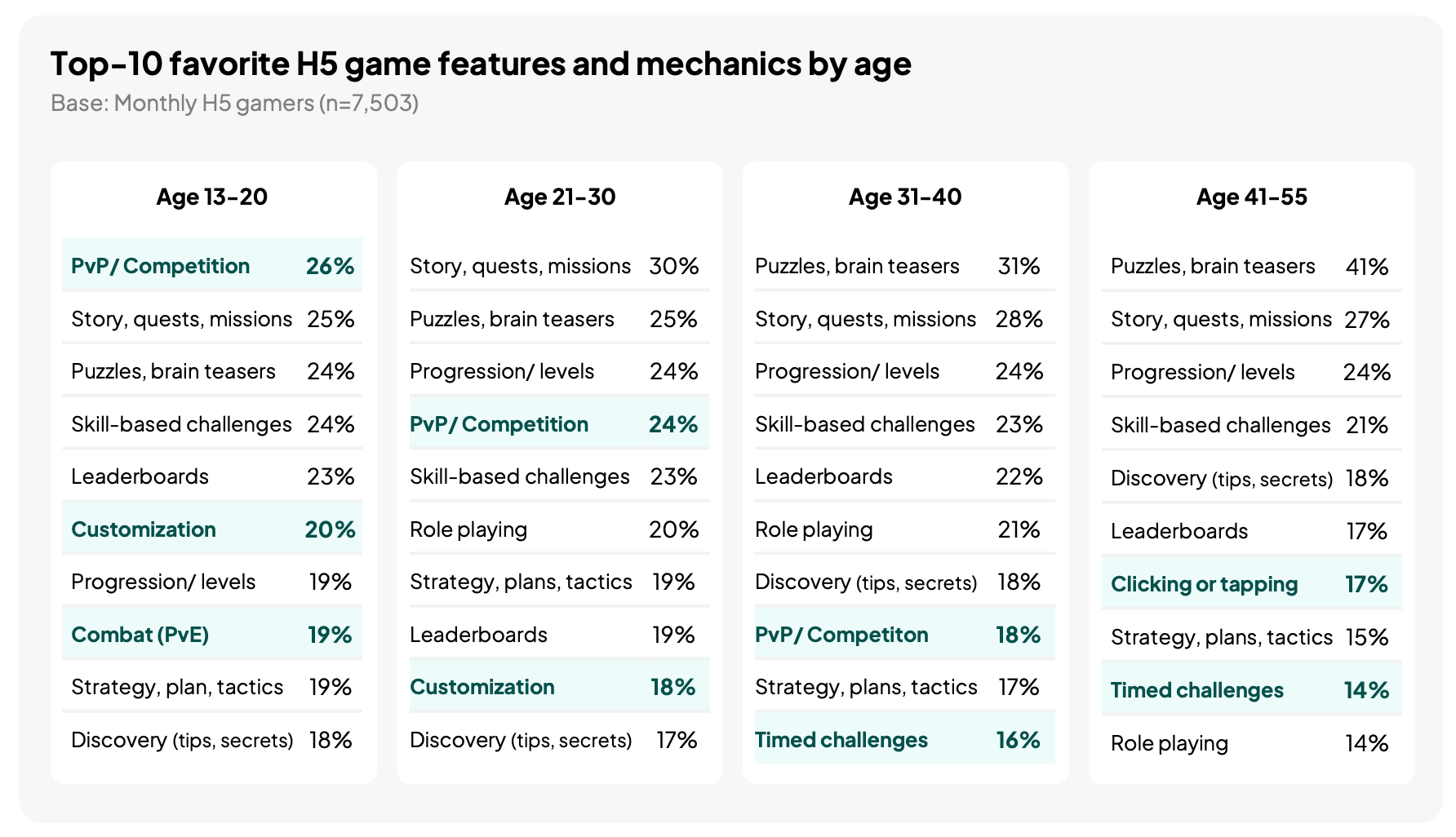
Across all ages, story and quests, brain teasers, and progression are among the top mechanics. Players aged 13-30 are more likely to pick PvP (26% in the 13-20 segment) and customization (20%). Players aged 41-55 pick clicking and tapping mechanics (17%) and timed challenges (14%).
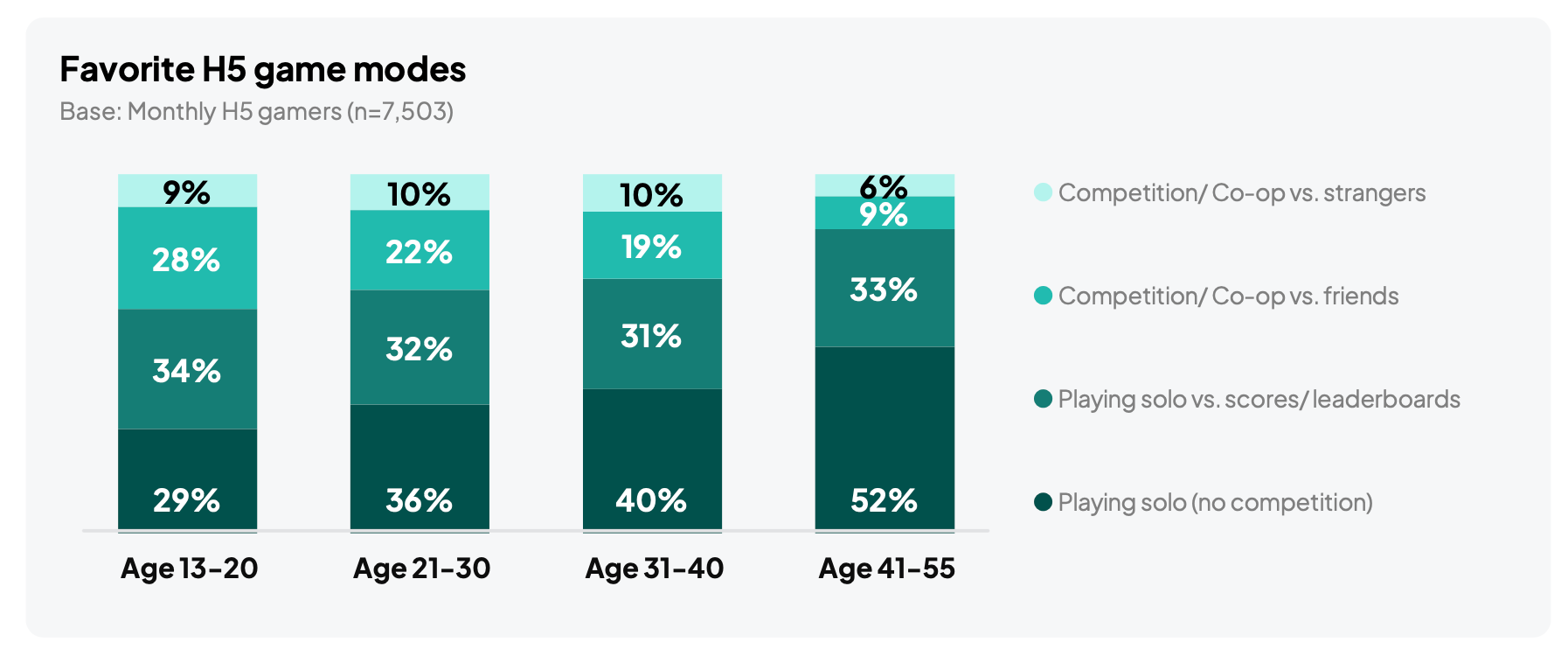
The older the player, the more likely they are to play solo. 52% of players aged 41-55 play without any competitive elements, compared with 29% of those aged 13-20.
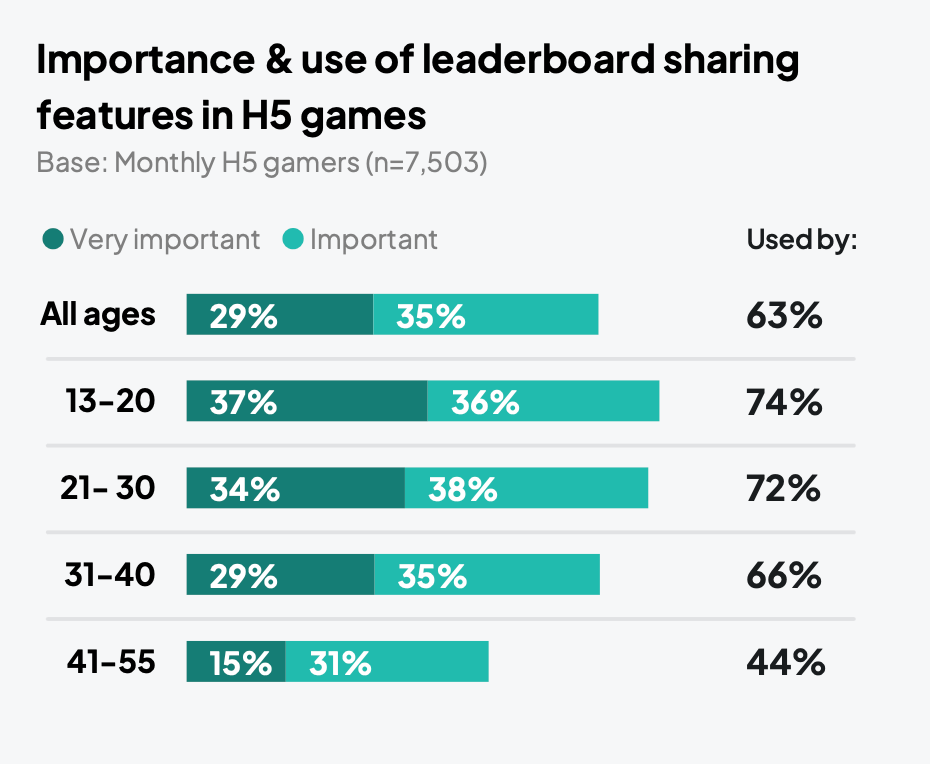
64% of players consider leaderboards and score sharing important, and 63% have used them. In the 13-20 segment, 74% have used them; in the 41-55 group, 44%.
Portals and Gaming Sites
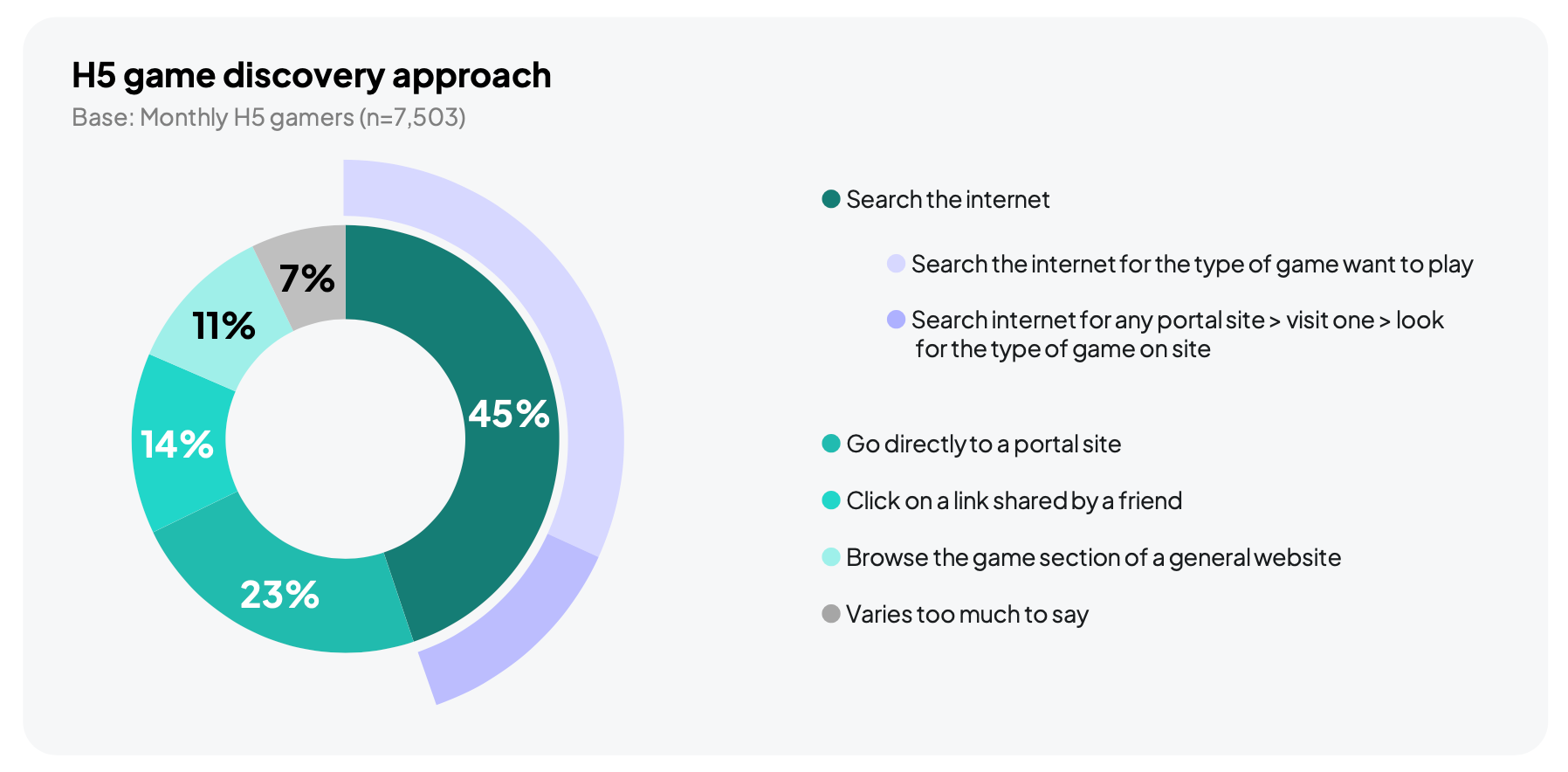
Only 23% of players go directly to a site they already know. 45% start with a search engine, and most of them (about 70%) search for a specific type of game. For comparison, Sensor Tower reports that direct and organic traffic accounts for 94.1% of visits to poki.com and 93.3% to crazygames.com.
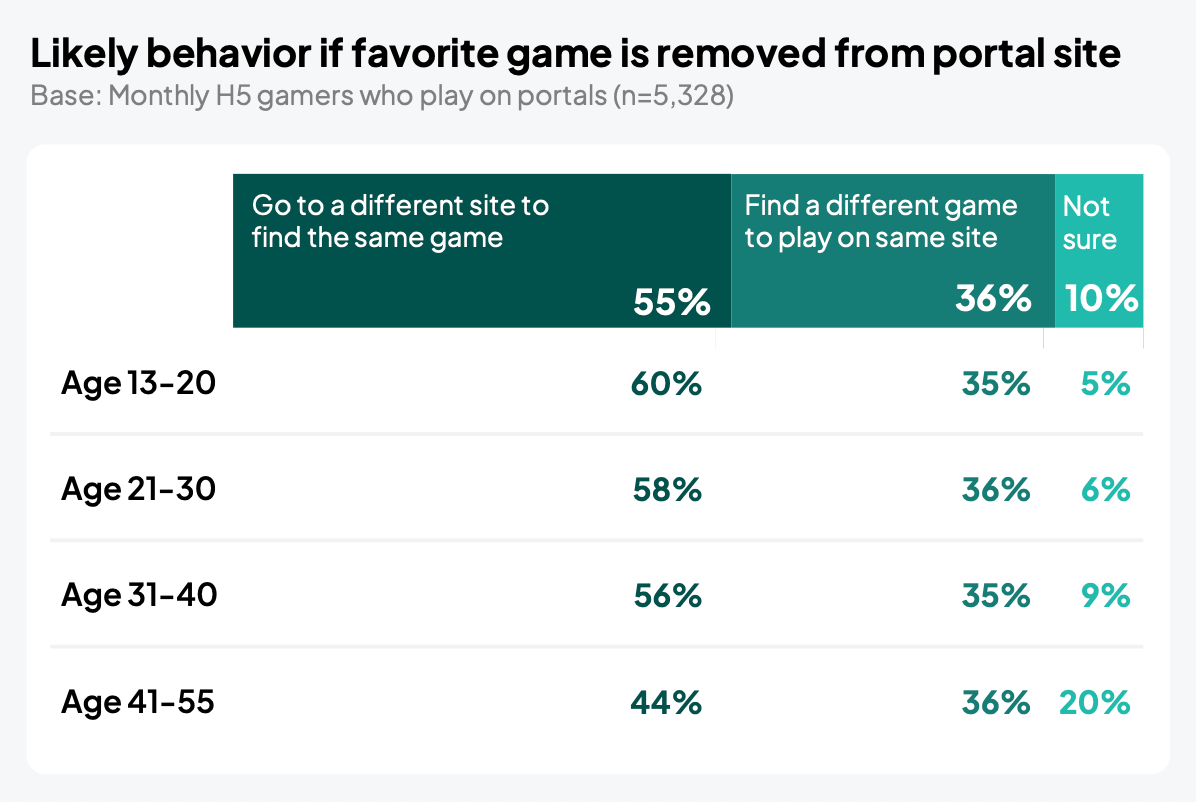
If their favorite game were removed from a site, 55% of players would look for it elsewhere. Another 36% would find a different game on the same portal. Younger players are even less loyal: in the 13-20 segment, 60% would leave.
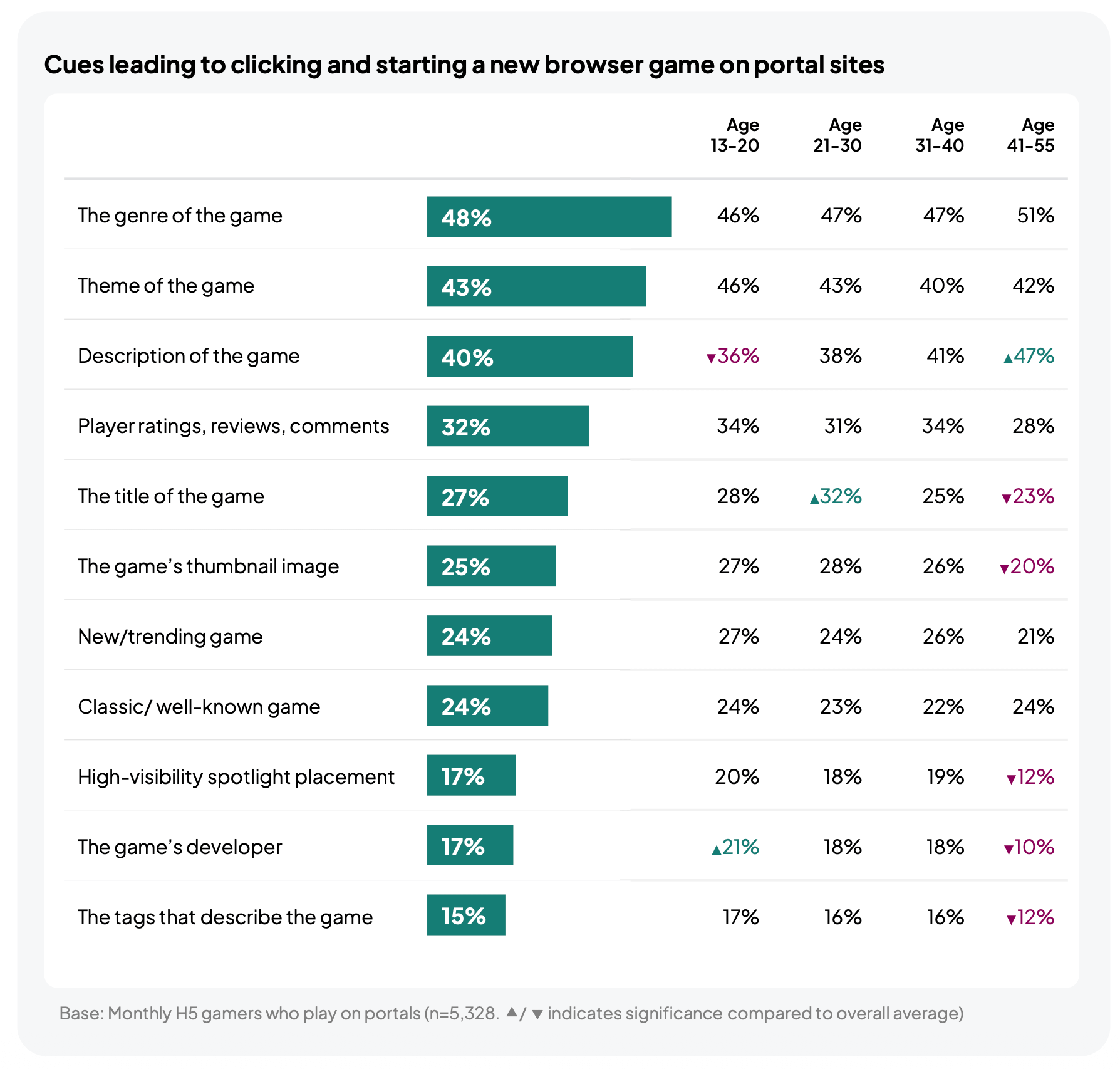
When choosing a game on a portal, players look first at the genre (48%), theme (43%), and description (40%). The title (27%) and thumbnail (25%) matter less. Promo placements and the developer’s name matter to only 17% of players.
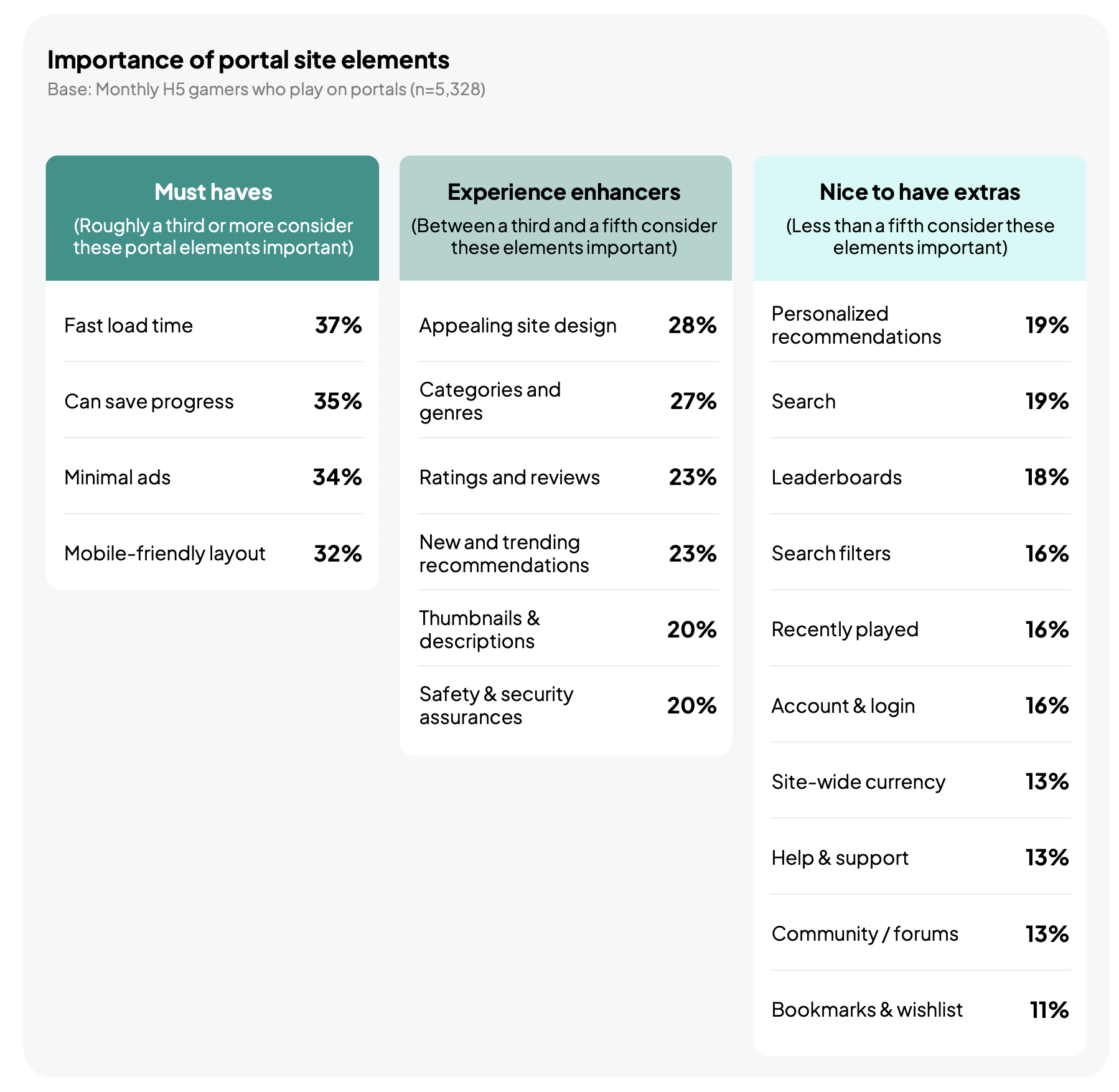
Players value fast loading (37%), the ability to save progress (35%), minimal ads (34%), and a mobile-friendly layout (32%) most on gaming sites. Search (19%), leaderboards (18%), and wishlists (11%) matter to far fewer players.
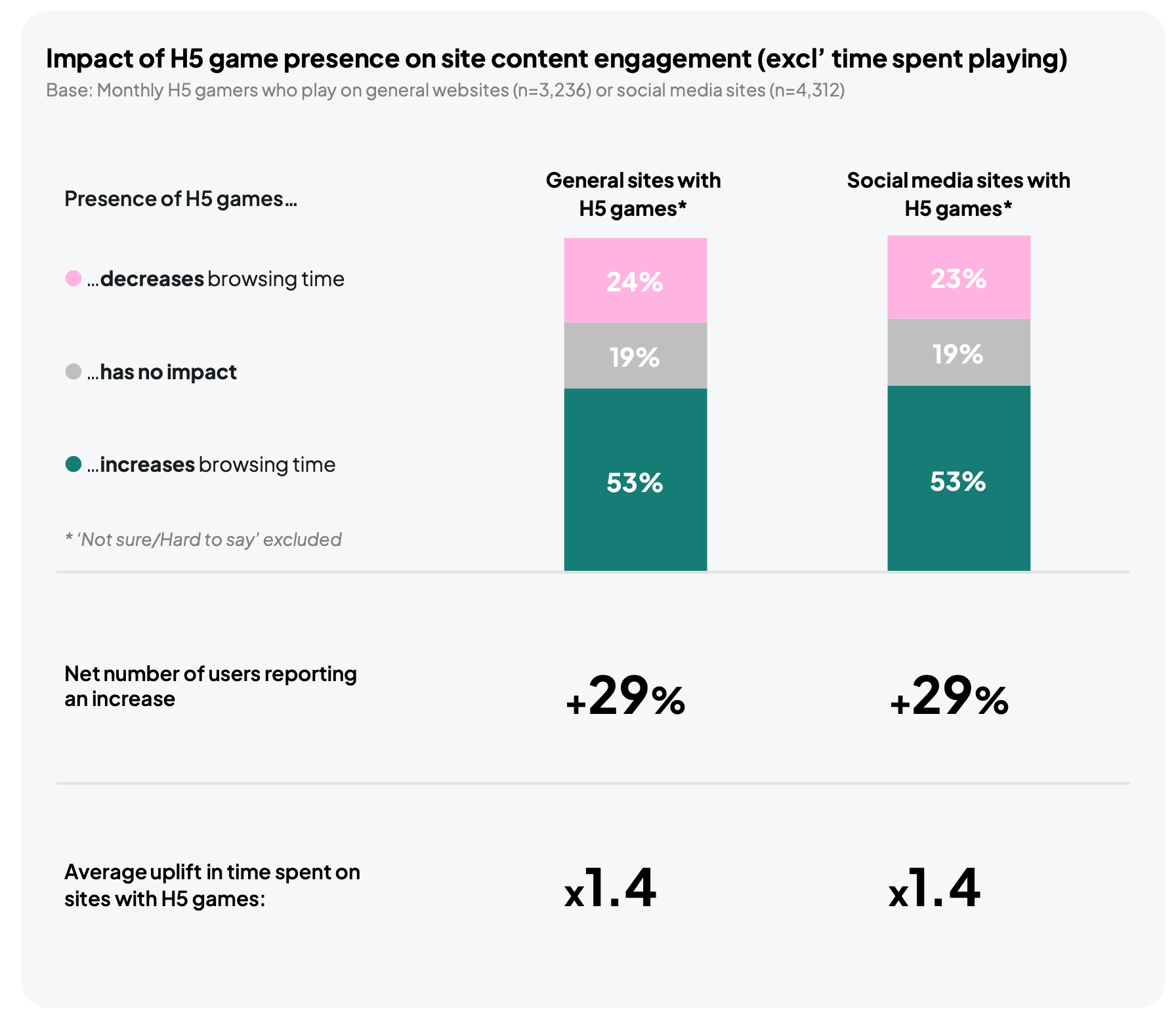
53% of players say browser games on regular websites and social media increase the time they spend on the site itself (excluding the game). 23-24% say they decrease it.
For those whose time increases, it goes up 1.4x on average. By the players’ own estimate, a 10-minute visit turns into 14 minutes.
❗️People are usually very bad at judging how much time they spend on a task. Metrics like this are better measured objectively than through a survey.
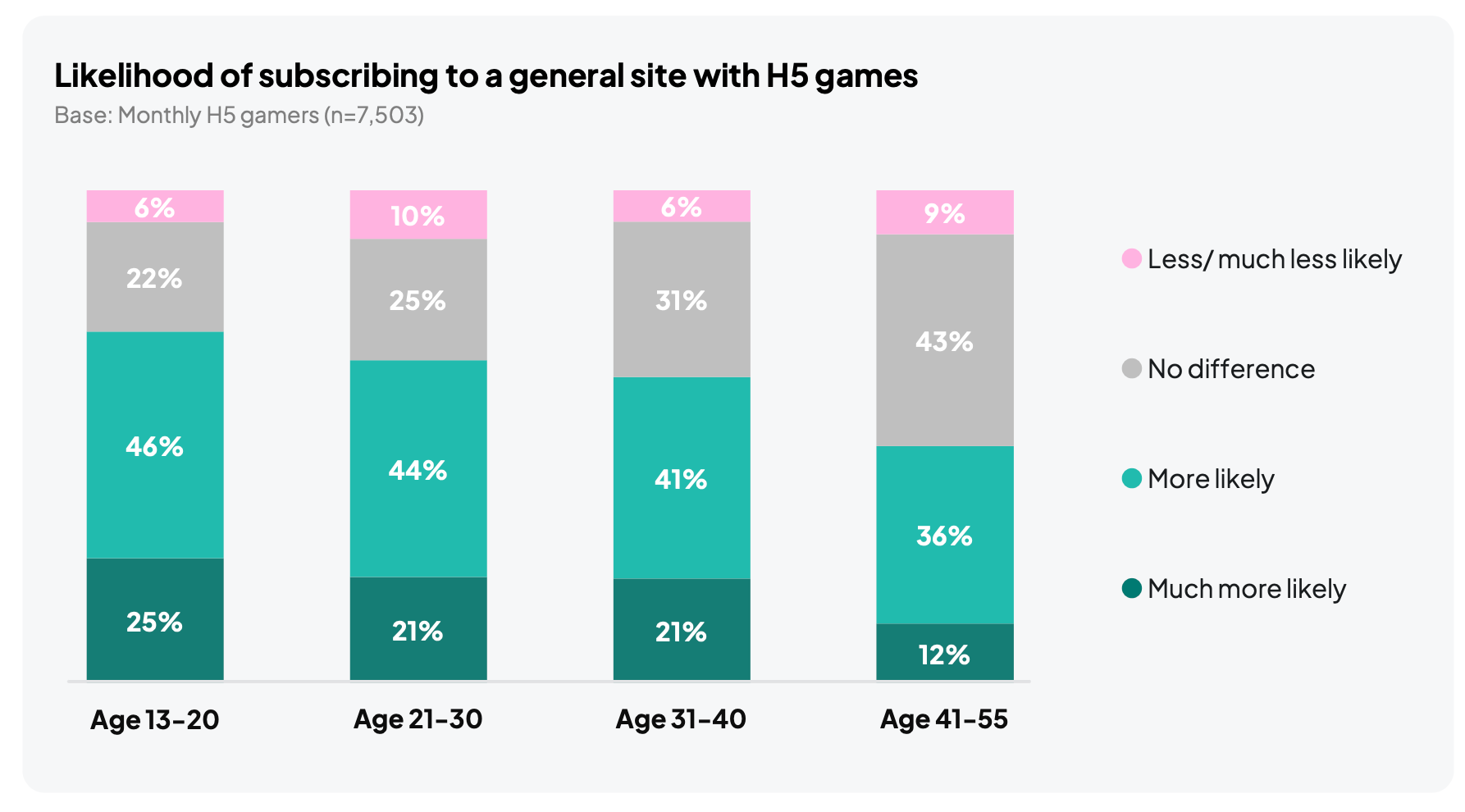
Players are more willing to subscribe to sites that have browser games. In the 13-20 segment, 71% of players said so; in the 41-55 segment, 48%.
A word from our sponsor
Need a freelance 3D artist, composer, or QA tester fast? Mellow’s AI Scout finds qualified talent in under 48 hours — free to try, no commitment. Describe the role, get a shortlist, hire when you’re ready.
Monetization and Advertising
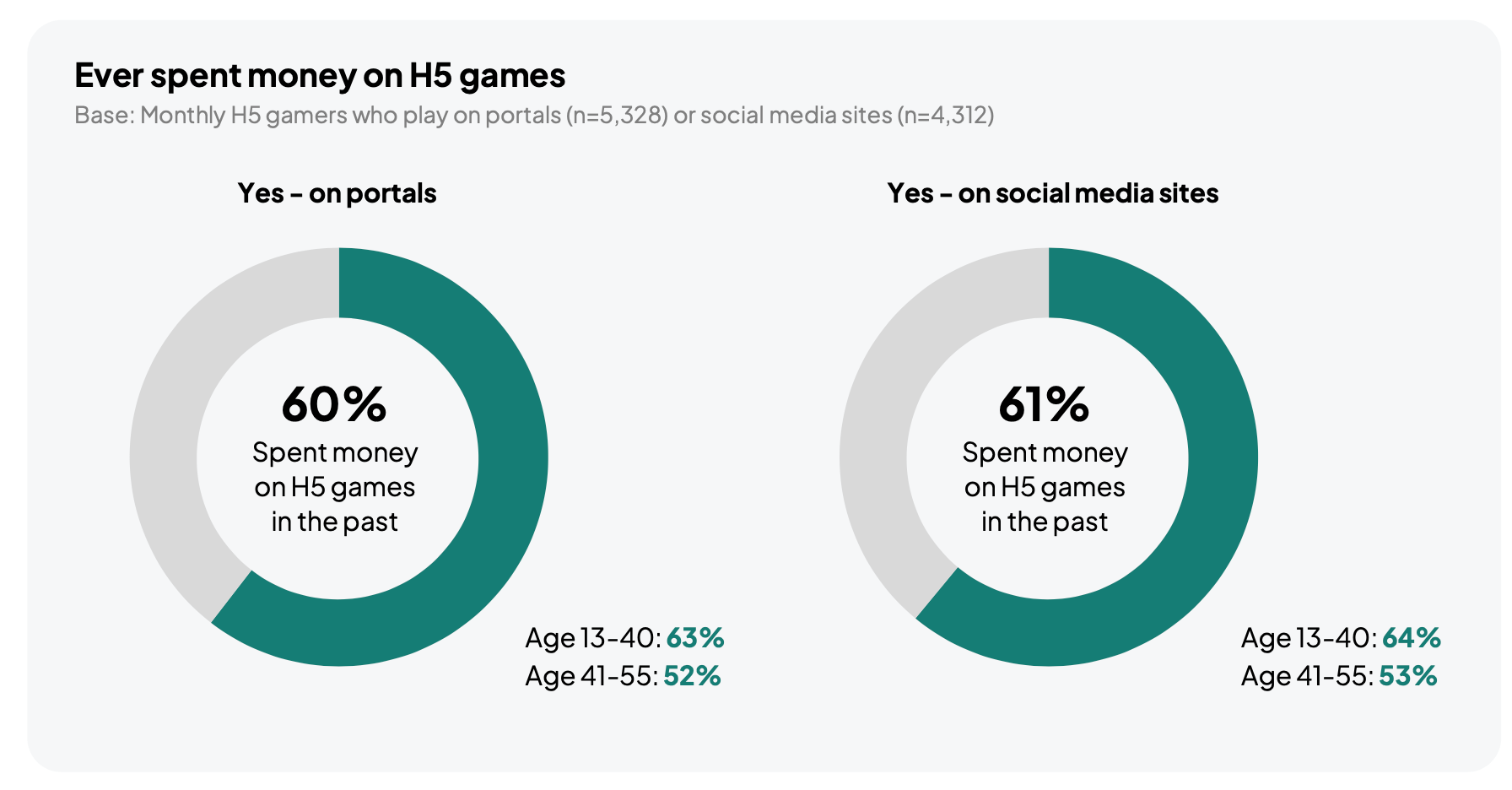
60% of surveyed players on gaming portals and 61% of players on social media have spent money on browser games at least once. In the 41-55 segment, the shares are lower (52% and 53%).
❗️This is the share of those who have ever paid in H5 games, not the monthly share of paying users.
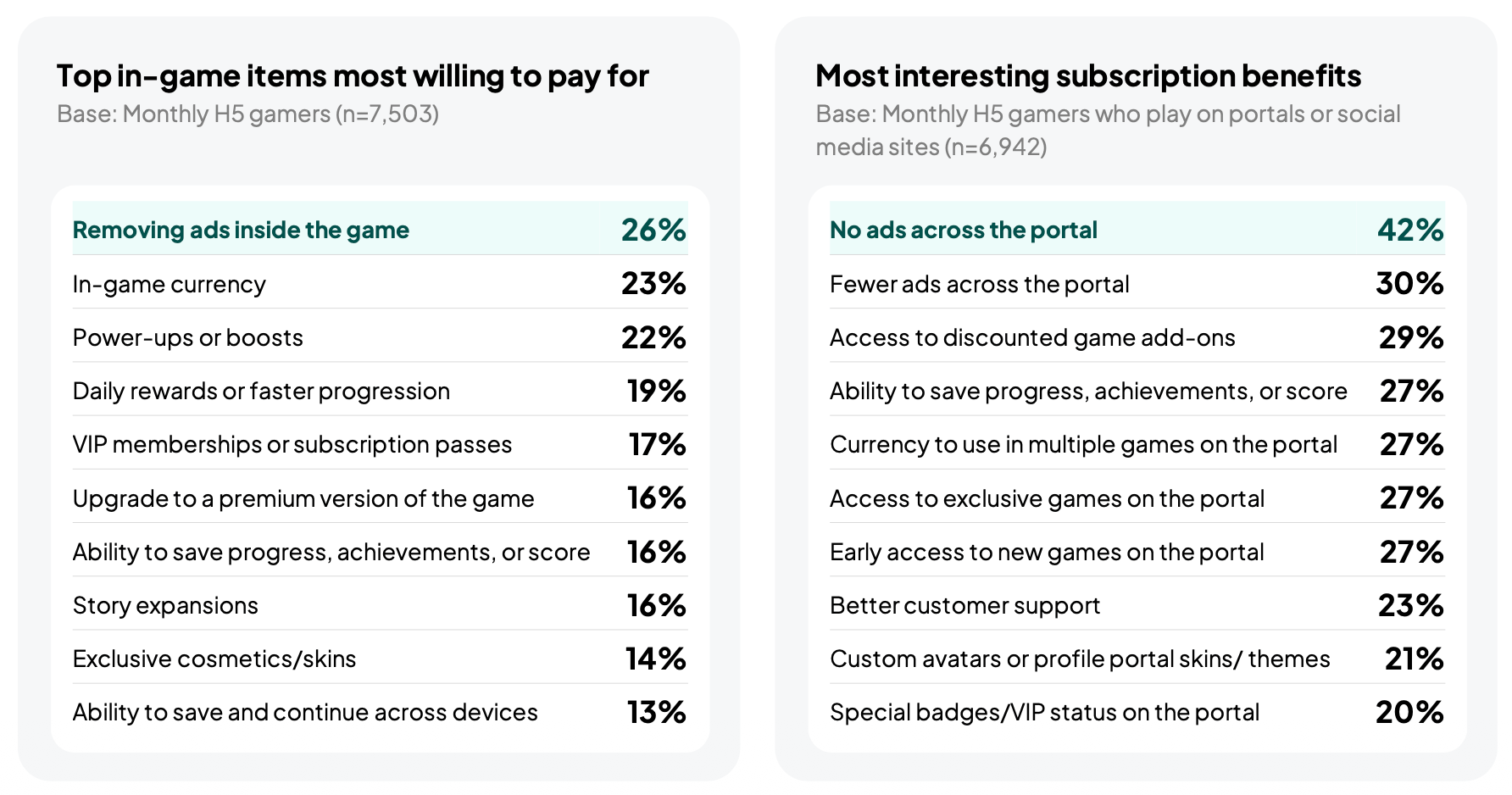
In-game, players are most willing to pay to remove ads (26%), for in-game currency (23%), and for boosts (22%). Story expansions (16%) and skins (14%) are of less interest.
In a gaming portal subscription, players value no ads across the whole portal most (42%), followed by fewer ads (30%) and discounts on game add-ons (29%).
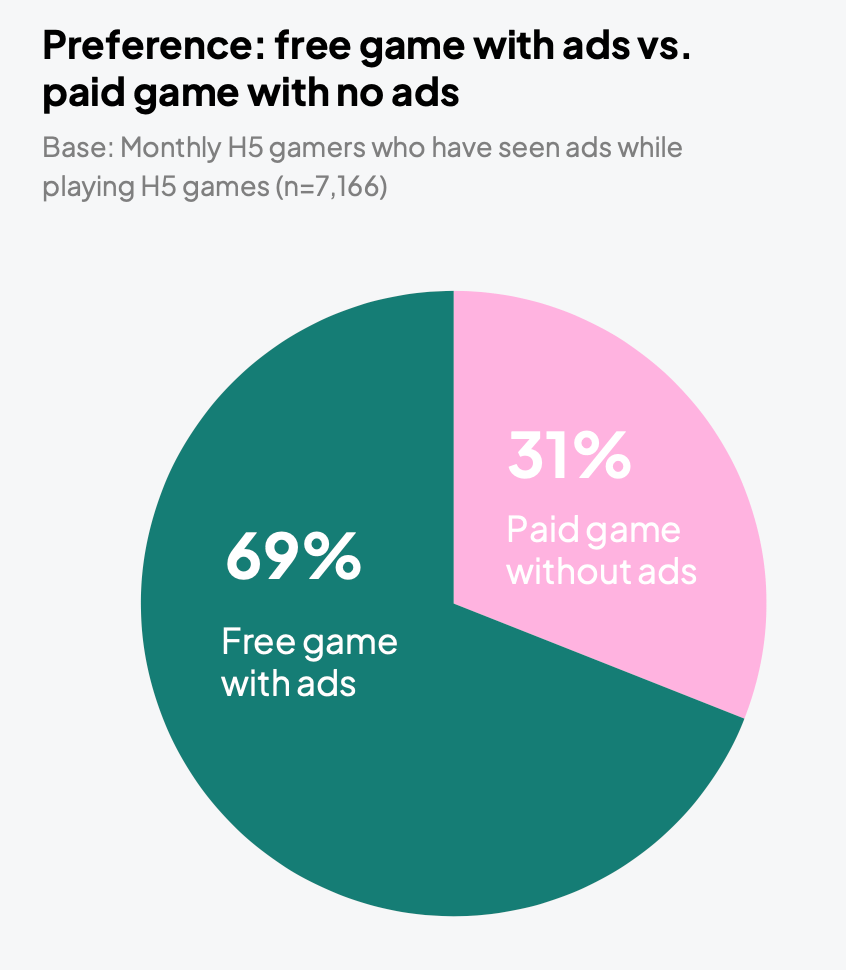
94% of players have seen ads in browser games. 69% of them would choose a free game with ads over a paid game without them. In the 41-55 segment, it is 80%. The share is lowest in India (59%) and Brazil (61%).
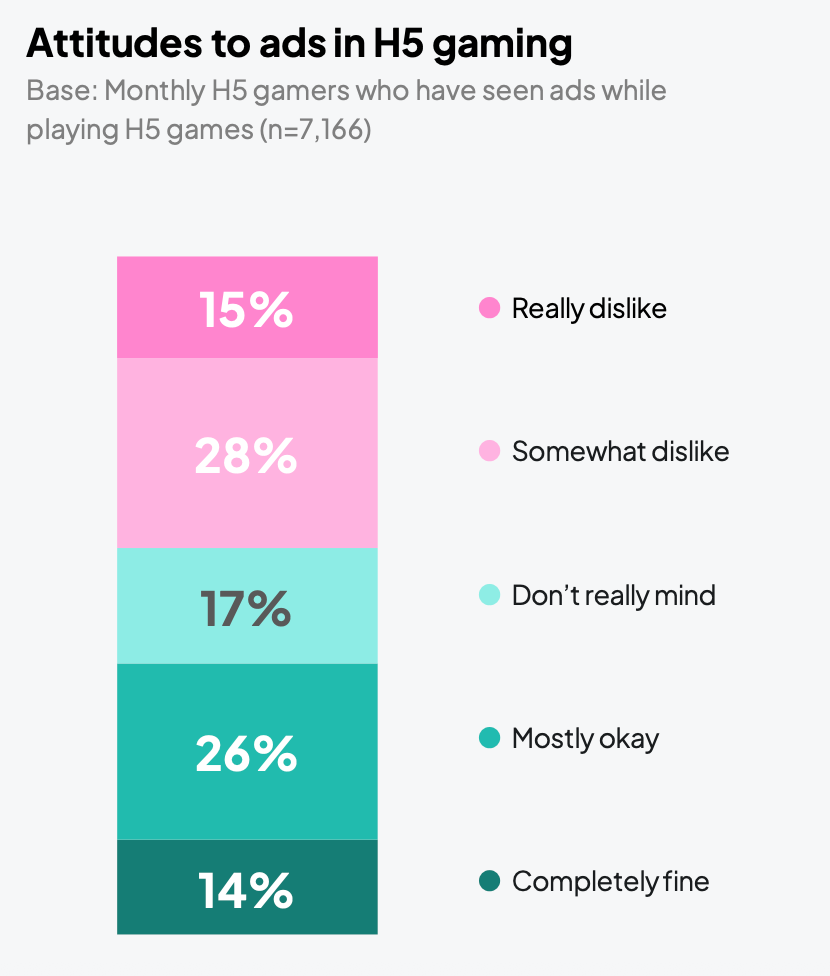
40% of players are generally fine with ads in H5 games, and another 17% don’t really mind. 43% dislike ads, and 15% dislike them strongly.
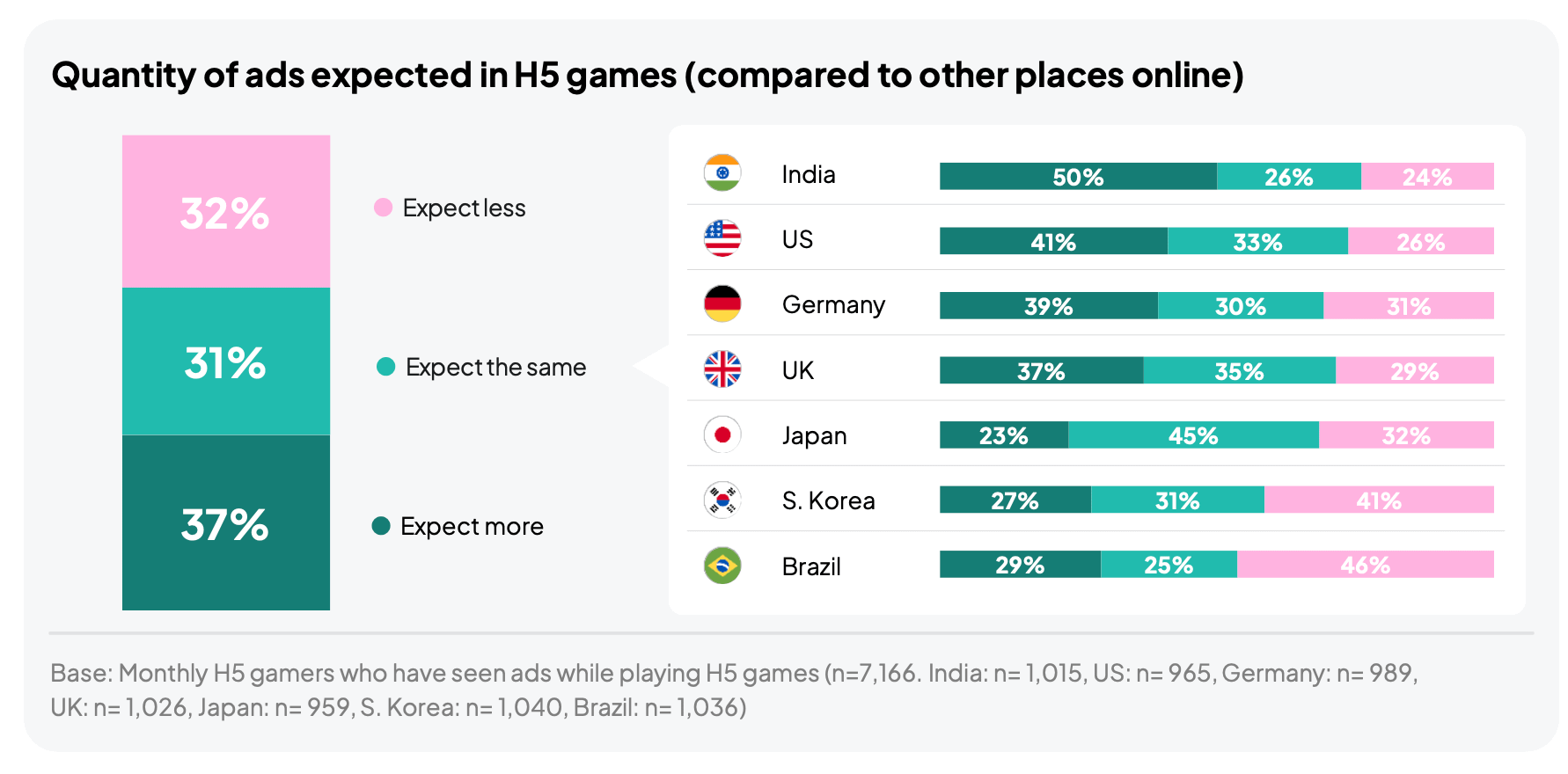
37% of players expect more ads in browser games than elsewhere online, 31% expect the same amount, and 32% expect fewer. Players in India (50%), the US (41%), and Germany (39%) expect the most ads. In Brazil, by contrast, players more often expect fewer ads (46%).
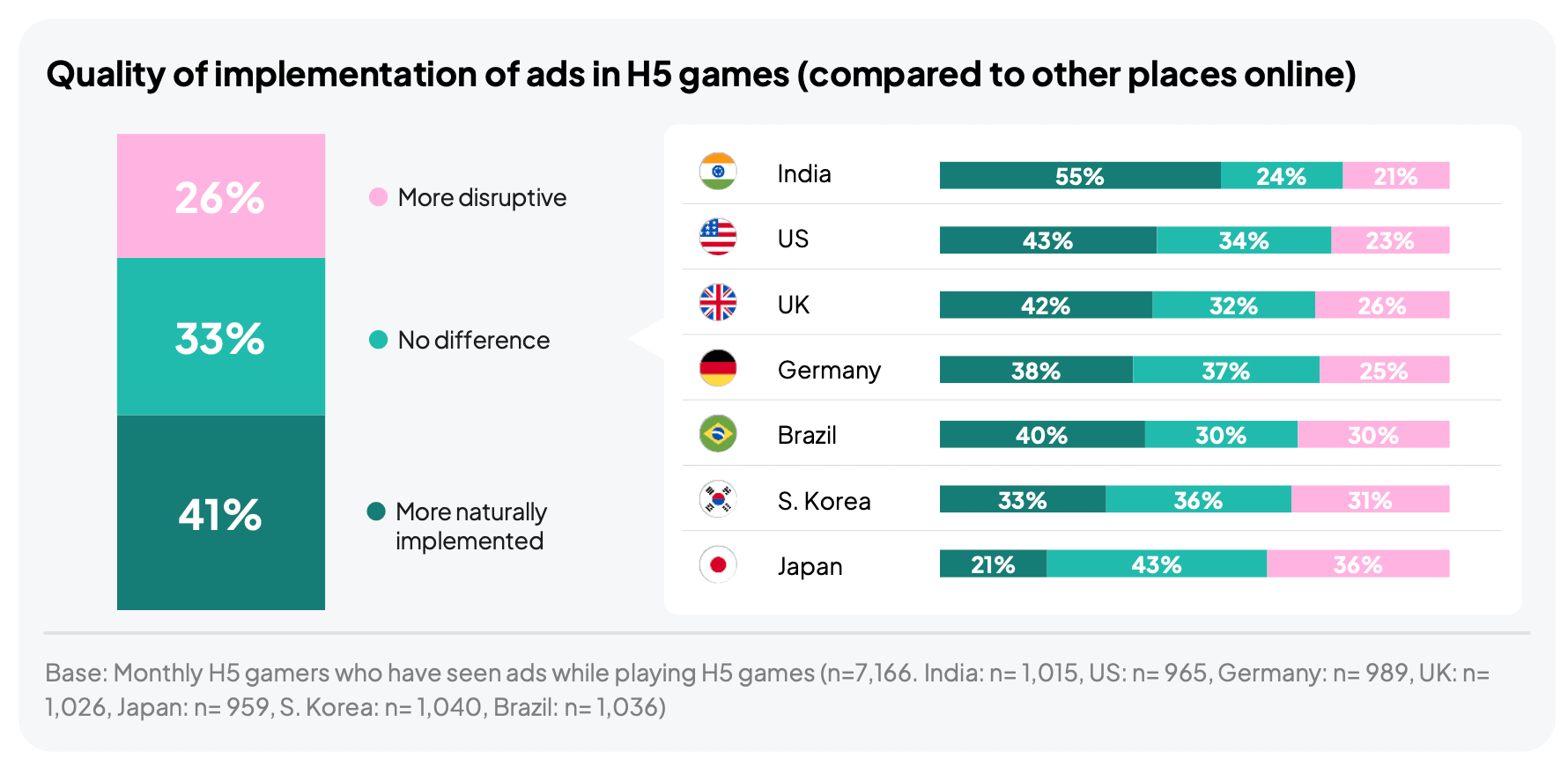
41% of players think ads in H5 games are more naturally implemented than elsewhere online. 26% think they are more disruptive. Attitudes are worst in Japan (21% vs. 36%).
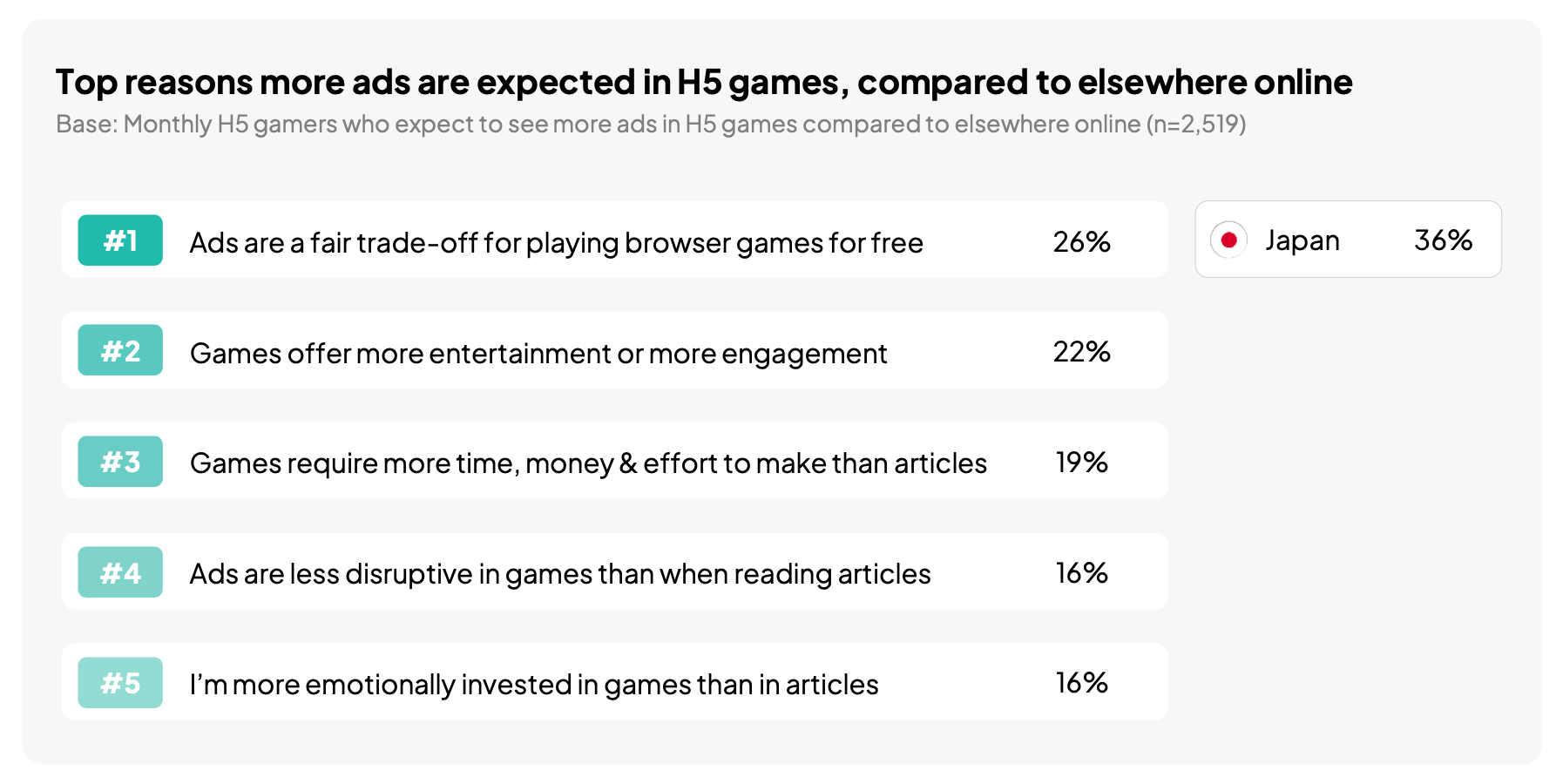
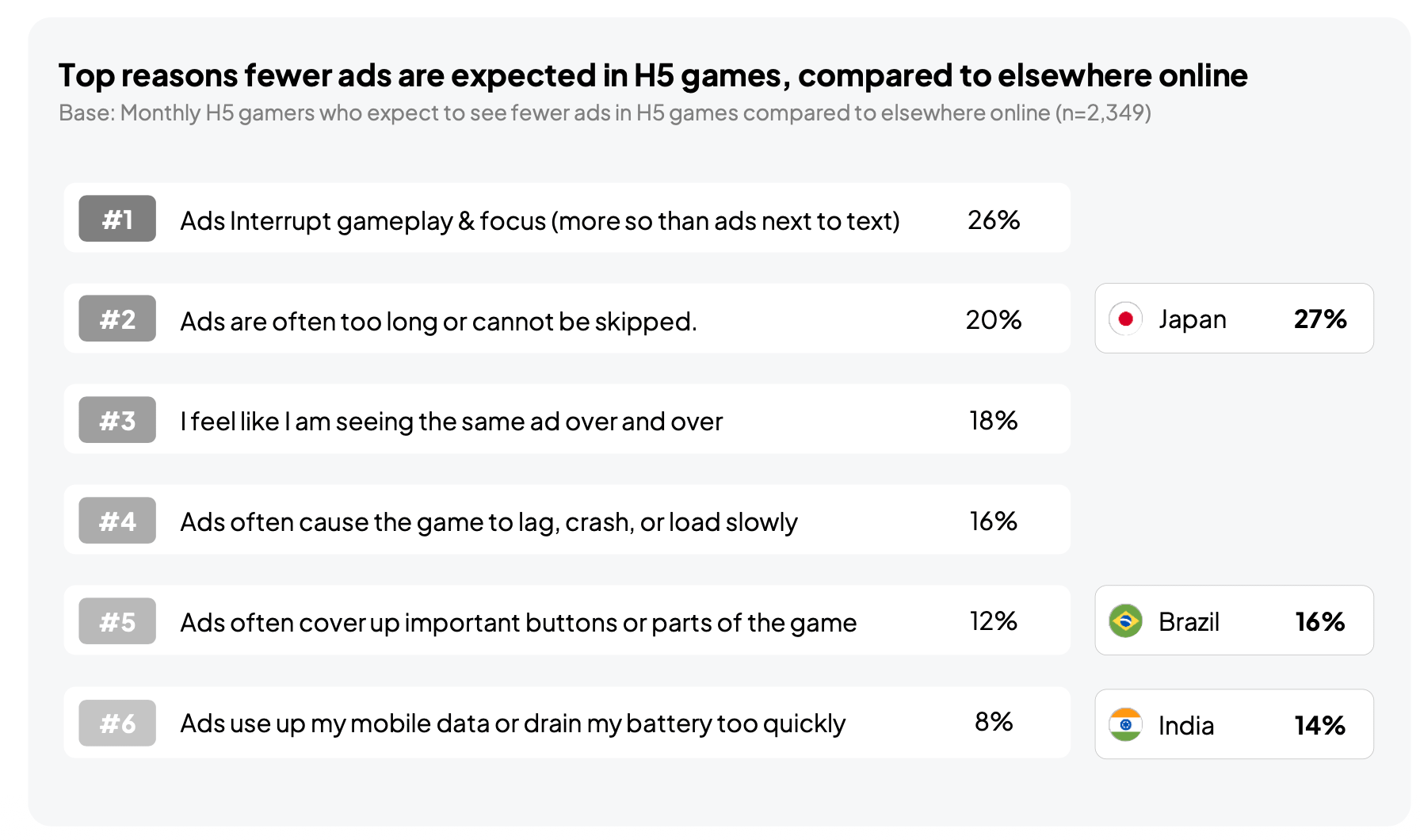
The main reason players accept more ads in games is that they see it as a fair price for a free game (26%, and 36% in Japan). The main reason for the opposite view is that ads in games are more disruptive than while reading an article (26%).
Ads offering a second life after losing are received best: 56% of players like them or are fine with them. Ads during gameplay are received worst: 41% of players dislike them, and another 11% would quit the game because of them.
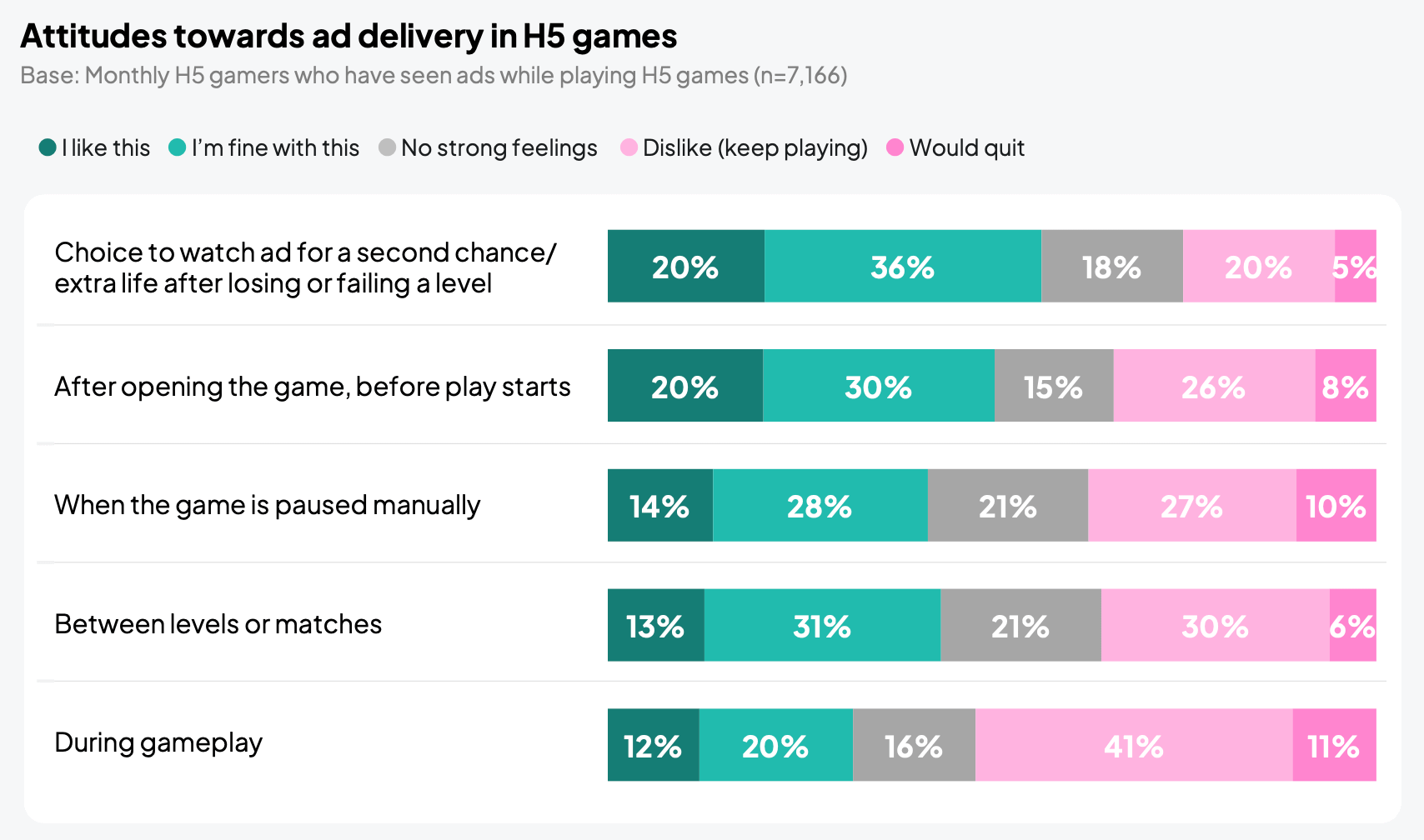
Among the formats shown in the survey as videos, 49% of players liked rewarded ads and 34% liked banners.