



Chris Zukowski (How To Market A Game) collected data on all games in the October 2026 Steam Next Fest from the Steam festival page. The post was written on October 21, a couple of days after the festival started, so the figures are preliminary. The author estimates wishlists by a game's Steam followers and demo popularity by peak CCU. Data on past festivals (from June 2023 to June 2026) comes from GameDiscoverCo.
Festival Scale
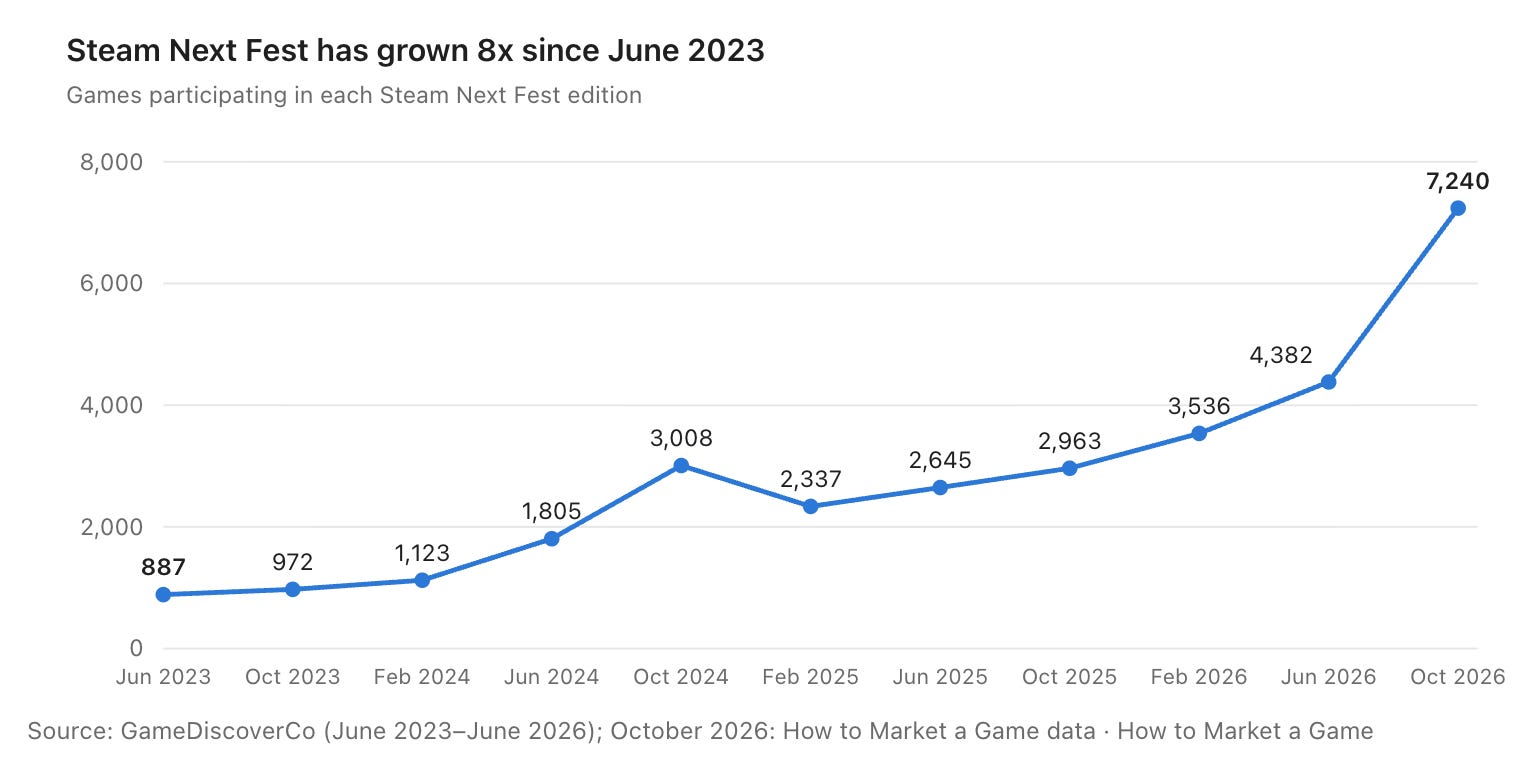
The October 2026 Steam Next Fest has 7,240 games. That is 65.2% more than the June festival (4,382 games). Since June 2023, participants have grown 8x; then, there were 887.

Managing a distributed dev team shouldn’t mean managing a compliance headache. Mellow’s Contractor Management gives you ready-made contracts, IP compliance, and automated payouts for contractors in 150+ countries — for $35/month per contractor.
The author believes the growth isn't just about AI-made games. Developers have finally realized that Steam Next Fest is a free opportunity to collect wishlists. Meanwhile, most Steam games never take part in the festival.
❗️Zukowski named the growing popularity of festival participation as one reason for wishlist inflation: developers take part in Steam Next Fest more often and collect more wishlists, which convert into sales worse.
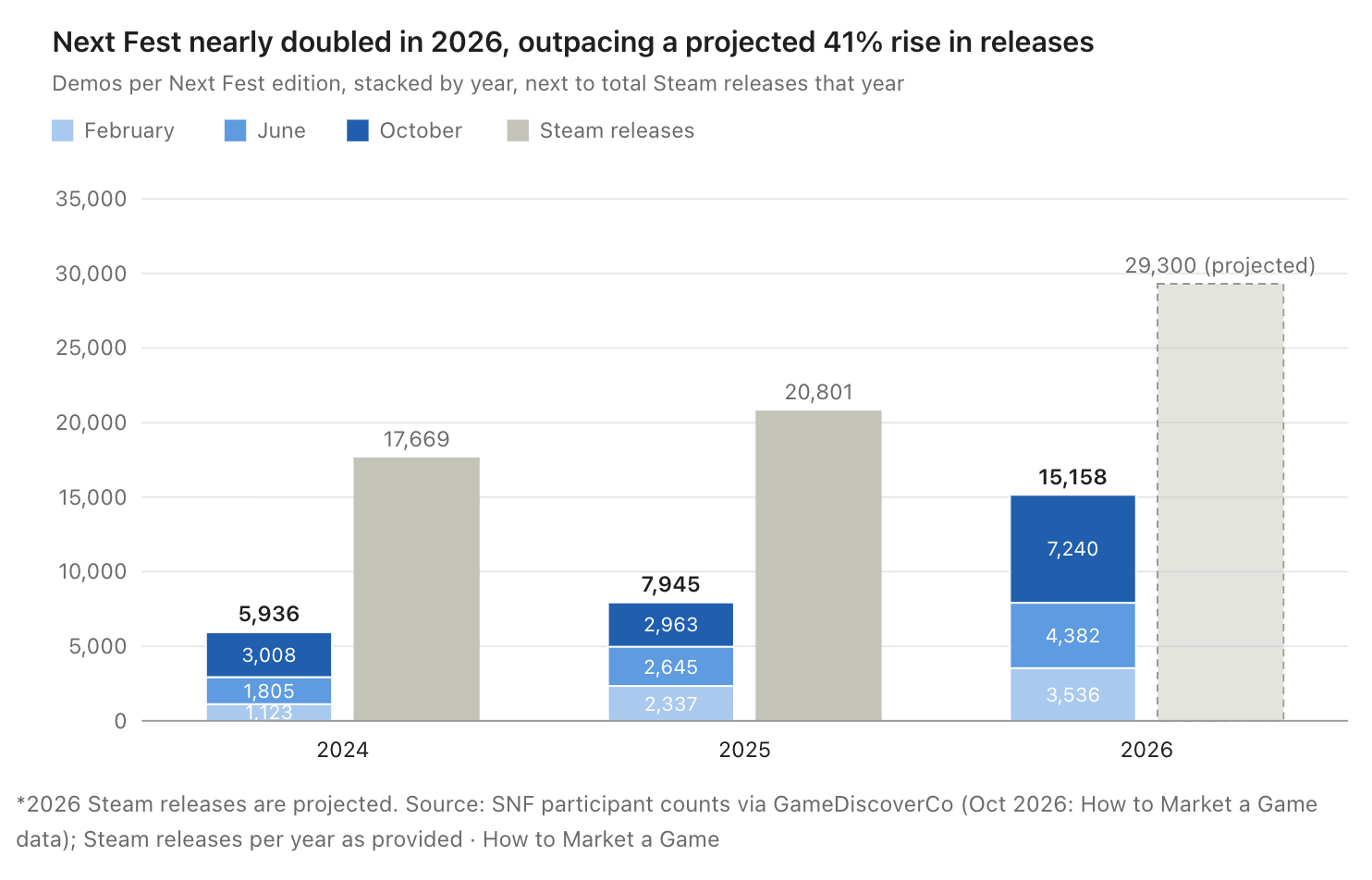
In 2024, the three festivals had 5,936 demos; in 2025, 7,945; and in 2026, already 15,158. So the number of participants nearly doubled in a year. Meanwhile, Steam releases are expected to grow 41%: from 20,801 games in 2025 to 29,300 games in 2026 (according to the author's projection).
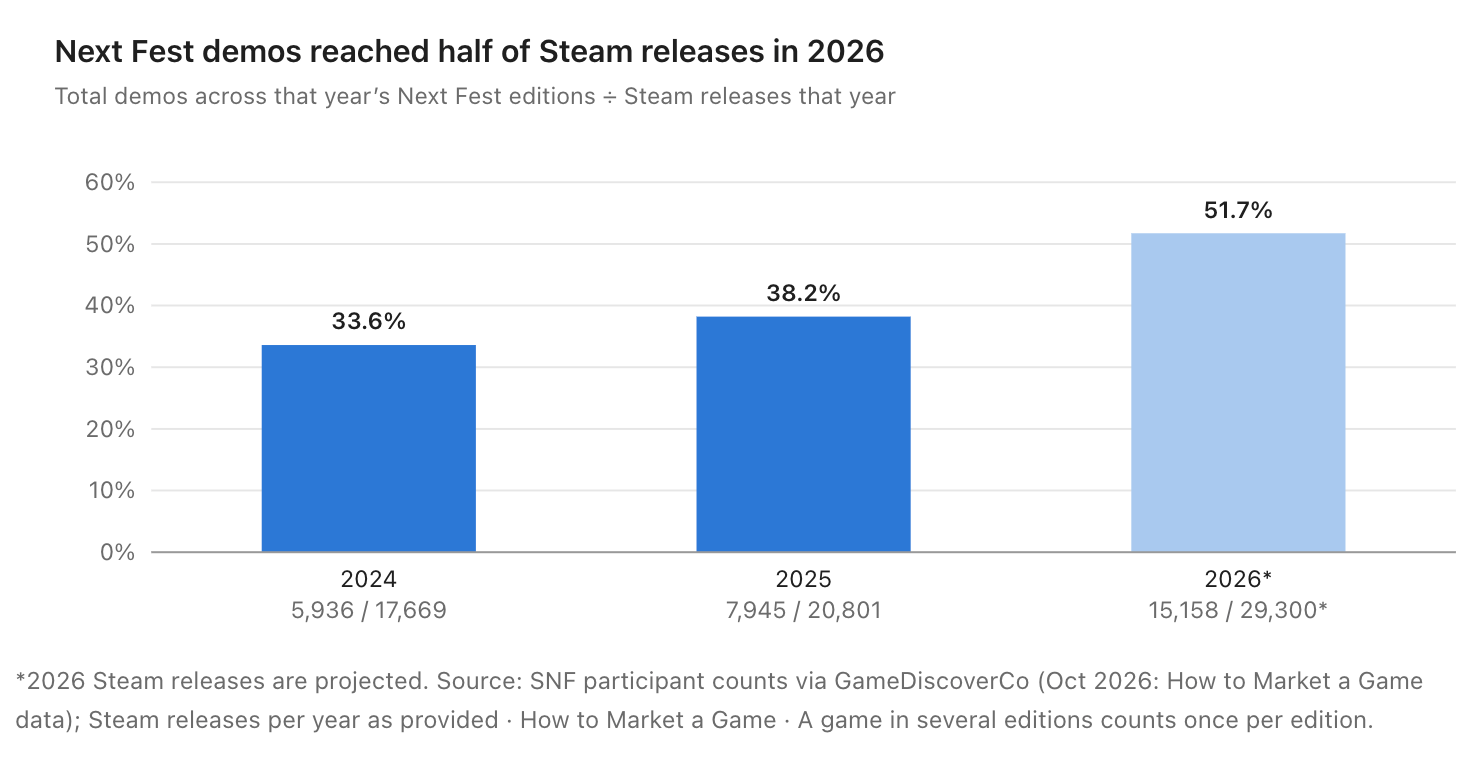
In 2026, Steam Next Fest demos reached 51.7% of the year's total releases. In 2024, the figure was 33.6%.
The author has two hypotheses. First, developers of AI-made games use their first festival to test whether the game clicks with players, and then release it in 2027. If the hypothesis is right, there will be even more releases in 2027.
Second, the 2026 release projection is too low. Usually, 76% of the year's releases are out on Steam by October. But thanks to AI, releases may spike. In that case, around 40,000 projects will be released on Steam in 2026.
Who Is Leading the Festival
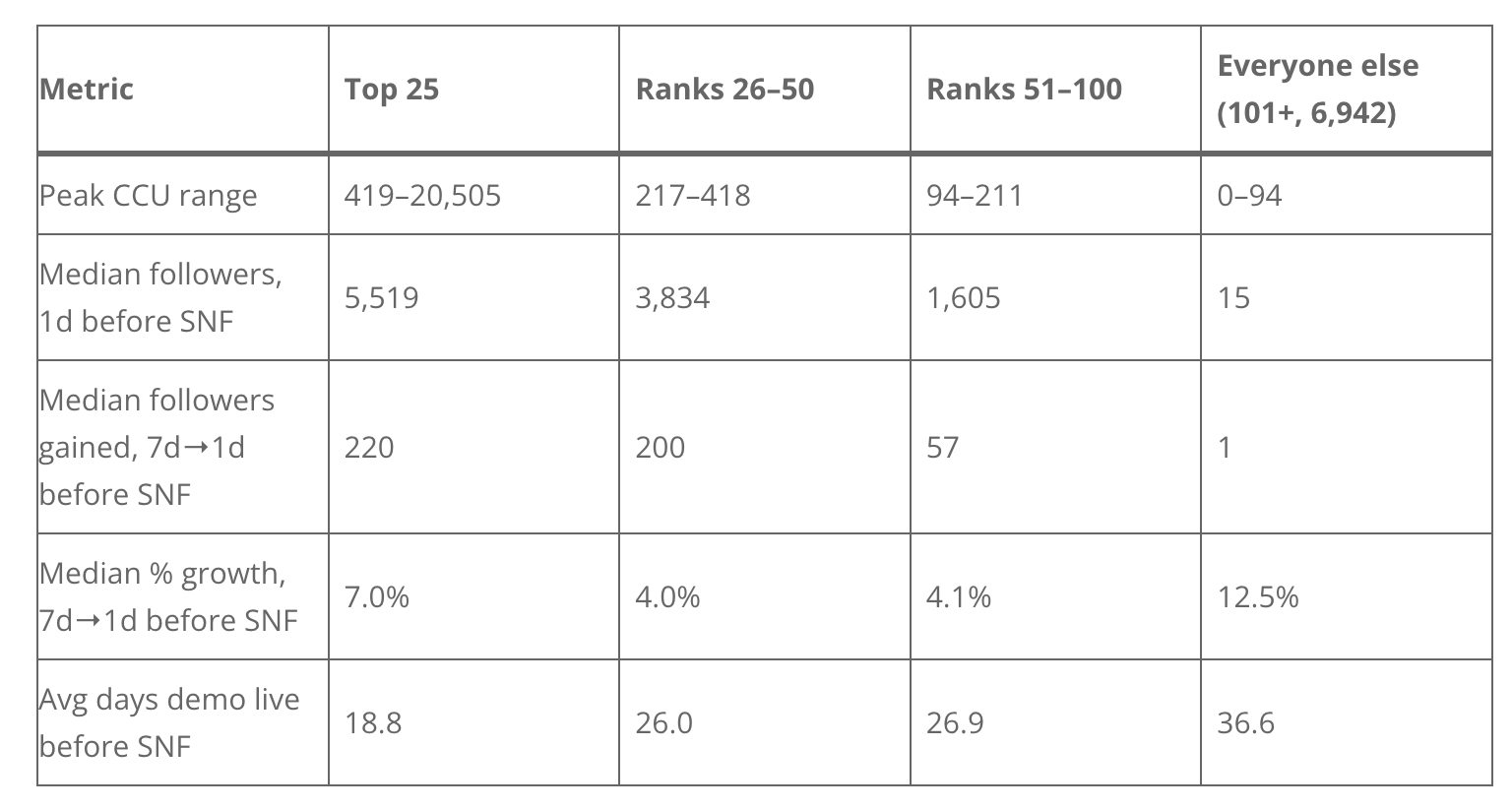
The festival's top 25 games by peak CCU (from 419 to 20,505 players) had a median of 5,519 followers a day before the start. Games ranked 26-50 had a median of 3,834, and those ranked 51-100 had 1,605. The remaining 6,942 games had just 15.
In the last week before the festival, the top 25 games gained a median of 220 followers (+7%), games ranked 26-50 gained 200 (+4%), and those ranked 51-100 gained 57 (+4.1%). The remaining projects grew 12.5%, but in absolute numbers, that is just 1 follower.
On average, the top 25 games had their demo available 18.8 days before the festival started, games ranked 26-100 had it 26 days before, and the rest 36.6 days before.

Zukowski tried to answer the eternal question: is it better to build wishlists before the festival, or announce the game shortly before the start to get a burst of interest? The Spearman correlation of peak CCU with total followers a day before the festival is 0.55, and with new followers in the last week, 0.52. With growth in percent, the correlation is even slightly negative (-0.13).
❗️A Spearman correlation of 1.0 would mean that the ranking of games by followers fully matches the ranking by CCU.
So a large number of wishlists matters slightly more. But the author says the best option is to come to the festival with a large wishlist base and actively collect more in the final weeks. Zukowski promises to look at this in more detail after the festival ends.
AI in Festival Games

Among the festival's top 25 games, only 2 (8%) disclosed AI use. Among games ranked 26-50, 3 did (12%); among those ranked 51-100, 13 (26%). Among the rest, 35% (2,427 games).
Zukowski counts only what developers stated on their game's Steam page. The author admits that big projects fear negative audience reactions, so some may be hiding their AI use.
The two top 25 games that disclosed AI use are BORE (developed with an AI assistant under human direction, with no content generated while the game is running) and Path of the Yaoguai (some images were generated by AI and then modified).
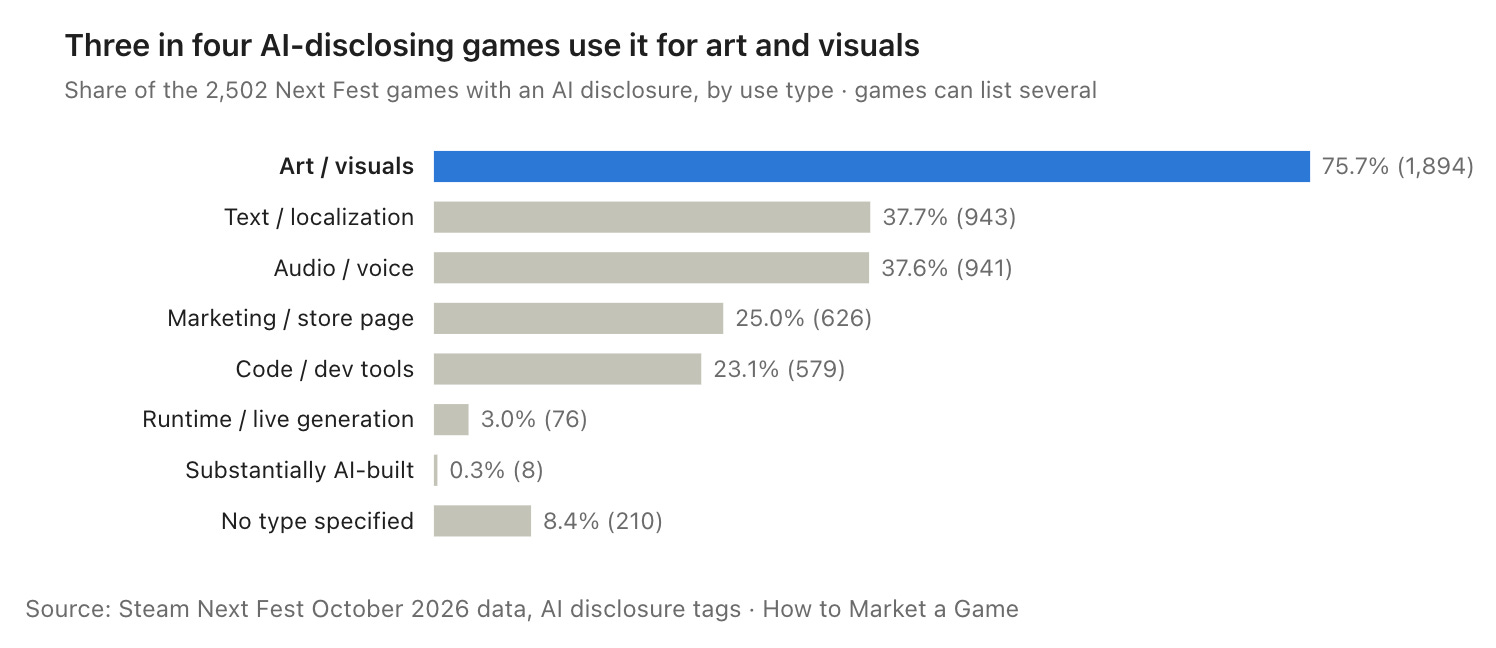
In total, 2,502 festival games (34.6%) disclosed AI use. For comparison, BCG reported that 21% of games on Steam were AI-assisted in Q3'25. AI is most often used for art and visuals (75.7% of games that reported AI use). Text and localization are second (37.7%), and audio and voice are third (37.6%).
23.1% of these games (579 games) use AI to write code. However, Valve doesn't require disclosure of AI tools used in development, so the real share is likely higher.
Zukowski cites a GameDiscoverCo survey in which code generation was most often cited as an acceptable use of AI (~239 mentions). Prototyping and placeholder assets were mentioned 119 times, and automating repetitive tasks 101 times.
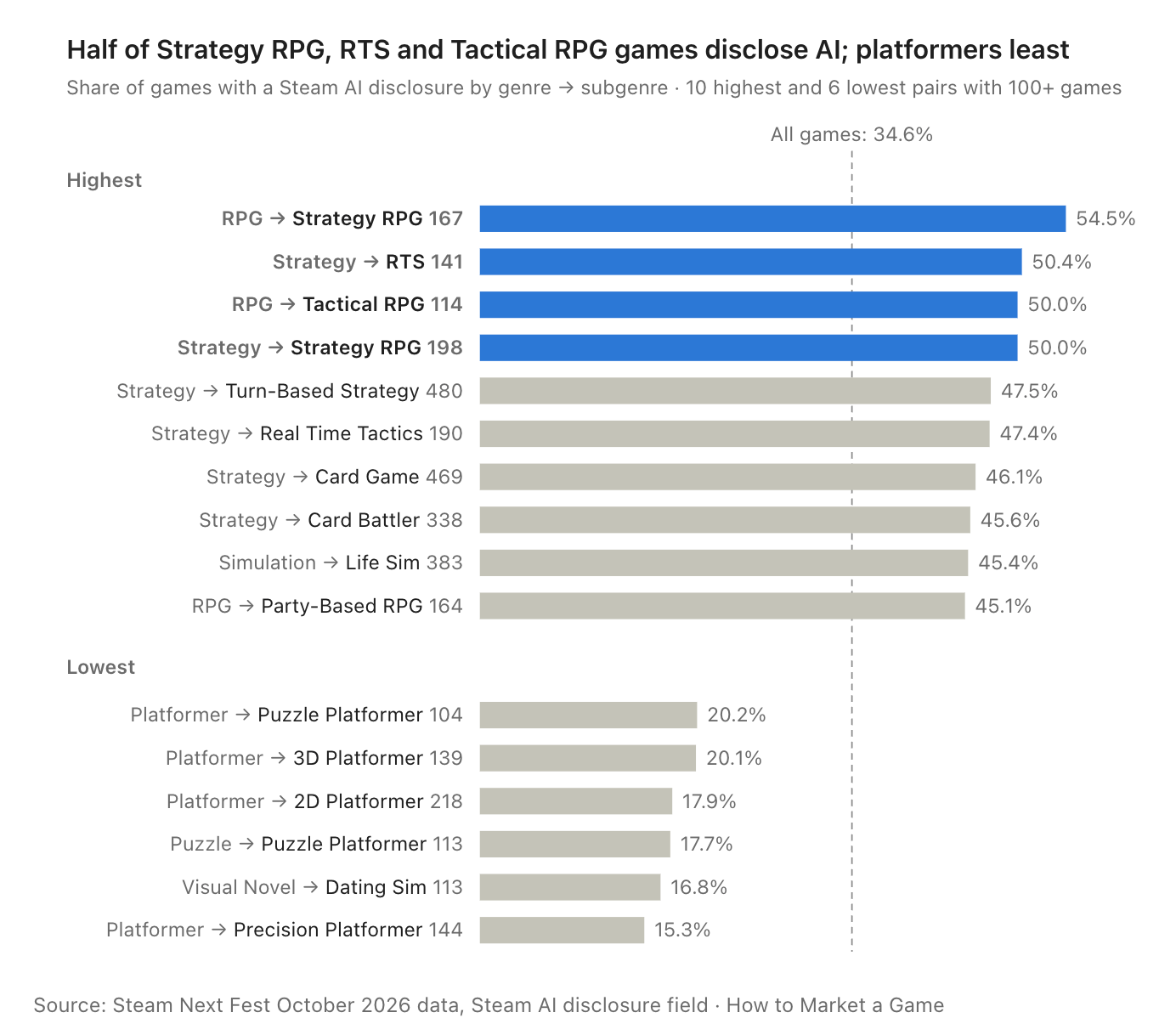
AI use is most often disclosed in RPG and Strategy games. The leaders: Strategy RPG (54.5%), RTS (50.4%), and Tactical RPG (50%). The lowest shares are in Precision Platformer (15.3%), Dating Sim (16.8%), and Puzzle Platformer (17.7%).
Developers specified their own genres and subgenres when registering for the festival.
Zukowski links this genre split to Chinese developers. In his view, they are more comfortable with AI and more often make RPG and Strategy games. The three most popular (by CCU) Strategy RPGs with an AI disclosure were all made by Chinese studios: Path of the Yaoguai, General Jeon, and 灵劫变. The author also notes that Steam has many Three Kingdoms strategy games made with AI.
The Most Popular Genres
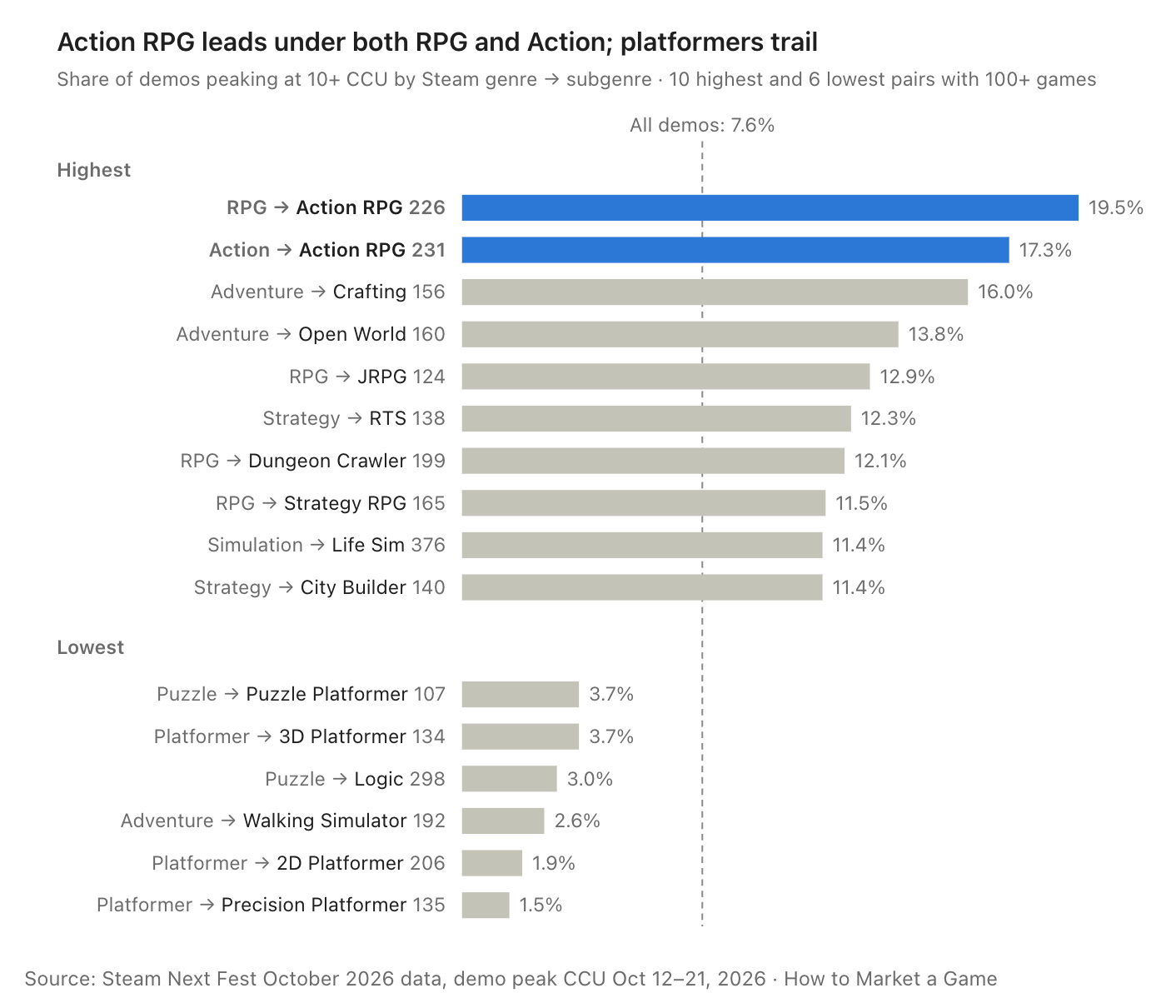
7.6% of the festival's demos reached a peak CCU above 10 players. Action RPG does best here (19.5% under RPG, and 17.3% under Action), followed by Crafting (16%). The worst are Precision Platformer (1.5%), 2D Platformer (1.9%), and Walking Simulator (2.6%).
According to Zukowski, Steam players like crafting, building, strategy, and simulation games the most. Platformers, though, are the least interesting.
So AI games are being made precisely in the most popular genres. Strategy RPG, RTS, and Life Sim made the top 10 in both AI disclosure share and demo share with 10+ CCU. Platformers rank at the bottom of both rankings.