The report was prepared by Niko Partners in partnership with ESL FACEIT Group and Hero Esports. In May 2026, Niko Partners surveyed Gen Z gamers (born 1996-2013) who had attended esports events or watched streams in the past month. 1,000 respondents were surveyed in each of 8 countries (USA, China, Indonesia, Korea, Thailand, Germany, Malaysia, UK).
❗️Niko Partners estimates the global Gen Z esports fan audience at 400 million people. The report’s authors note that “about 20% of Gen Z” regularly watch or participate in esports events, and apply this to some estimate of the global Gen Z population. However, the report’s methodology doesn’t disclose how the 20% figure was derived, nor what baseline global Gen Z population was used to calculate the 400 million estimate.
Portrait of the Gen Z esports fan
Gender split in the sample: 68.3% men, 31.7% women. Five years ago the ratio was closer to 80/20, so the share of women is growing.
In mobile-first markets like Thailand and Indonesia, the gap is even narrower, and at offline events in China women sometimes dominate - up to 90% at the Peacekeeper Elite League and 50%+ at KPL. At DreamHack Birmingham 2026, 41% of attendees were women.
A word from our sponsor

Still paying for impressions and clicks that never convert? Advertise your PC game with PWN Games! With our CPA model, you only pay when a player installs, engages, or pays. 250+ PC games promoted, 42M+ players acquired, 10 years in the business. Trusted by top PC game publishers worldwide.
60.8% of Gen Z esports fans work full-time, 18.4% are self-employed, 16% work part-time. Only 3% are still in school, while 72.9% have completed at least some higher education.
85% notice branding in esports, and 73.6% say it affects their purchasing behavior.
Esports as part of culture
76.2% of fans both play the titles they follow and watch them. 98.6% play video games, and only 1.4% don’t play at all.
71% attended a professional sporting event in the past year, and 36% rank watching other sports among their top interests outside of gaming.
By Niko Partners’ estimate, the global esports audience in 2026 is around 640 million fans, with industry revenue of about $3 billion (from broadcast and streaming, sponsorship and advertising, media rights, tickets, licensing, and merch).
Esports disciplines and platforms
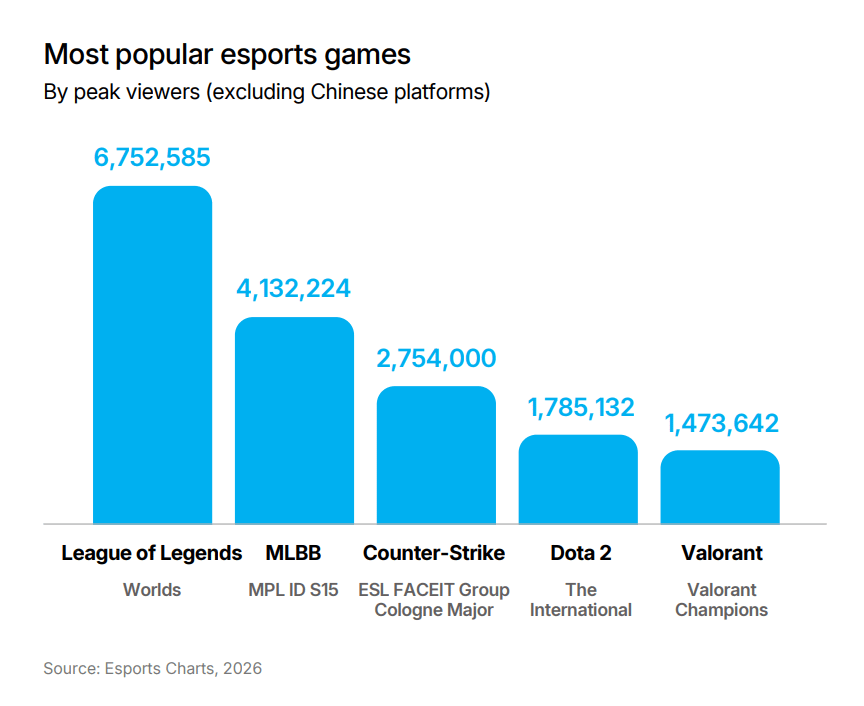
Most-watched esports events of 2025 (excluding China) by peak viewership - LoL Worlds - 6.752 million viewers, MLBB MPL ID S15 - 4.132 million, CS ESL FACEIT Cologne Major - 2.754 million, Dota 2 The International - 1.785 million, Valorant Champions - 1.473 million.
Leading international platforms for watching esports: YouTube (81.8%), TikTok (56.6%), Twitch (37.4%), Facebook (34.7%).
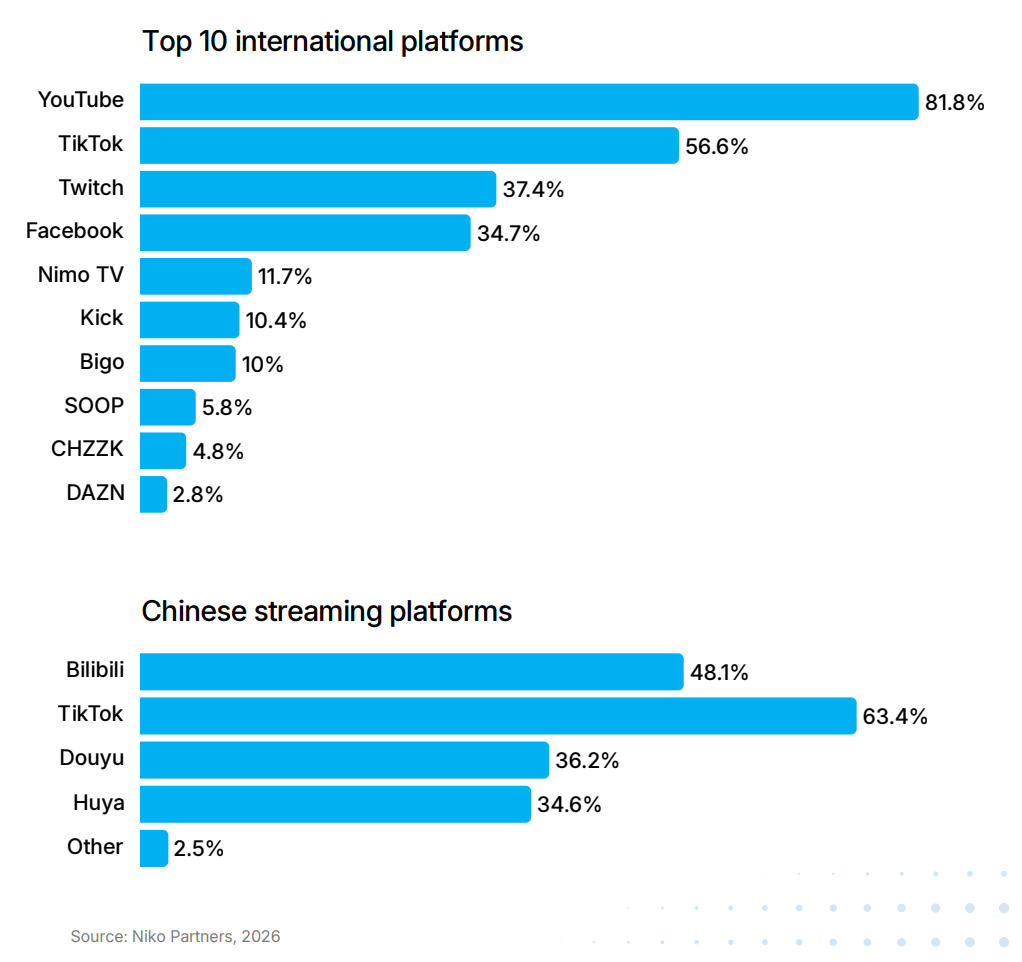
In China: TikTok (63.4%), Bilibili (48.1%), Douyu (36.2%), and Huya (34.6%).
Media consumption
Nearly all respondents spend at least an hour a week on social media; 26% spend 10+ hours. 27.7% spend more than 10 hours a week gaming.
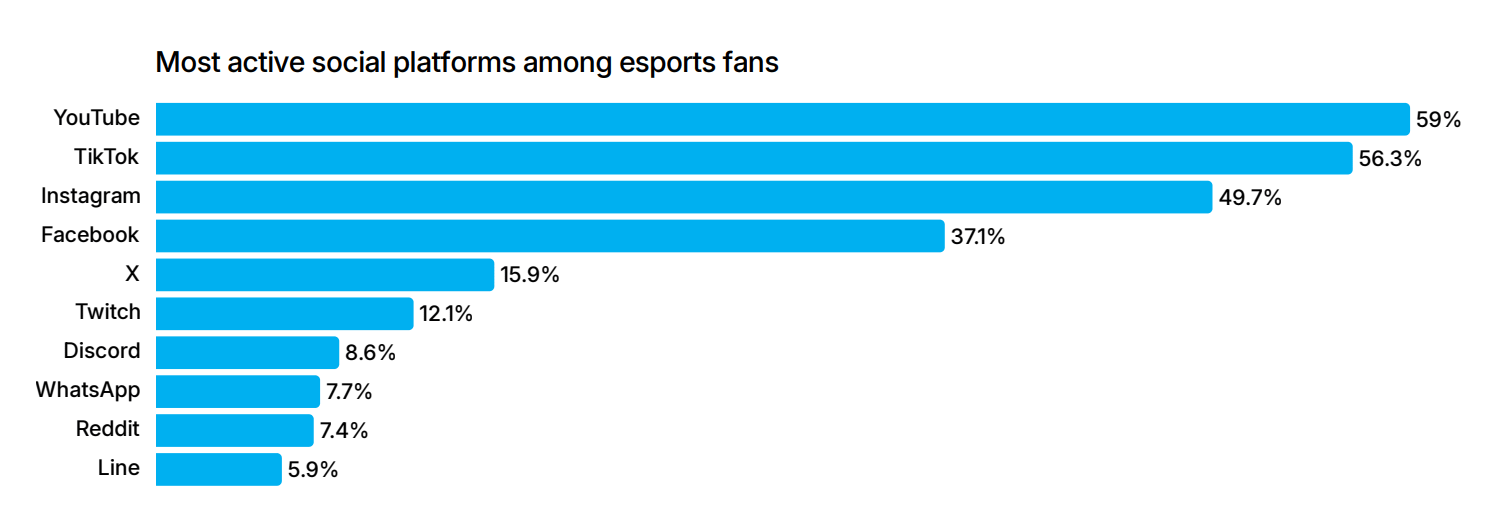
Top platforms: YouTube (59%), TikTok (56.3%), Instagram (49.7%), Facebook (37.1%), X (15.9%), Twitch (12.1%), Discord (8.6%), Reddit (7.4%).
26% don’t watch TV in any form at all, another 19.7% watch less than an hour a week.
Among Gen Z’s top interests outside of gaming: music (47.5%; 53% pay for a music subscription), streaming movies and TV shows (37.4%; 51.9% pay for a subscription), sports (36.2%), fitness (31.1%), variety shows and streams (28.6%), movies (28%), fashion and beauty (26.2%).
Fans who also follow traditional sports are more active in esports (by 8-12 percentage points): they’re more likely to watch tournaments (+8%), attend them in person (+7%), attend events (+11%), buy tickets (+12%) and merch (+12%), and buy branded peripherals (+8%) and sponsor products (+9%).
What draws fans in
Most often, people get into esports through friends (38.6%); because they play the game themselves (35.4%); because esports stars and teams become part of mainstream culture (32.6%).
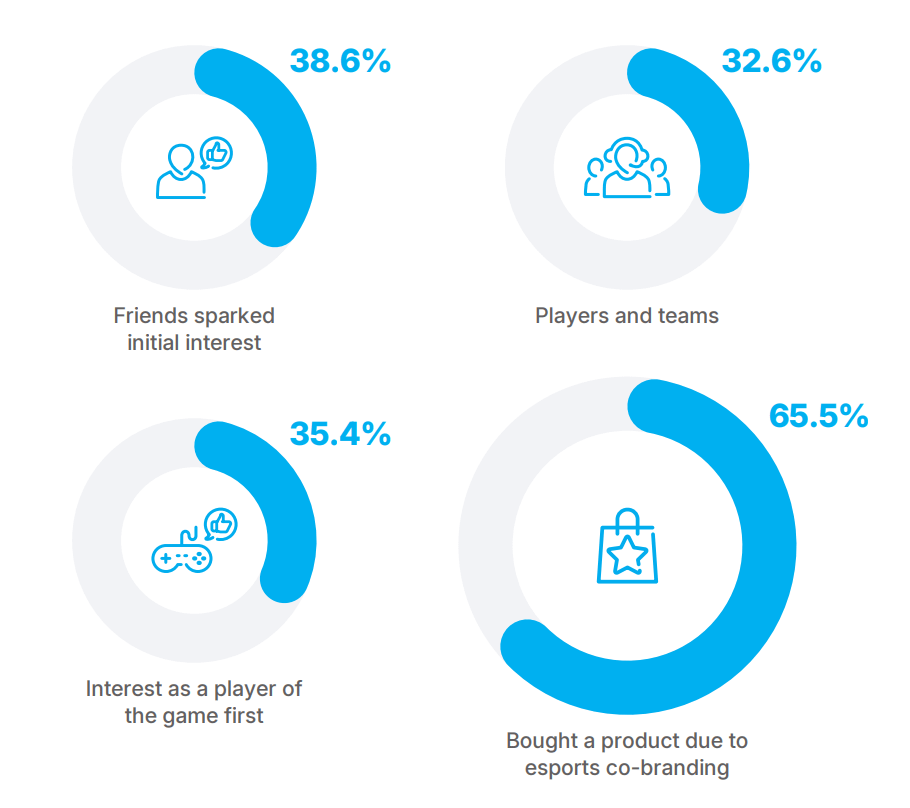
65.5% have bought a product because of a collaboration with an esports team, game, or player.
When evaluating a tournament, fans look first at production and graphics (32.4%), then the venue (25.8%), commentary (22.6%), crowd atmosphere (11.4%), and event flow (7.7%).
What esports fans spend money on
76.3% made an esports-related purchase in the past year. Half bought digital items (skins, cosmetics), 40.9% bought physical merch, 33% bought branded peripherals.
33.5% paid for a battle pass, 26% paid for game subscriptions (PS Plus, Xbox Live, and similar).
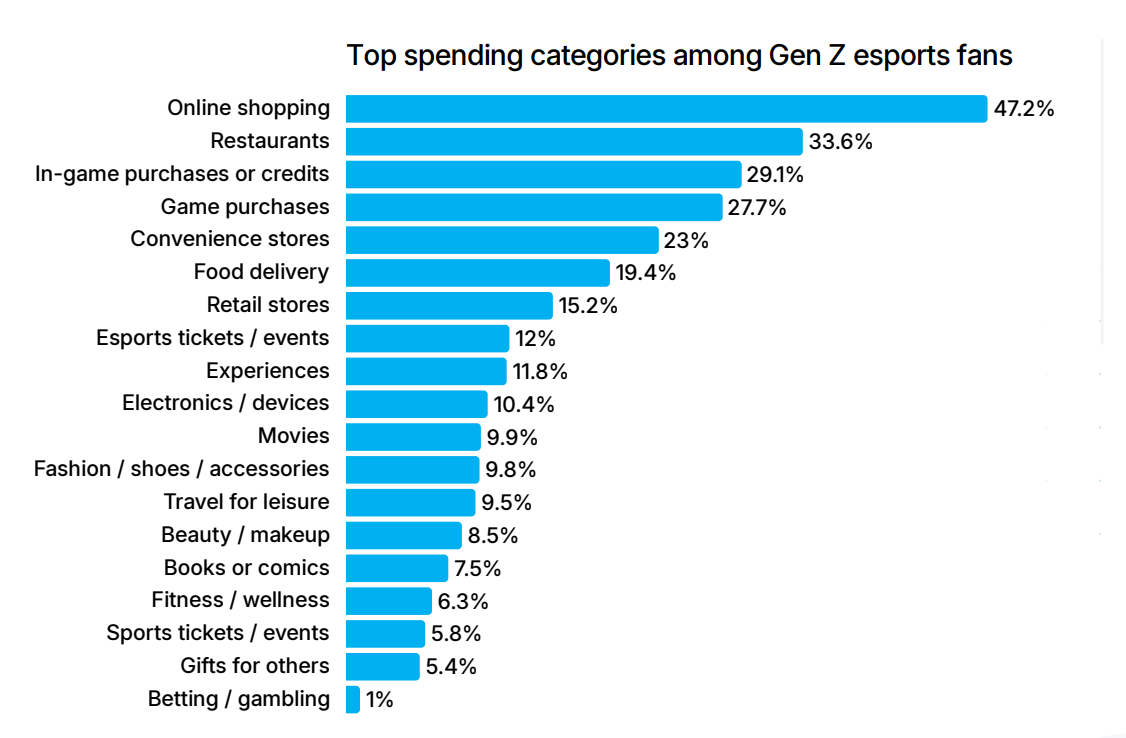
Top spending categories among esports fans: online shopping (47.2%), restaurants (33.6%), in-game purchases (29.1%), game purchases (27.7%), convenience stores (23%), food delivery (19.4%), retail purchases (15.2%), esports tickets (12%). 32% bought food and beverages from brands that had partnered with esports.
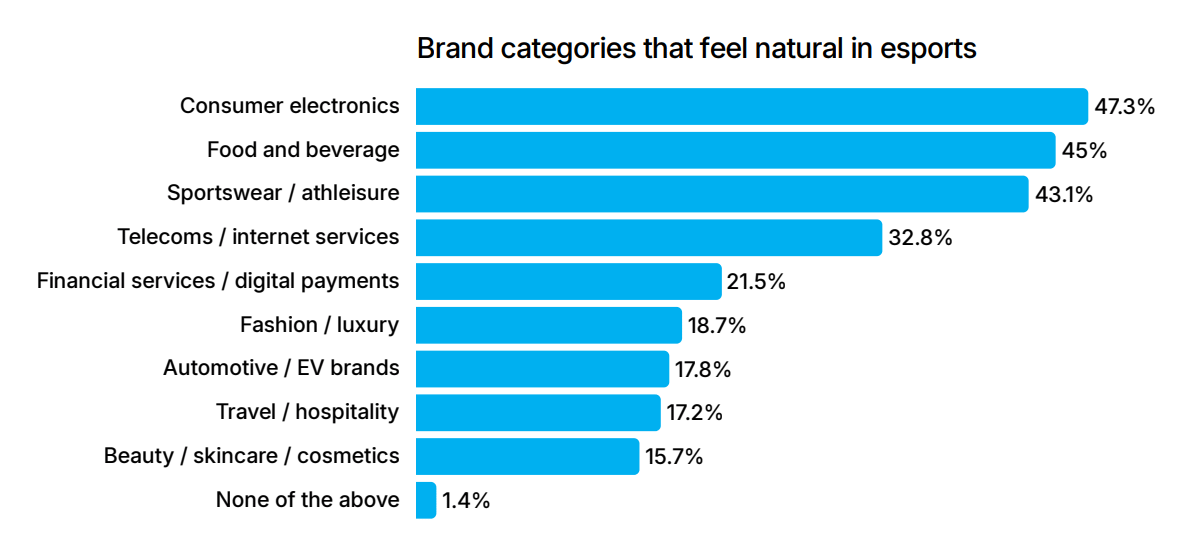
Categories fans consider the most natural fit for esports: electronics (47.3%), food and beverage (45%), sportswear (43.1%), telecom (32.8%), fintech (21.5%), fashion and luxury (18.7%), automotive/EV (17.8%), travel (17.2%), beauty (15.7%).
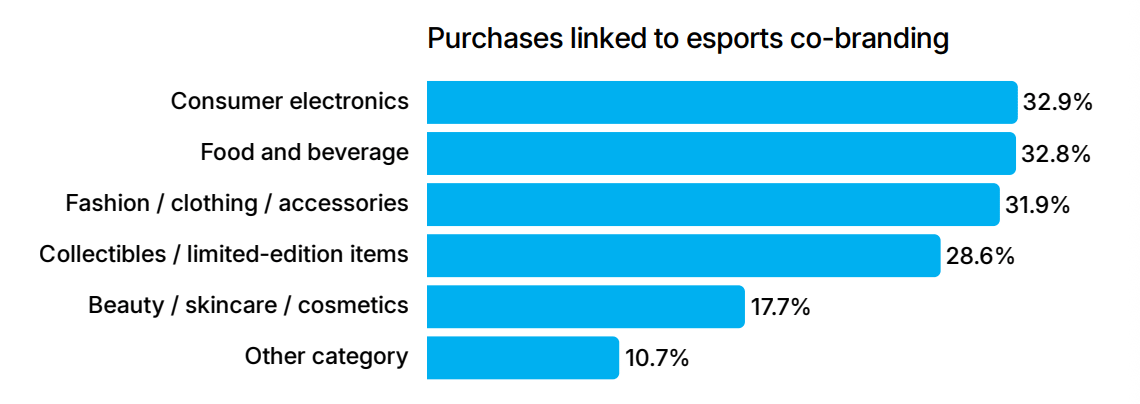
Actual purchases from esports brand partners look like this: electronics (32.9%), food and beverage (32.8%), fashion (31.9%), collectibles (28.6%), beauty (17.7%).