


Niko Partners has updated its SEA-6 market model and shared some data from its player survey in the region.
Niko Partners’ SEA-6 covers Indonesia, Malaysia, the Philippines, Singapore, Thailand, and Vietnam. The player behavior data comes from a survey.
The Market
In 2025, players in Southeast Asia spent $5.63 billion (+4.7% YoY). In 2026, Niko Partners projects the region’s revenue will pass $5.9 billion.
By 2030, the market should grow to $7 billion, at a projected CAGR of 4.8%.
❗️A year ago, Niko Partners expected 2025 growth of 1.8%, so the region did notably better than the forecast. The longer view is less rosy, though: analysts were promising SEA-6 $7 billion as early as 2028, and now that mark is not expected until 2030.
The region will have more than 300 million players in 2026. In last year’s report, Niko Partners counted 290 million for 2025.
Indonesia has the most gamers: more than 126 million. The country does not bring in much money, though: player spending there is expected to reach only $1.5 billion by 2030.
A word from our sponsor

Game studios run on contractors — artists, composers, QA testers, translators — often spread across a dozen countries. That’s a lot of contracts, tax rules, and IP clauses to track. Mellow handles all of it: compliant contracts, automated payments, and IP protection built in, for contractors in 150+ countries.
Thailand is the region’s biggest market by money. Niko Partners writes that player spending in the country will pass $2 billion as soon as 2026.
Thailand, the Philippines, and Indonesia are the region's fastest-growing markets. They grow in different ways. In Indonesia, the Philippines, and Vietnam, new player growth is driven by rising smartphone and internet penetration. In the more mature Malaysia, Singapore, and Thailand, growth rests on localization, LiveOps, community, and esports.
The Audience and Its Preferences
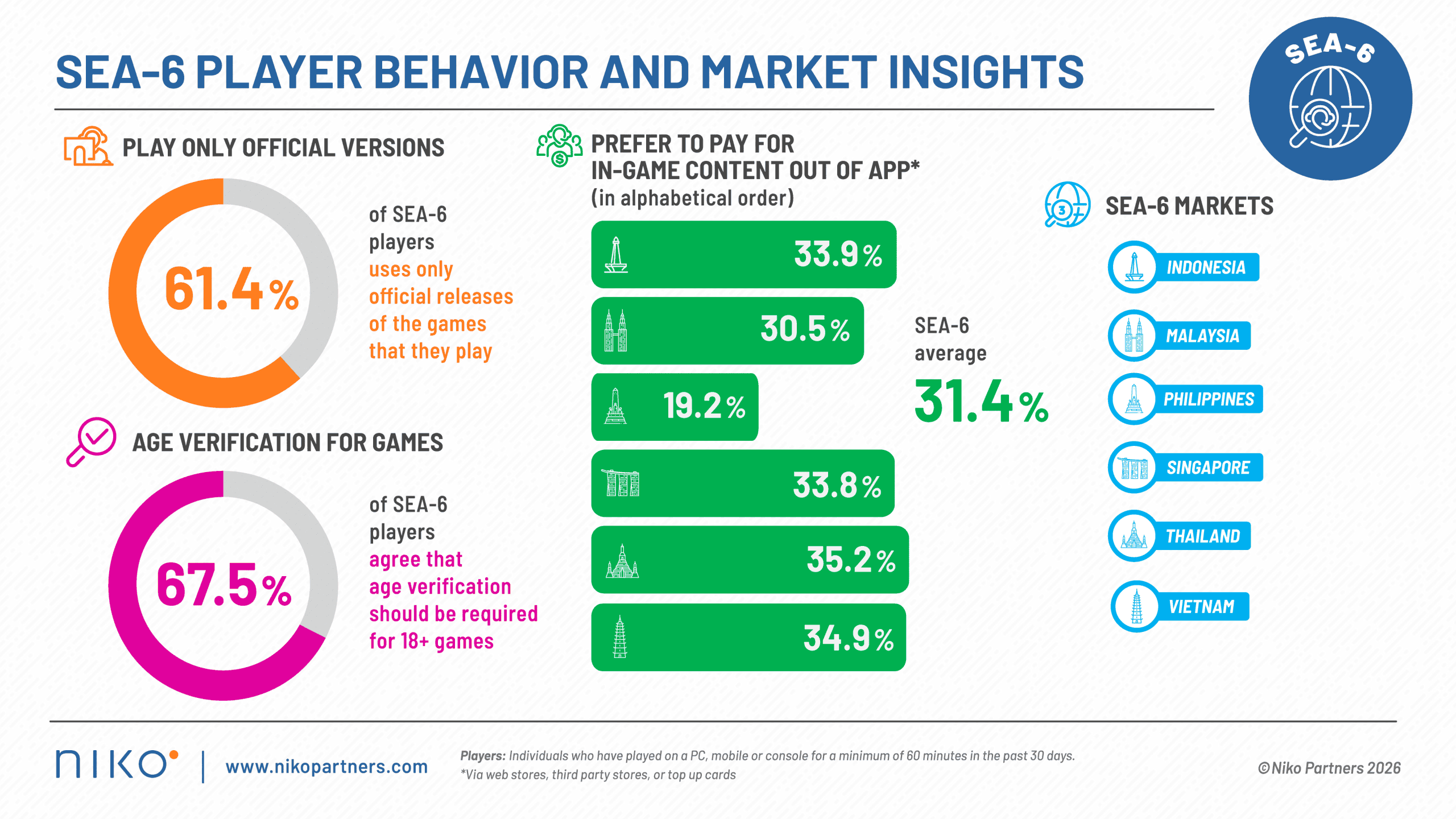
67.5% of players in the region support mandatory age verification for games rated 18+.
61.4% of players only launch the official version of a game. Piracy still exists in the region, and it remains large.
Nearly a third of players in Southeast Asia prefer to buy in-game content outside the usual storefronts. It is most pronounced in Thailand, where the share is above 35%.
❗️In last year’s report, Niko Partners said that 26.9% of in-game payments in the region go through third-party stores, the highest share in Asia.
Governments across the region are intervening in the gaming market more and more. Indonesia, for example, is introducing its own IGRS rating system, and in Vietnam, entering the local market requires a special license.