


The player behavior data comes from a survey. Niko Partners defines the players as people who spent at least 60 minutes gaming on PC, mobile, or console in the past 30 days.
The Market
In 2025, players in China spent $51.8 billion on games (+5.4% YoY). The country’s market crossed the $50 billion mark for the first time.
❗️Niko Partners has raised its estimate for the Chinese market several times. In September 2025, analysts expected $50.7 billion for the year and $54.8 billion by 2029. In November, the forecast was raised to $51.2 billion and $57.1 billion, respectively. In the end, 2025 closed at $51.8 billion. Niko Partners attributes this to strong results from both new releases and older evergreen titles.
In 2026, Niko Partners projects the market will grow 4% to $53.9 billion. By 2030, revenue should reach $59.8 billion, at a projected CAGR of 2.9%.
❗️Meanwhile, according to CADPA, China’s domestic market grew 12.17% YoY in H1’26, to 188.45 billion yuan (~$27.9 billion). Based on official data, the growth rate is 3 times higher than Niko Partners expects for full-year 2026. The two approaches use different methodologies: CADPA counts the revenue of Chinese platforms and developers based on official data, while Niko Partners models player spending.
ARPU in China exceeded $70 for the first time in 2025. By 2030, it should rise to $77.68. In last year’s report, ARPU for 2024 was $68.

Managing a distributed dev team shouldn’t mean managing a compliance headache. Mellow’s Contractor Management gives you ready-made contracts, IP compliance, and automated payouts for contractors in 150+ countries — for $35/month per contractor.
By 2030, China will have 769 million players, which makes it the world’s largest gaming market by this metric. A year ago, Niko Partners counted 722 million players at the end of 2024.
Trends
China’s 15th Five-Year Plan (2026-2030) supports the gaming industry as part of the country’s push for digital innovation and cultural industries. More game licenses are being issued in 2026 than in 2025. In the first 10 months of 2025, China issued 1,441 licenses (+24% YoY).
Chinese companies are actively adopting generative AI in content production, operations, and the games themselves. UGC is growing at the same time. Many successful live-service games in China are gradually becoming platforms where players create and share content.
Niko Partners expects publishers to take more payments outside the usual storefronts, improving their margins. Direct-to-consumer monetization of IP (in the form of merchandise, etc.) will also grow.
Spending on premium PC and console games is growing, for both domestic and international titles. Foreign companies can still enter the Chinese market through platforms like Steam.
Analysts also expect growth in niche genres aimed at underserved audiences.
Niko Partners analysts see the AI infrastructure boom as the market’s main problem, since it has driven up demand for memory and semiconductors. As a result, consumer electronics components are in short supply, and device prices are rising.
The Audience and Its Preferences
On average, players in China spend 15.8 hours a week gaming. In 2025, it was 14.1 hours.
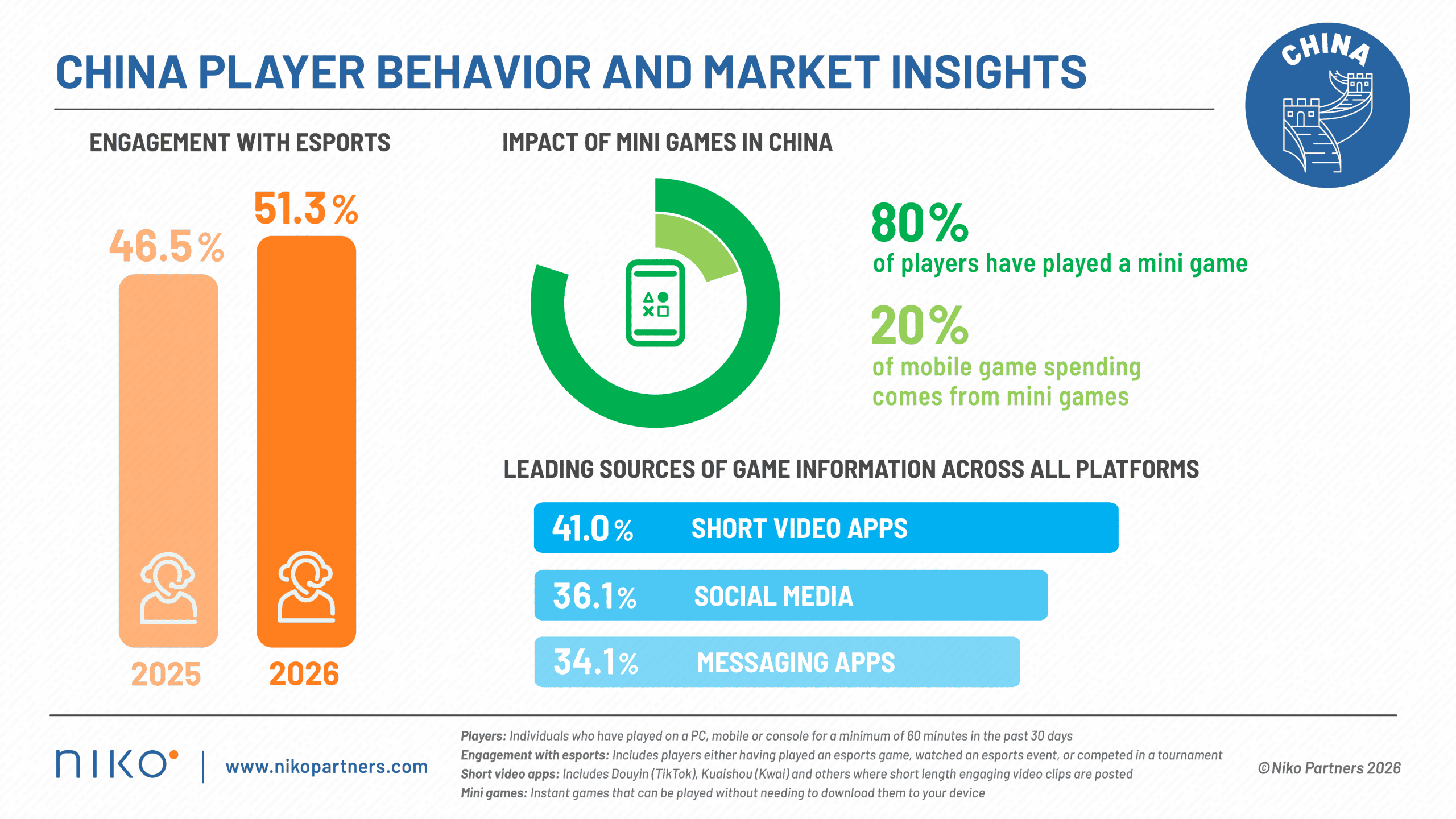
In 2026, 51.3% of players in China engage with esports in one way or another. A year ago, the share was 46.5%. Niko Partners counts as esports-engaged those who played esports games, watched tournaments, or competed in them.
80% of players in China have played mini games at least once. In last year’s report, the share was 84.4%.
Mini games, however, now account for nearly 20% of mobile game spending in the country. A year ago, Niko Partners put their share at ~10%, though of the whole market’s revenue, not just mobile. For comparison, according to CADPA, mini games earned 31.66 billion yuan (~$4.7 billion, +36.01% YoY) in H1’26, making them the fastest-growing segment of the Chinese market.
Short video apps like Douyin and Kuaishou are the main source of game information in China. 41% of players discover new games through them, and it is the #1 channel across all platforms: PC, mobile, and console. Social media (36.1%) and messaging apps (34.1%) follow. The short video share did not change over the year, while social media grew from 33.9%.
66% of players in China access games beyond the Great Firewall in one way or another. 33.6% use so-called “boosters” (gaming accelerators), 30.8% play on global servers, and 21.9% use a VPN.
The main reasons players in China quit games are poor balance (37.2%), cheaters and hacks (35.3%), and bugs (31%).