


Reports of the week:
game: The German Games Industry in 2026
Adjust & Sensor Tower: Japan’s Mobile Market in 2026
game: The German Games Industry in 2026
The German association game has published its annual industry report. I covered the 2025 market figures in April, so this time it focuses more on the audience, the state of the industry, and Gamescom.
Market and audience data comes from a YouGov Shopper survey of 25,000 people, along with data from Sensor Tower, Nielsen IQ, and GSD. Company and employment figures come from the gamesmap.de database as of 31 March 2026.
Audience
Germany has 41.2 million players, or roughly 6 in 10 residents aged 6 to 69.
❗️This year, game counted everyone living in Germany for the first time, regardless of citizenship. Last year’s report had 37.5 million players, so the increase here comes from the methodology change, not from real growth.
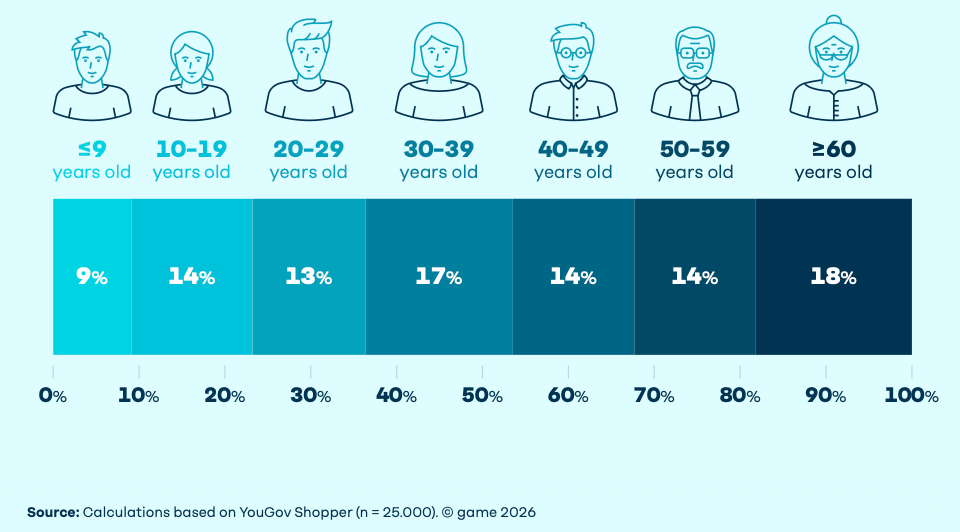
The average player in the country is 38.3 years old. Last year’s report put that figure at 39.5. 79% of players are over 18, and the largest age group is people over 60, who account for 18% of all players.
Male and female gamers in Germany are almost evenly split: 54% against 46%.
A word from our sponsor

Need a freelance 3D artist, composer, or QA tester fast? Mellow’s AI Scout finds qualified talent in under 48 hours — free to try, no commitment. Describe the role, get a shortlist, hire when you’re ready.
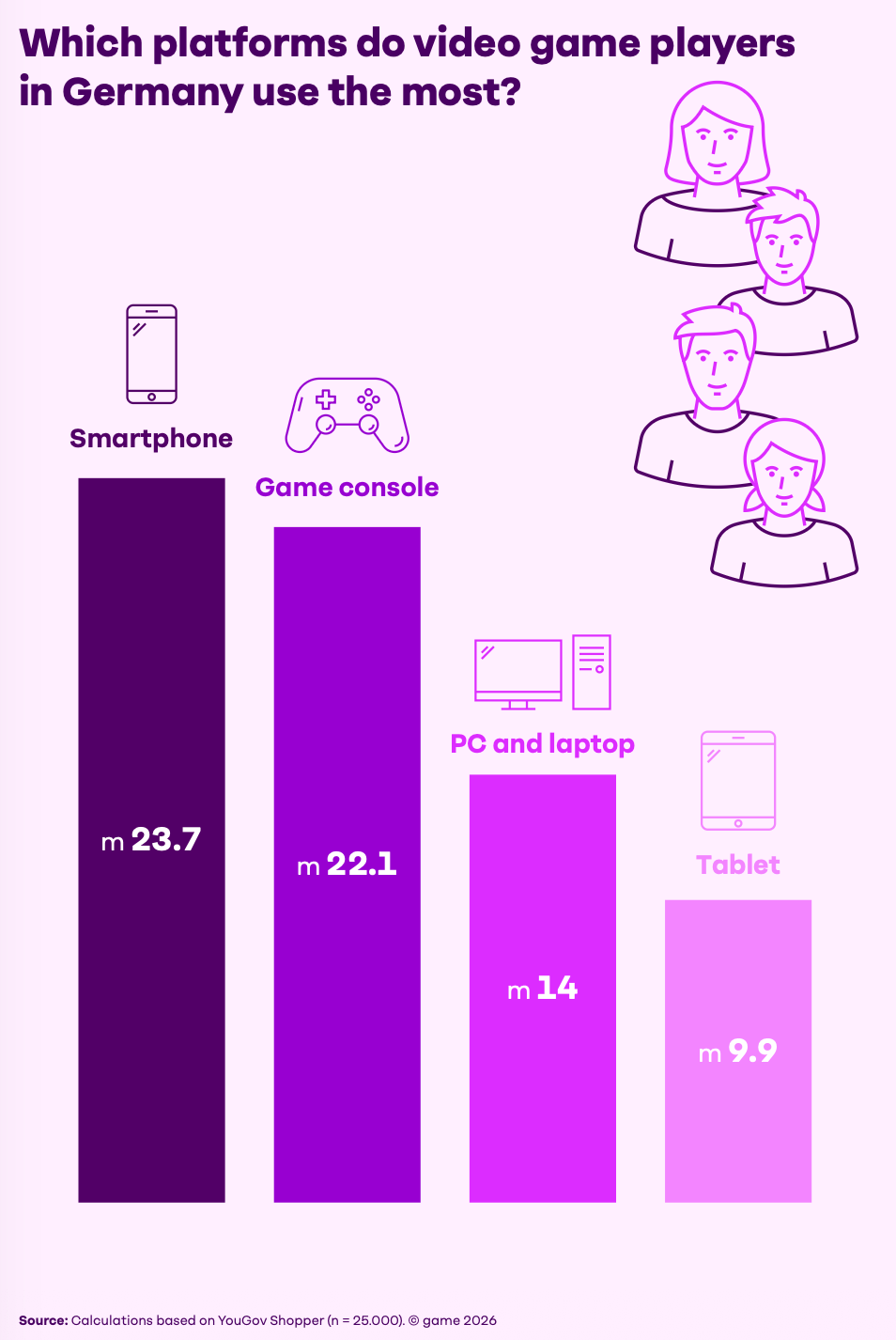
23.7 million people play on smartphones, the most widely used platform in Germany. Consoles have 22.1 million players, PCs and laptops 14 million, and tablets 9.9 million. Around 19 million people play on two or more devices.
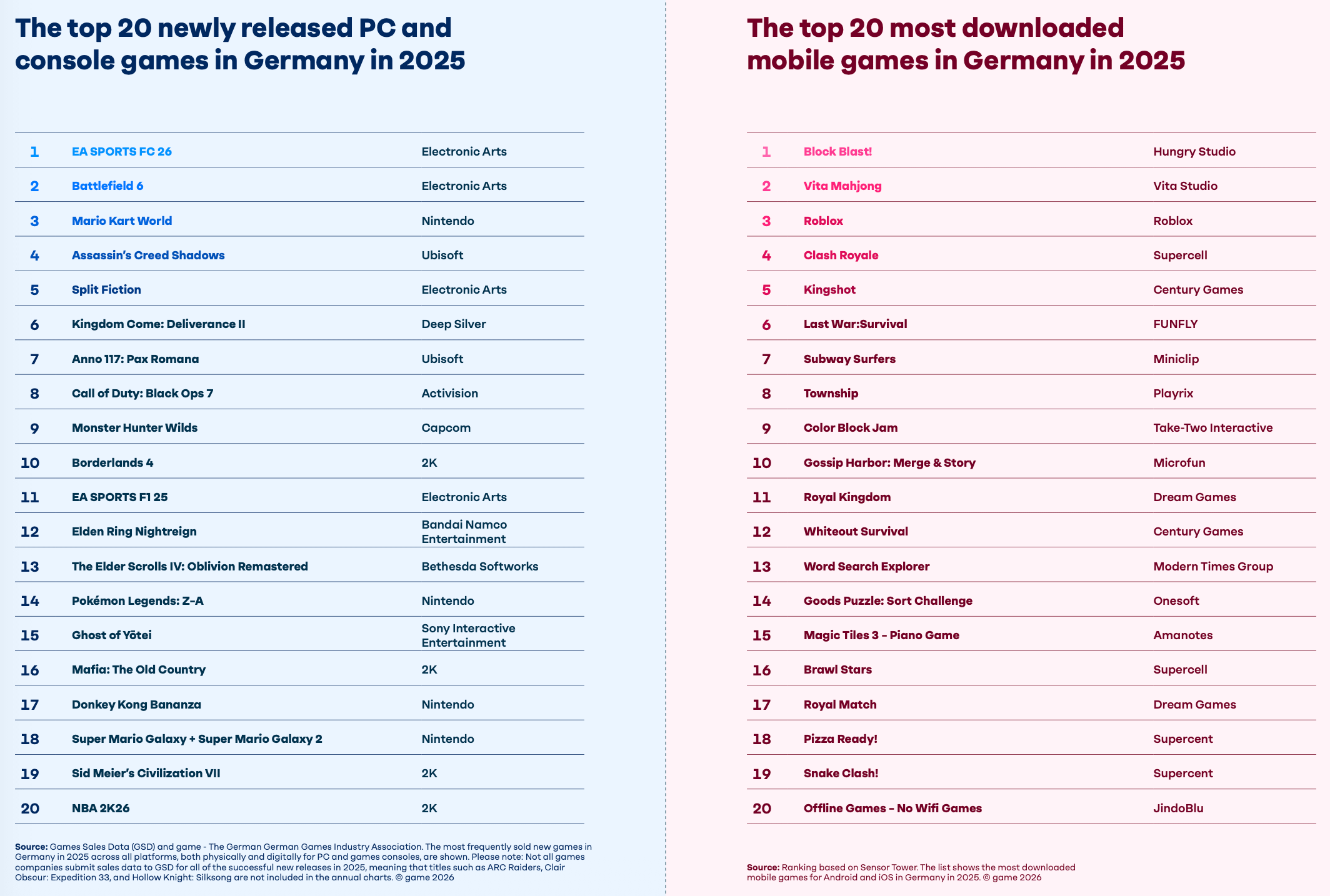
The best-selling new releases of 2025 on PC and console: EA SPORTS FC 26, Battlefield 6, and Mario Kart World. In mobile downloads, Block Blast!, Vita Mahjong, and Roblox lead.
❗️The GSD charts only count companies that submit their data. That is why the list is missing ARC Raiders, Clair Obscur: Expedition 33, and Hollow Knight: Silksong, among others.
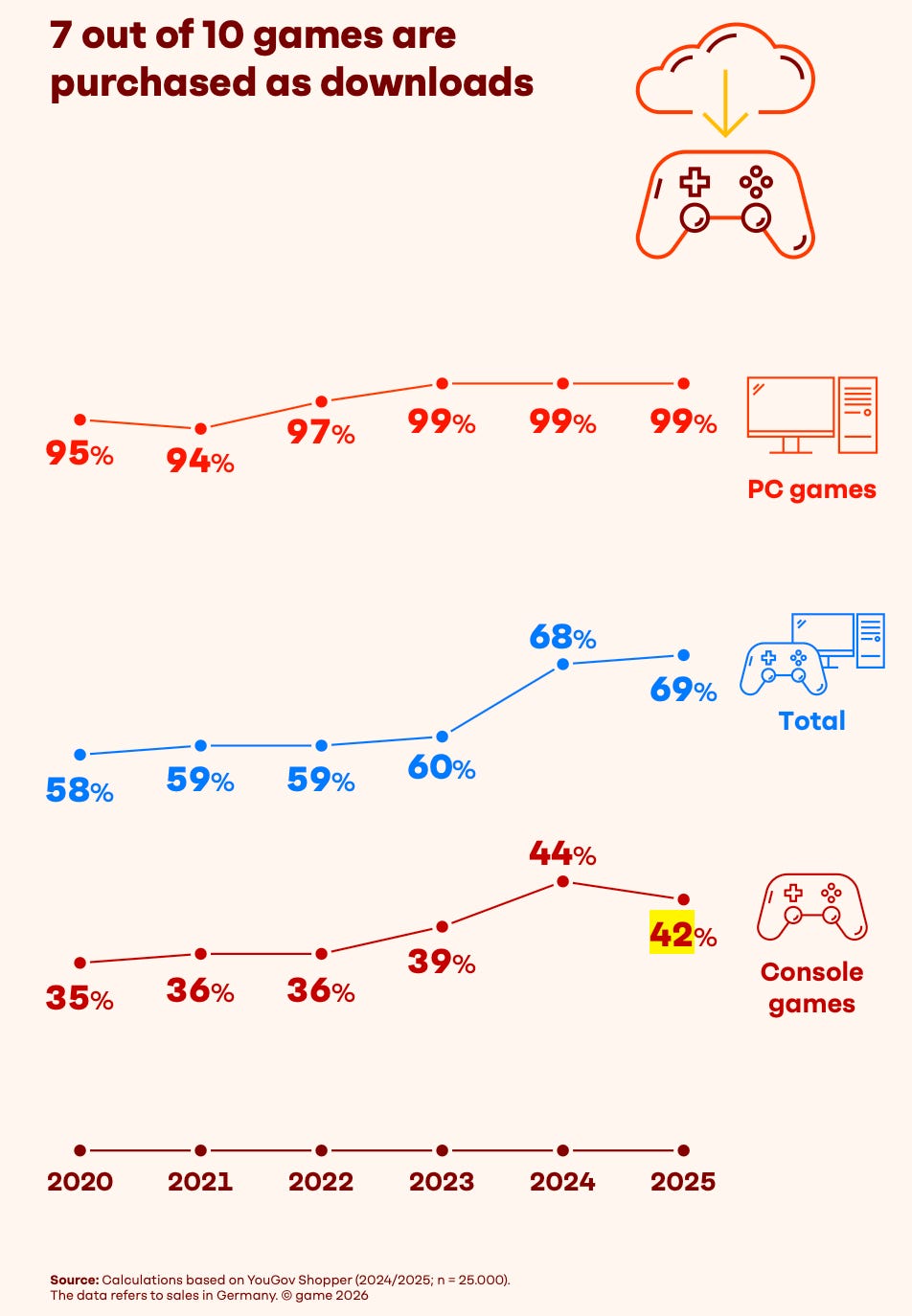
Digital copies accounted for 69% of all game purchases in the country, slightly up from 68% a year earlier. On PC, digital is almost the only option (99%), while on console, only 42% of purchases are digital.
Players aged 20-29 buy digital copies most often (82%), while those aged 40 to 59 buy them least often (60%).
The market
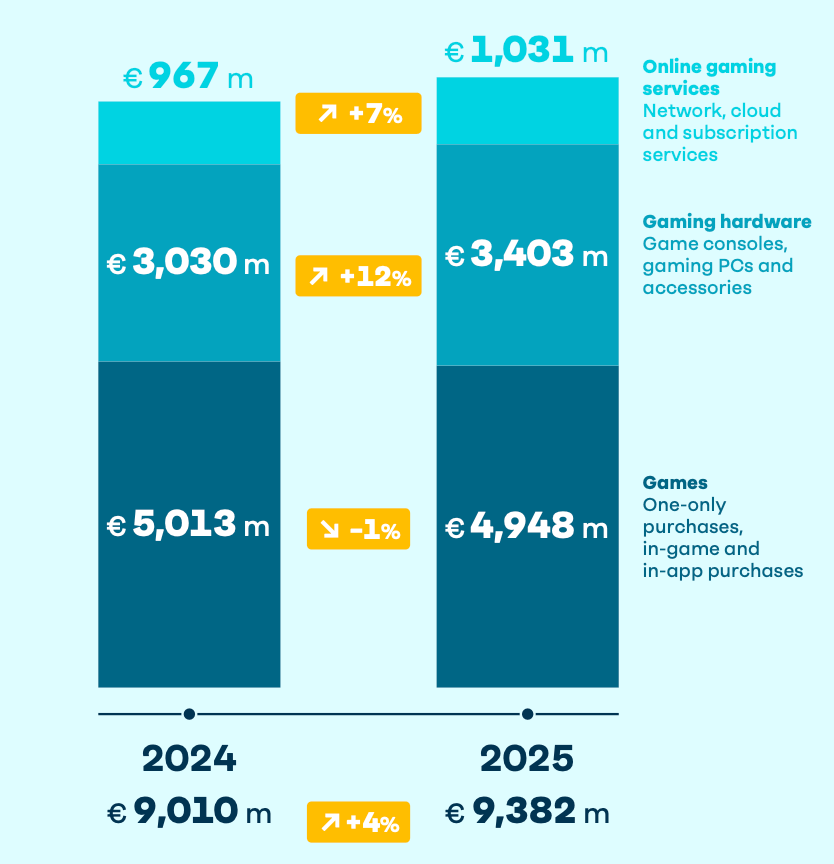
The German games market grew 4% in 2025, to €9.382 billion. Germany remains Europe's largest market and the world's fifth-largest.
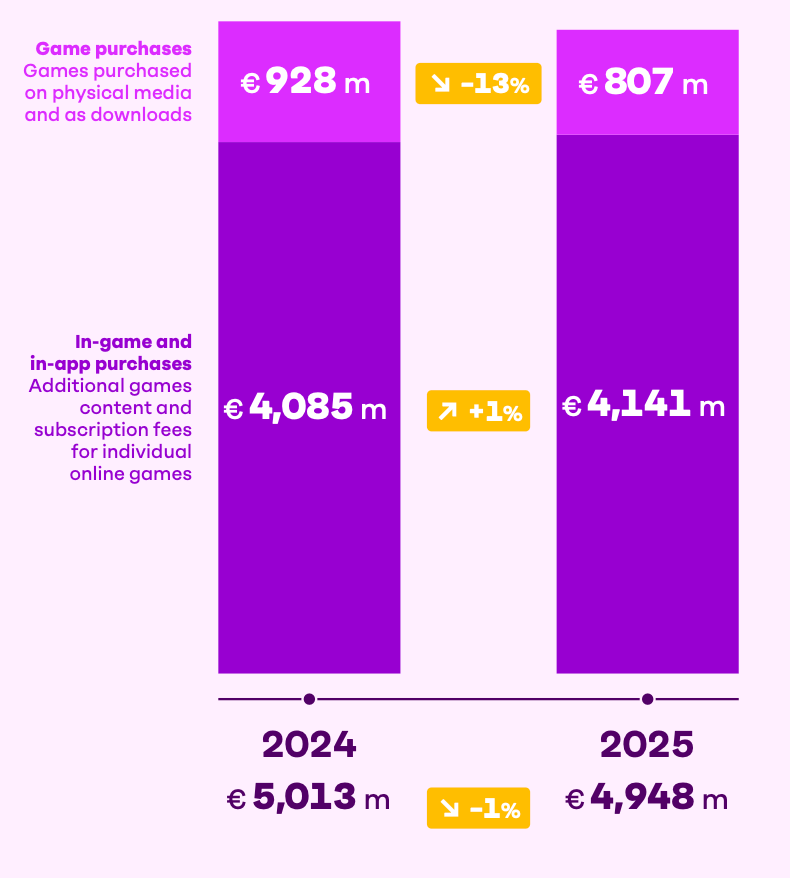
Revenue from game sales and in-game purchases declined 1%, to €4.948 billion. The growth came from hardware sales (€3.403 billion, +12%) and online gaming services (€1.031 billion, +7%). Game sales fell 13%, to €807 million.
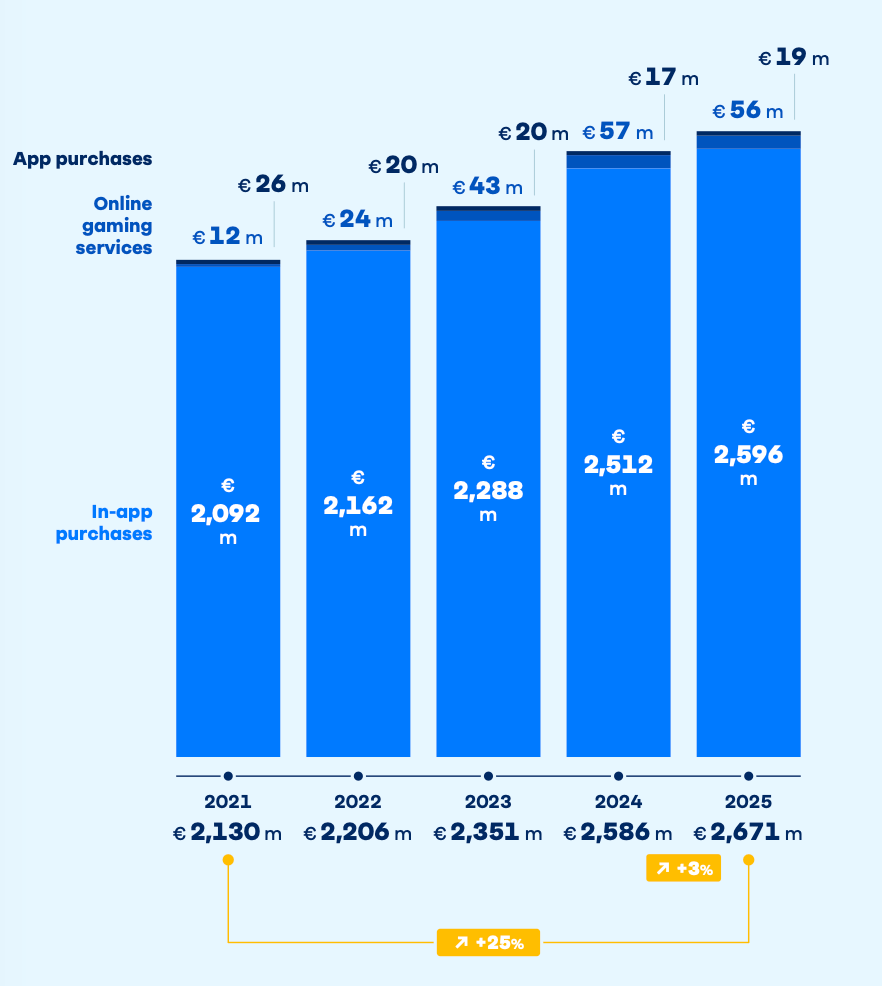
Mobile games earned €2.671 billion in the country (+3% YoY), and 97% of that came from in-app purchases.
Players spent €1.847 billion on consoles and €1.465 billion on PC.
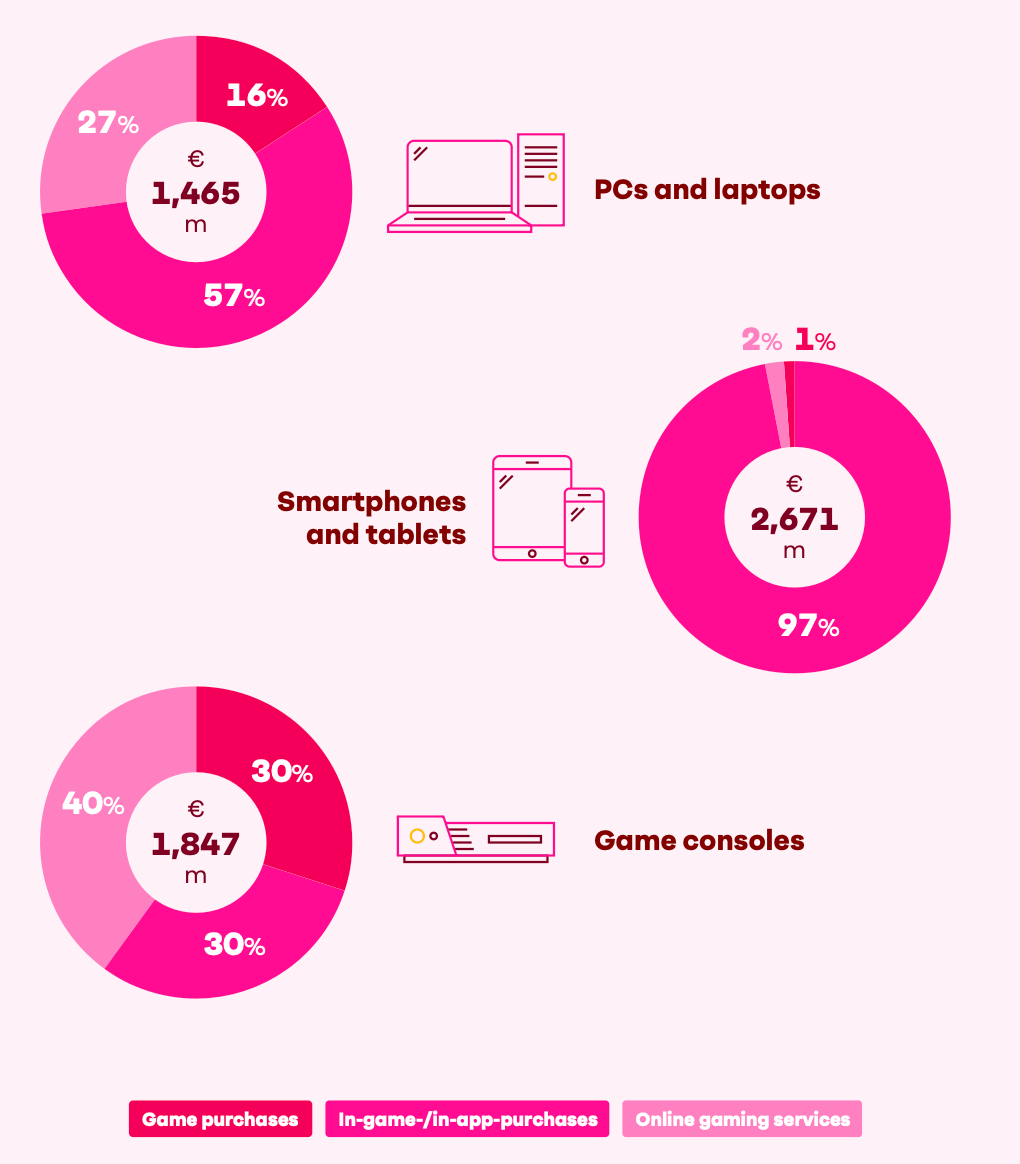
The revenue mix differs a lot by platform. On console, 40% of revenue comes from online gaming services, with another 30% each from game sales and in-game purchases. On PC, 57% of revenue comes from in-game purchases.
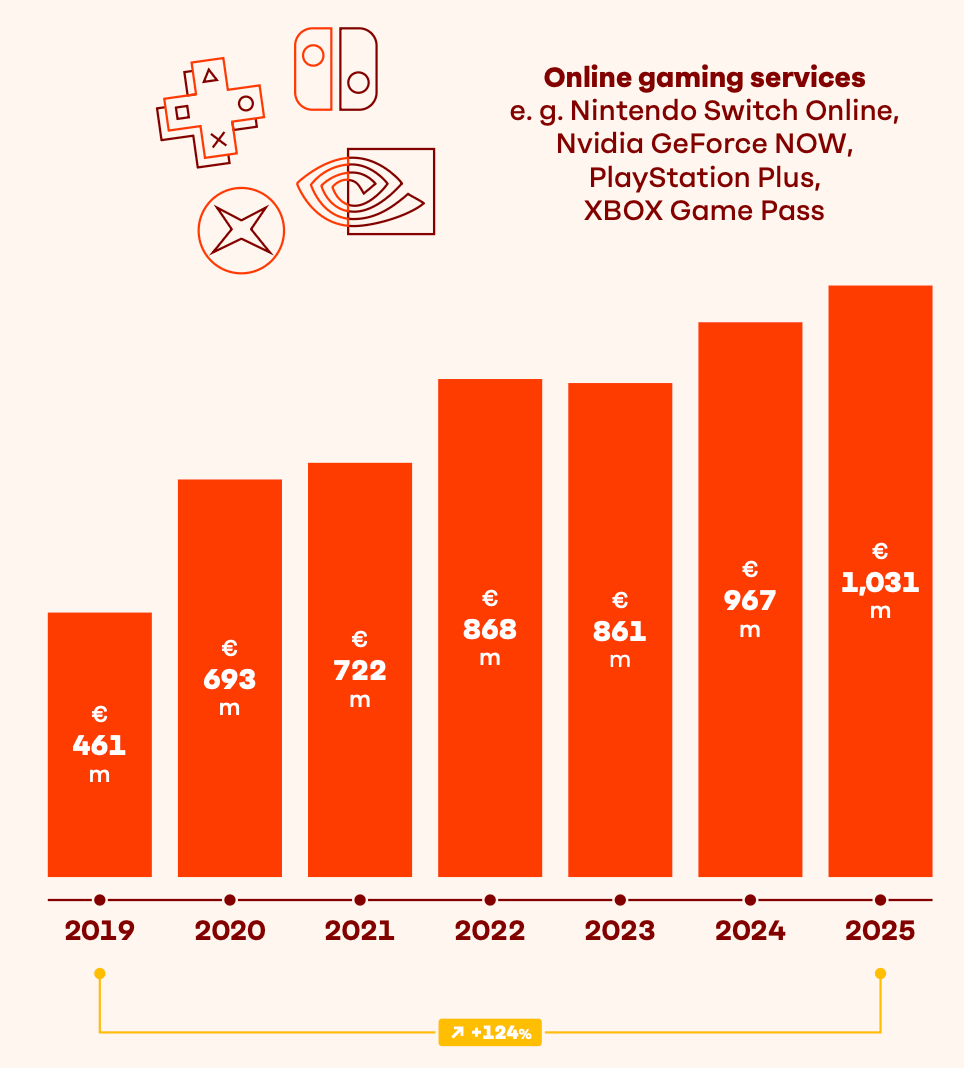
Online gaming services have grown steadily for several years now, and the segment reached €1.031 billion in 2025.
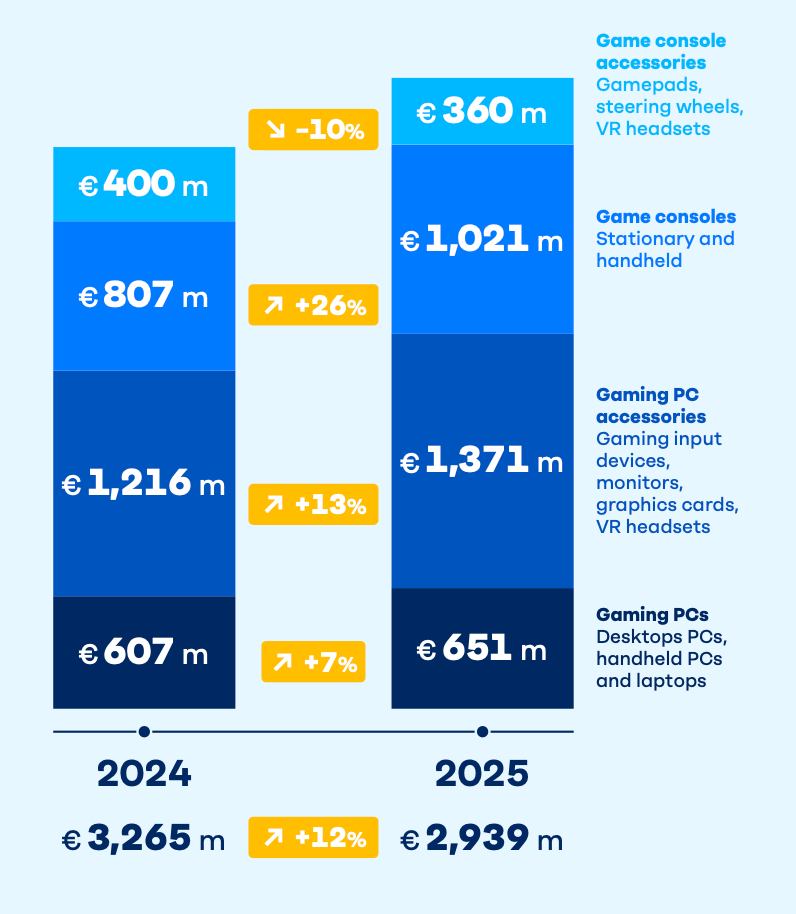
On hardware, growth in 2025 came from game consoles (+26% YoY, €1.021 billion), gaming accessories (+13% YoY, €1.371 billion), and gaming PCs (+7% YoY, €651 million).
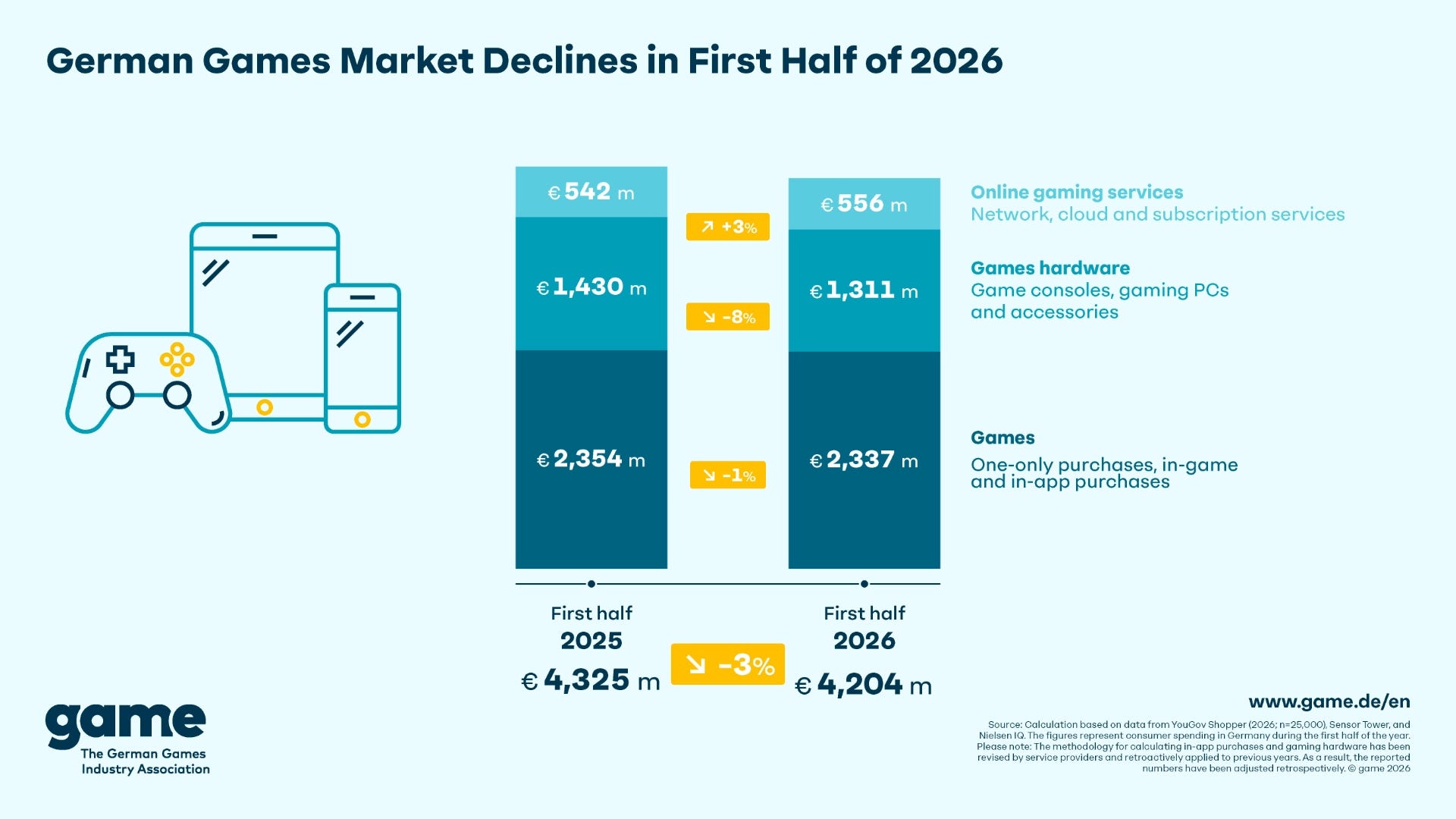
H1’26, however, closed down in Germany: €4.2 billion (-3% YoY). Game sales were €2.3 billion (-1%), hardware €1.3 billion (-8%), and online gaming services €556 million (+3%).
The industry
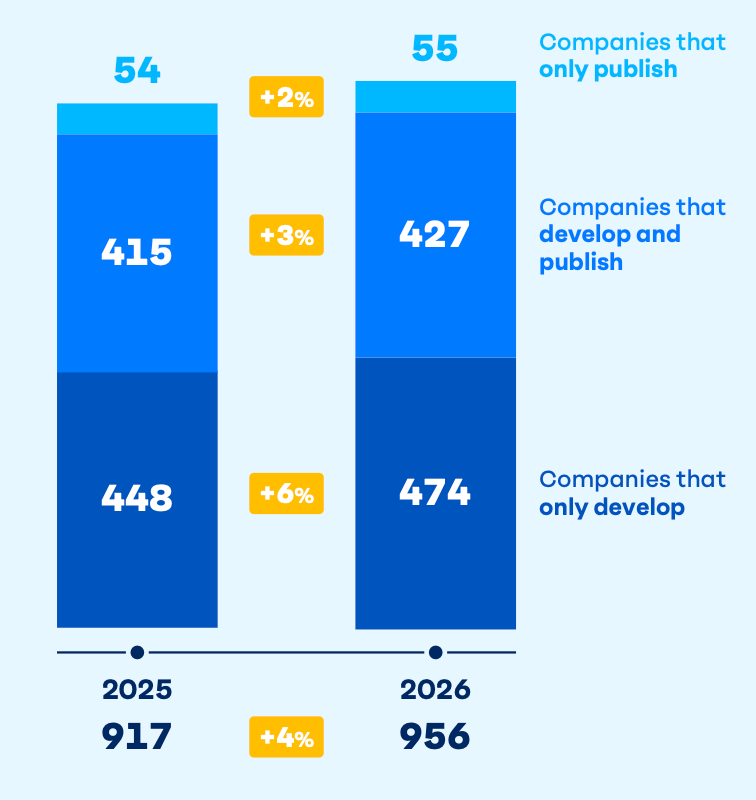
As of 2026, Germany has 956 game companies (+4% YoY). Of those, 474 develop only games (+6%), 427 develop and publish (+3%), and 55 publish only (+2%). The number of companies in the country fell last year for the first time since 2020, but in 2026 it started growing again.
Headcount at developers and publishers, by contrast, is down: 12,235 people against 12,659 in 2025 (-3% YoY). Overall, the games industry supports more than 30,000 jobs in the country, including education, media, the public sector, and retail.
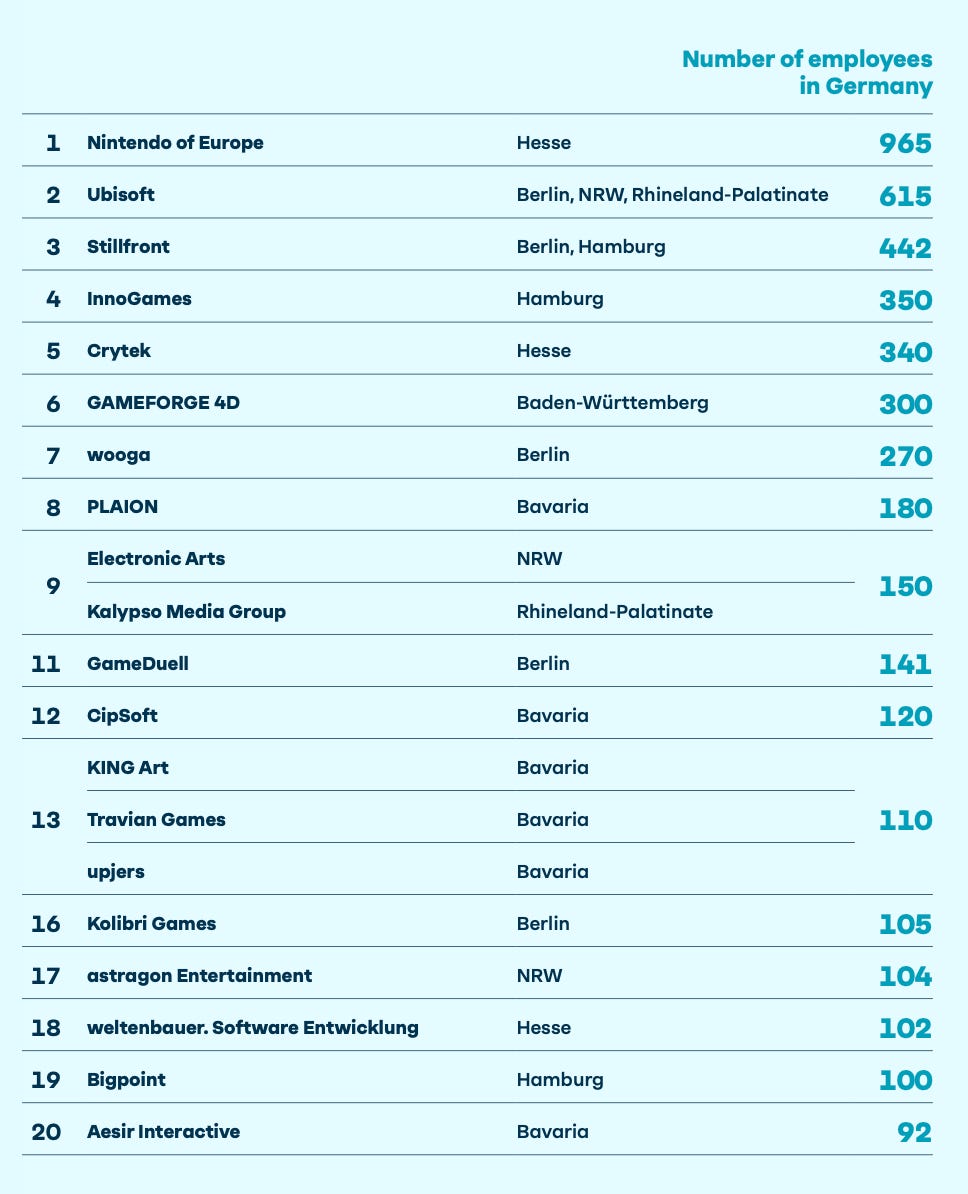
The largest employers in the German industry: Nintendo of Europe (965 people), Ubisoft (615), and Stillfront (442). Next come InnoGames (350) and Crytek (340).
Out of every €100 spent on games in Germany, only €5.50 goes to German companies.
State funding for games rose to €88 million in 2025, and from 2026 it will be €125 million a year. Before that, the program was frozen several times, and applications for projects longer than a year were not possible.
There is also a separate program, Press Start: Games Founding Grant. All 132 of its participants went on to register a company, and 75 new studios appeared in the country in total.
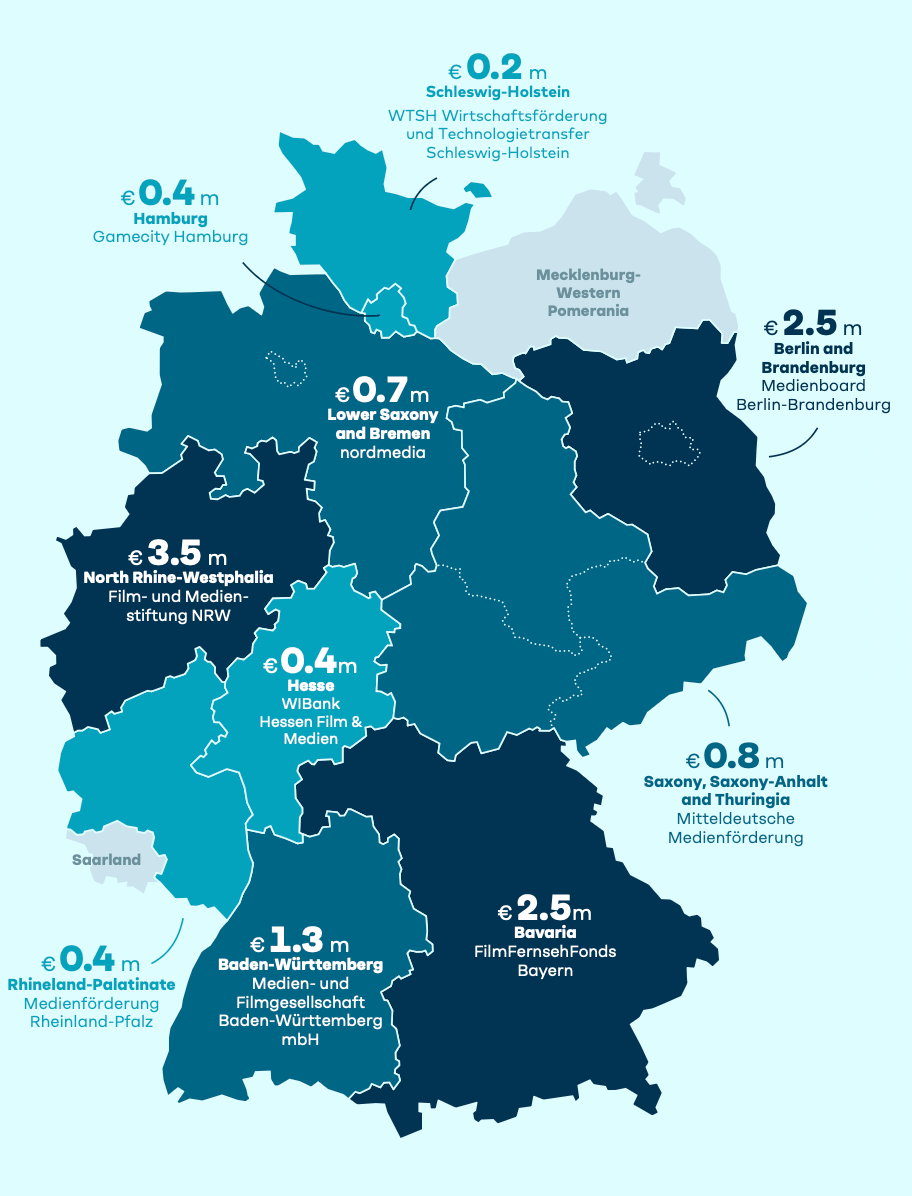
Regional funds hand out noticeably less. North Rhine-Westphalia gives the most (€3.5 million), followed by Berlin and Brandenburg (€2.5 million) and Bavaria (€2.5 million).
Sentiment, meanwhile, is improving. 29% of German companies expect the industry to develop in 2026, up from 17% a year ago. 31% take a negative view of the industry, against 45% a year earlier. Respondents worry less about their own business: 53% expect a good year and only 12% a bad one.
That said, 32% of companies plan to hire, exactly the same share as a year ago.
The main German Computer Game Awards 2026 prize went to The Darkest Files by Paintbucket Games, a game about a prosecutor bringing Nazi criminals to trial. Across 15 categories, 800,000 euros in prize money was handed out.
gamescom
gamescom 2025 drew 357,000 visitors from 128 countries and 1,568 exhibitors from 72 countries, across 233,000 square meters. Each figure is a record.
More than 34,000 trade visitors attended. The strongest growth came from the US, China, Canada, and Japan.
Opening Night Live was watched 91 million times (+50% YoY). All gamescom video formats together drew more than 1.1 billion views (+101% YoY).
devcom, renamed gamescom dev in October 2025, gathered 5,400 participants from 89 countries and representatives of more than 2,500 companies.
A word from our sponsor
Need a freelance 3D artist, composer, or QA tester fast? Mellow’s AI Scout finds qualified talent in under 48 hours — free to try, no commitment. Describe the role, get a shortlist, hire when you’re ready.
The satellite events are growing too. gamescom latam in São Paulo drew 154,000 people (+17.5% YoY), and gamescom asia x Thailand Game Show in Bangkok more than 200,000.
For gamescom 2026, the association published a survey on how games are perceived in Germany. 85% of respondents believe games strengthen a sense of community, 83% that they build tolerance, and 77% that they help develop democratic thinking.
17 million people in Germany play indie games. 82% of players say they admire what small teams do. What they value most in indies is creative gameplay (73%), story (68%), and visual style (65%).
Ratings
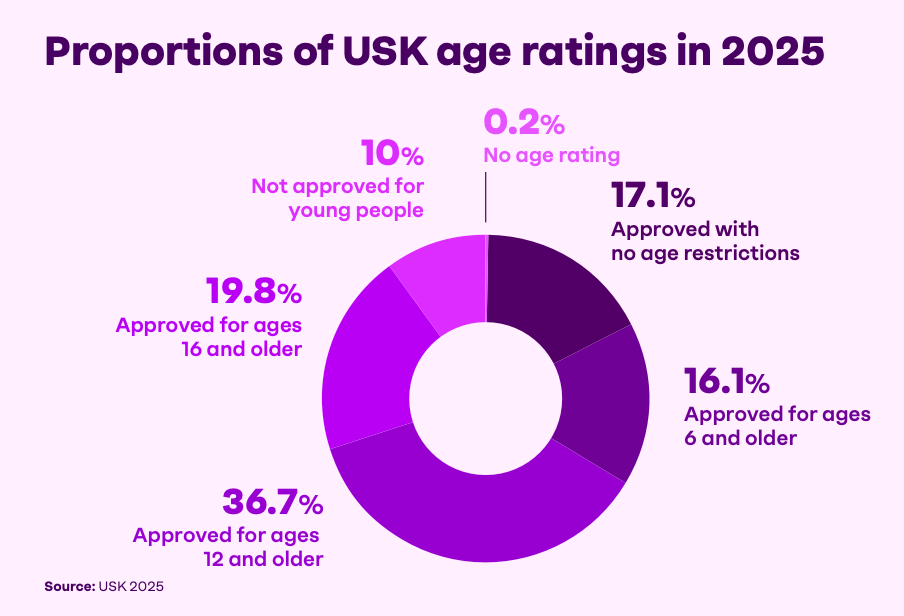
Since 1994, the USK has issued more than 58,000 age ratings. In 2025, 17.1% of games were approved with no age restrictions, 16.1% got a 6+ rating, 36.7% a 12+, 19.8% a 16+, and 10% an 18+.
In almost 30% of the games it reviewed, the USK found usage risks: chat functions, in-game purchases, and gambling-like mechanics. In roughly a third of those cases, it raised the age rating.
Adjust & Sensor Tower: Japan’s Mobile Market in 2026
Adjust and Sensor Tower have released their annual report on Japan’s app market. It covers four verticals: games, finance, entertainment, and manga (comics).
I will focus on games, but I will also cover the other segments in broad strokes.
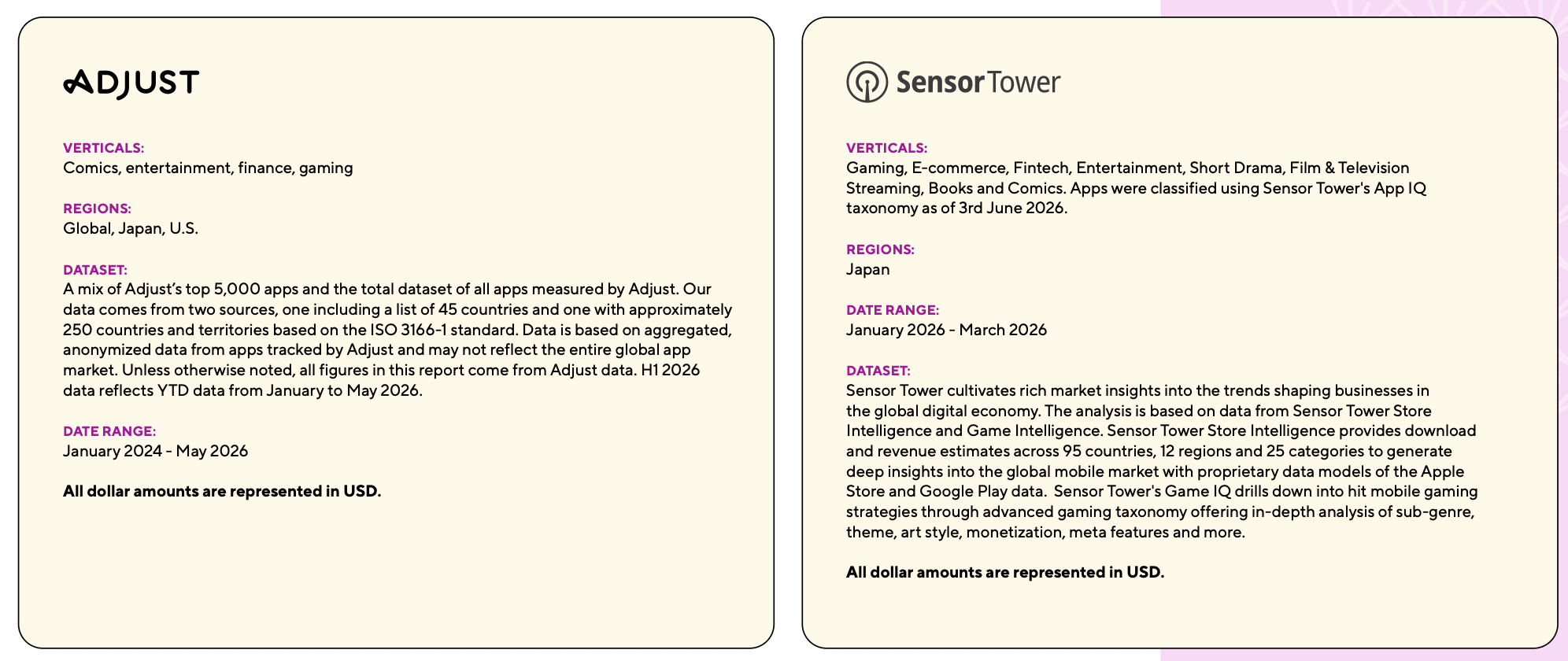
Adjust’s data covers the top 5,000 apps from January 2024 to May 2026. H1 2026 in the report runs from January to May, not a full six months. The charts and market estimates come from Sensor Tower, for January-March 2026.
The app market
In 2025, Japan downloaded 2.65 billion apps and spent 114 billion hours in them.
Smartphone penetration is around 85%, and iOS share is 67-68%, one of the highest of any major market.
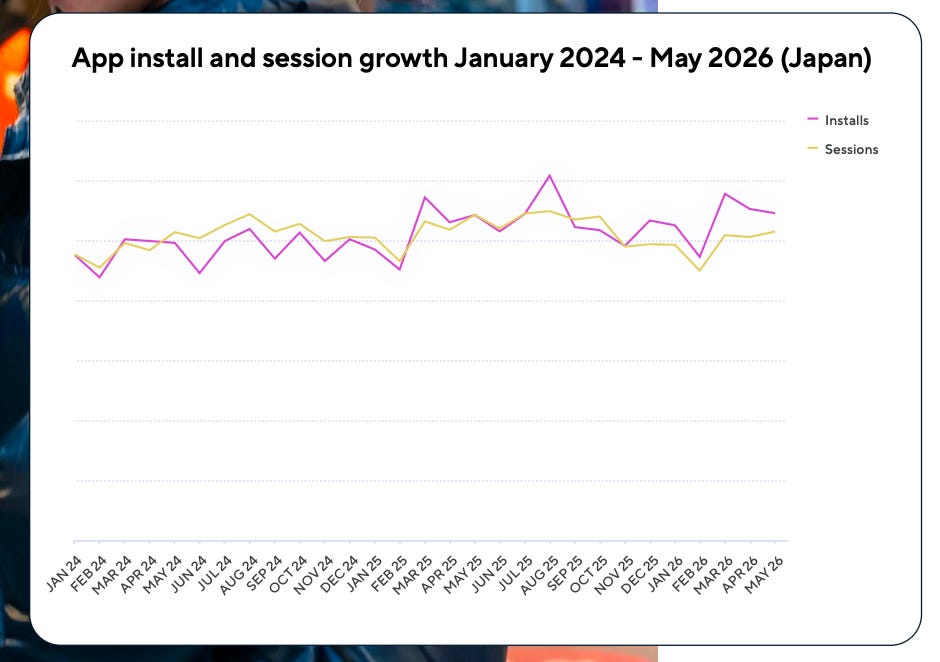
App installs grew 4% YoY in H1’26, with March as the peak month. Growth was stronger in 2025: +8% in installs and +3% in sessions.
Mobile games accounted for $10.6 billion of that IAP revenue and 16.58 billion hours, according to Sensor Tower. Last autumn, Sensor Tower put the Japanese market at $11 billion for the 12 months from August 2024 to July 2025.
The top apps by downloads in Q1’26: ChatGPT, TikTok, and Google Gemini. By revenue, the top two spots go to manga services ピッコマ and LINEマンガ, with Google One third.
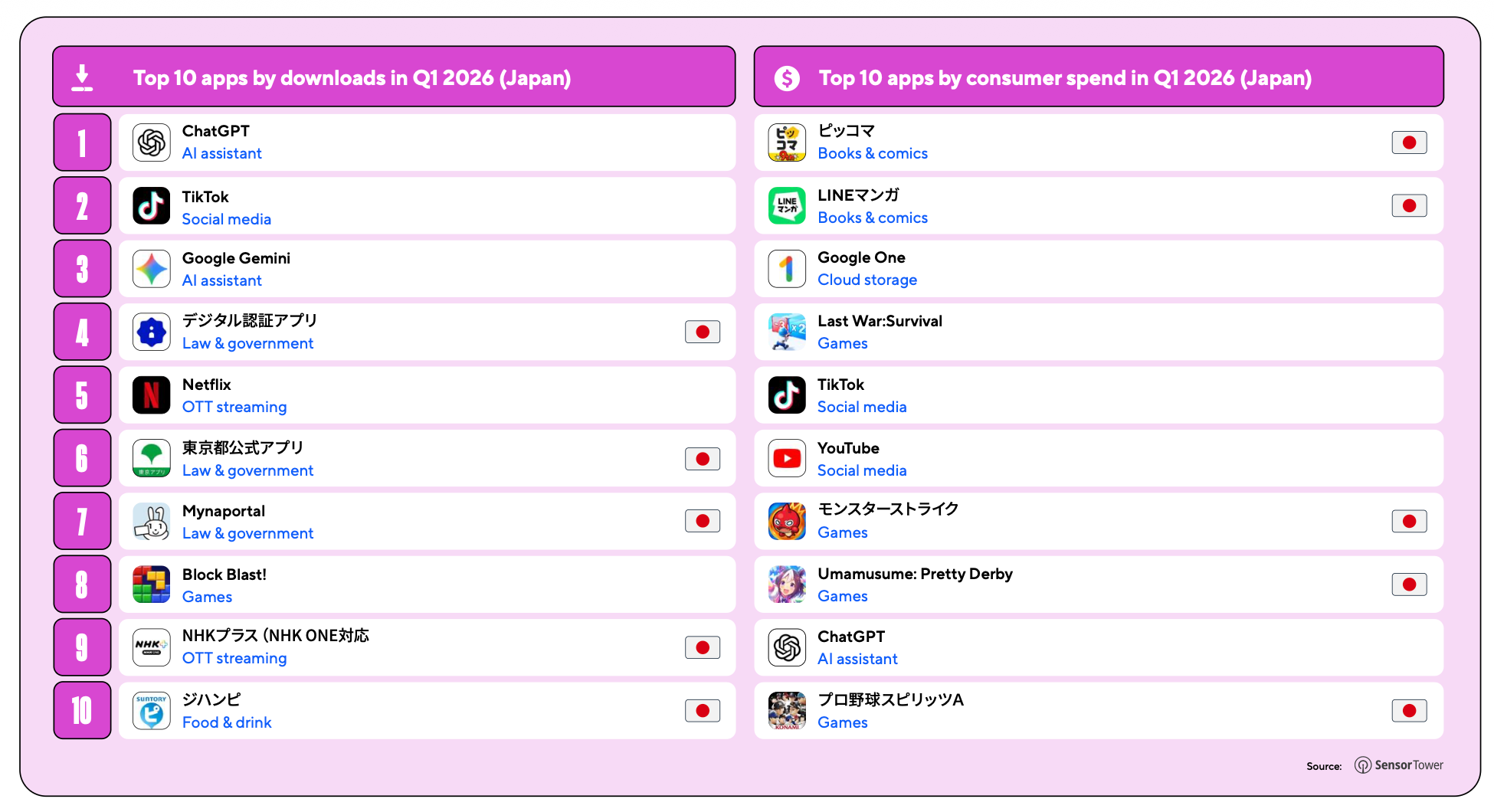
There are now four games in the top 10 by consumer spend: Last War: Survival (4th), モンスターストライク (7th), Umamusume: Pretty Derby (8th), and プロ野球スピリッツA (10th). In the 2024 edition of the report, that same chart had 8 games out of 10.
Games
Mobile game installs in Japan grew 3% YoY in H1’26, and sessions grew 5%.
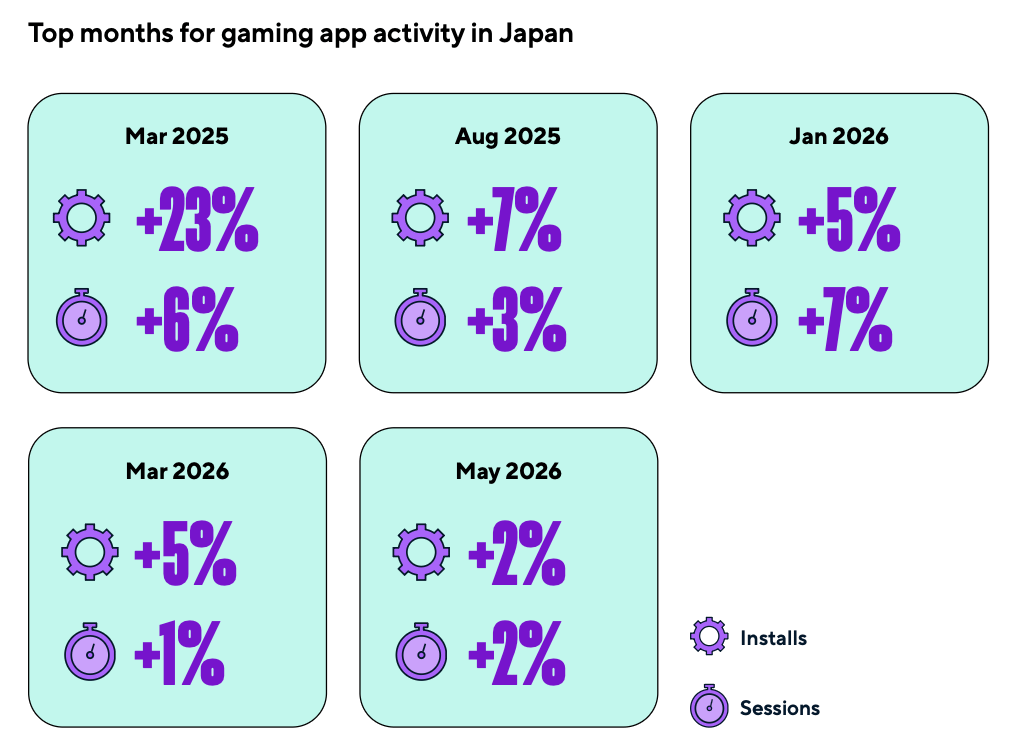
The best months across the two years, relative to the yearly average, were March 2025 (+23% in installs, +6% in sessions), August 2025 (+7% and +3%), and January 2026 (+5% and +7%).
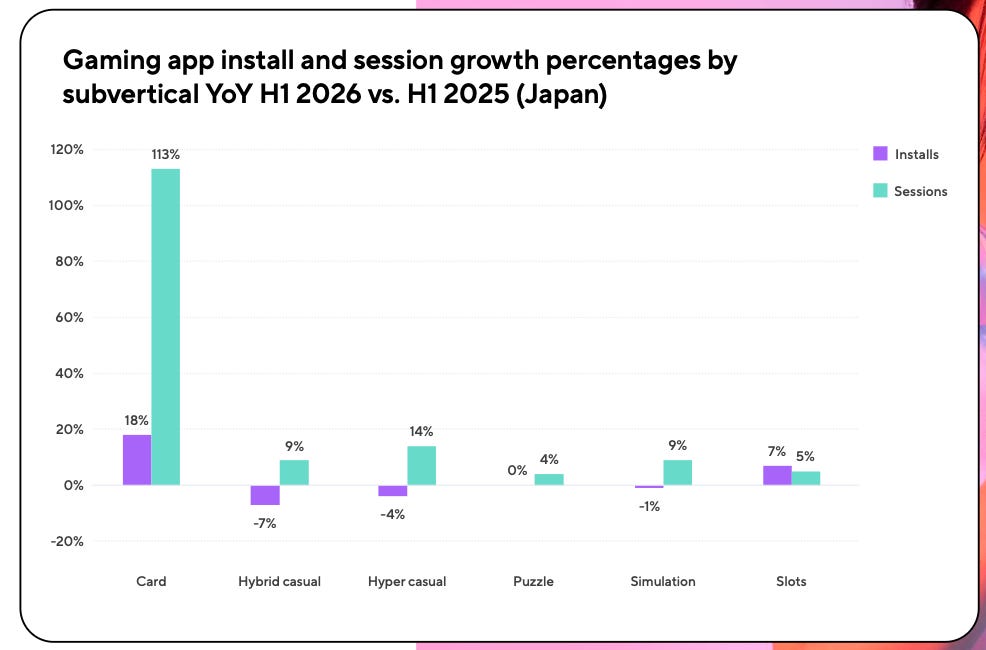
Card games grew fastest in H1’26: installs rose 18% YoY and sessions 113%. Slots grew 7% in installs and 5% in sessions YoY.
In the other genres, session counts rose while installs fell. Hyper casual was -4% in installs and +14% in sessions; hybrid casual was -7% and +9%; and simulation was -1% and +9%.
❗️Last autumn, Sensor Tower wrote that the card battler segment in Japan grew 305% YoY, largely thanks to Pokémon TCG Pocket. Sessions and installs appear to have caught up with the revenue.
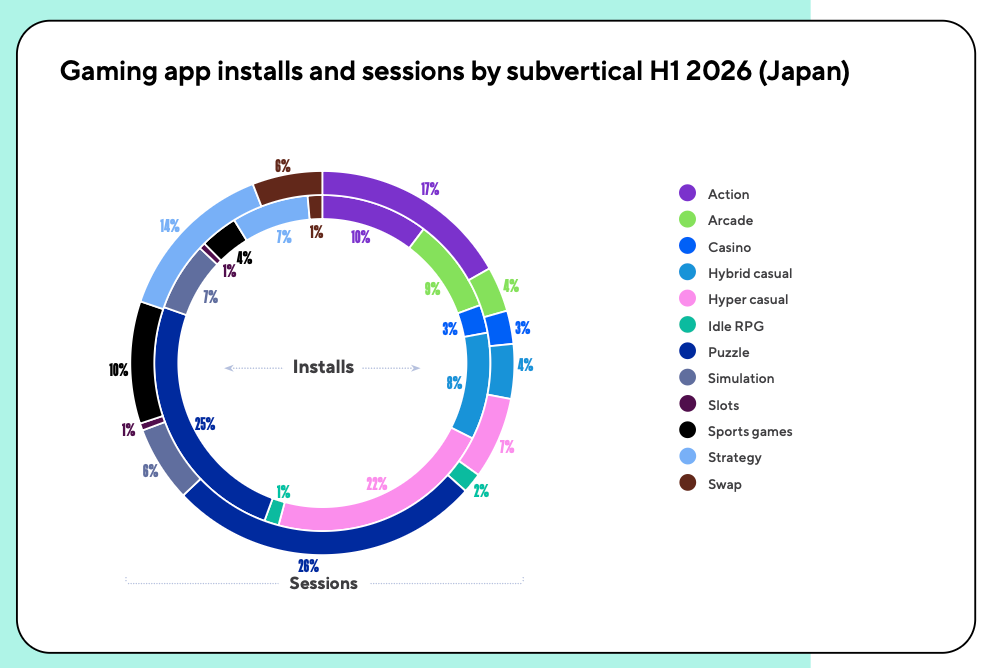
Puzzle (25%) and hyper casual (22%) lead the country in install share. Puzzle also comes first in sessions at 26%, while hyper casual accounts for just 7%.
The widest gap between sessions and installs is in sports games: 4% vs. 10%.
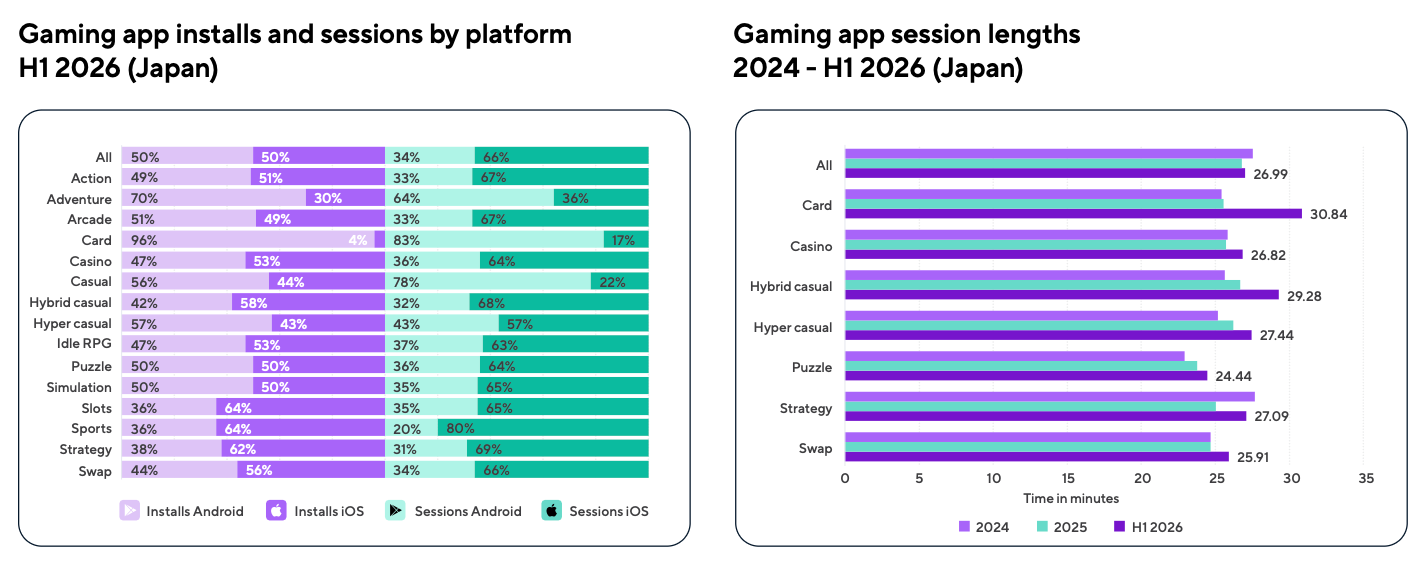
On installs, iOS and Android are broadly even, but iOS accounts for 66% of sessions.
The average game session length is 26.99 minutes (+1% vs. 2025). Card games gained the most: 30.84 minutes, 21% more than a year earlier. Hybrid casual grew 10% (29.28 minutes), and strategy grew 8% (27.09 minutes).
On install day in Q1’26, there were 1.85 sessions per user, against 1.81 in 2025 and 1.76 in 2024. Idle RPG leads with 2.08, followed by strategy (1.98) and puzzle (1.93).
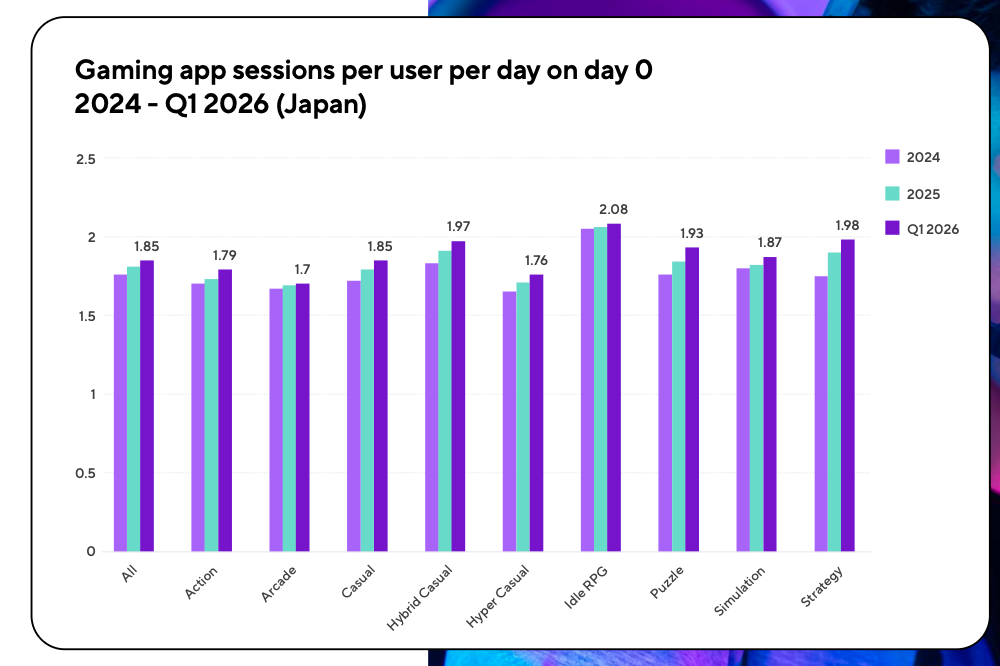
❗️In Adjust’s April report, the global average for day 0 sessions was 1.65; Japan leads the world on this metric.
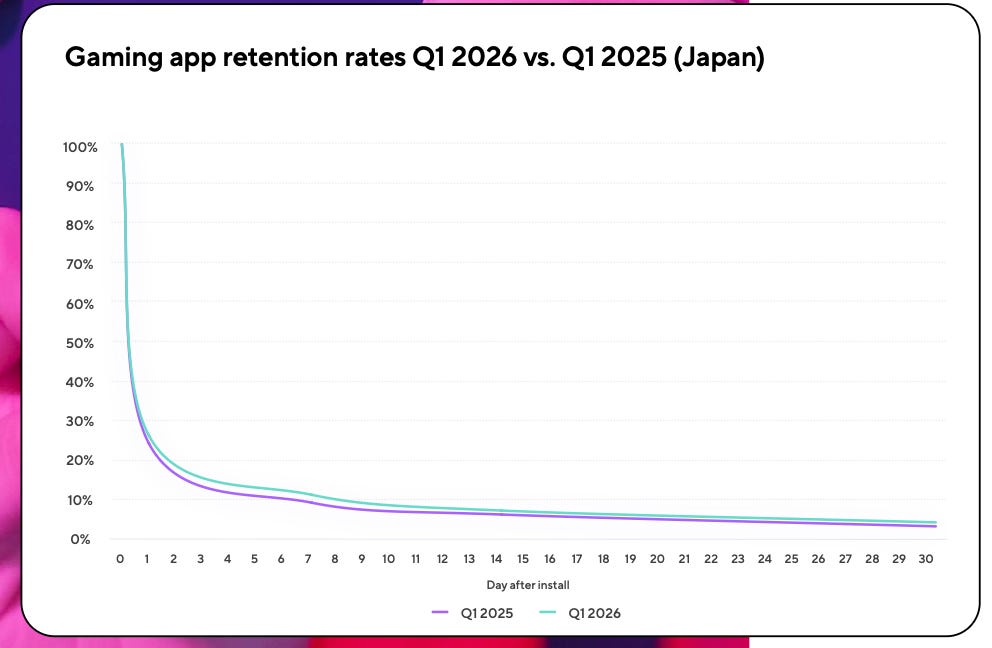
Retention grew across every day measured. D1 Retention in Q1’26 was 26% against 24% in Q1’25, D7 was 11% against 9%, D14 7% against 6%, and D30 4% against 3%.
❗️But the return numbers still fall short of past years. In 2024, Adjust reported 27% D1 Retention for Japan in Q1’24 and 28% for 2023.
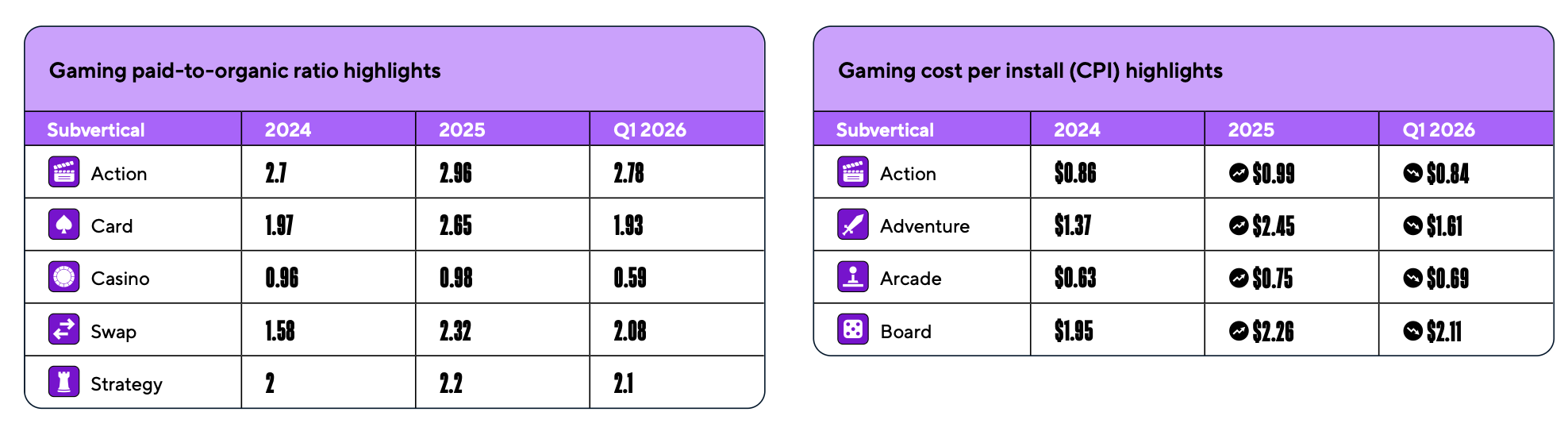
The paid-to-organic ratio fell in Q1’26 across every subvertical Adjust measures. Action was at 2.78 in Q1’26 against 2.96 in 2025, card games at 1.93 against 2.65, casino at 0.59 against 0.98, Swap at 2.08 against 2.32, and strategy at 2.1 against 2.2.
CPI fell as well. Cost per install in action was $0.84 in Q1’26 against $0.99 in 2025, in adventure games $1.61 against $2.45, in arcade $0.69 against $0.75, and in board games $2.11 against $2.26.
❗️Adjust’s global April report shows the exact opposite. The worldwide median paid-to-organic ratio rose from 2.07 to 3.33, CPI grew 30% to $0.56, and in APAC the share of paid installs grew 45%.
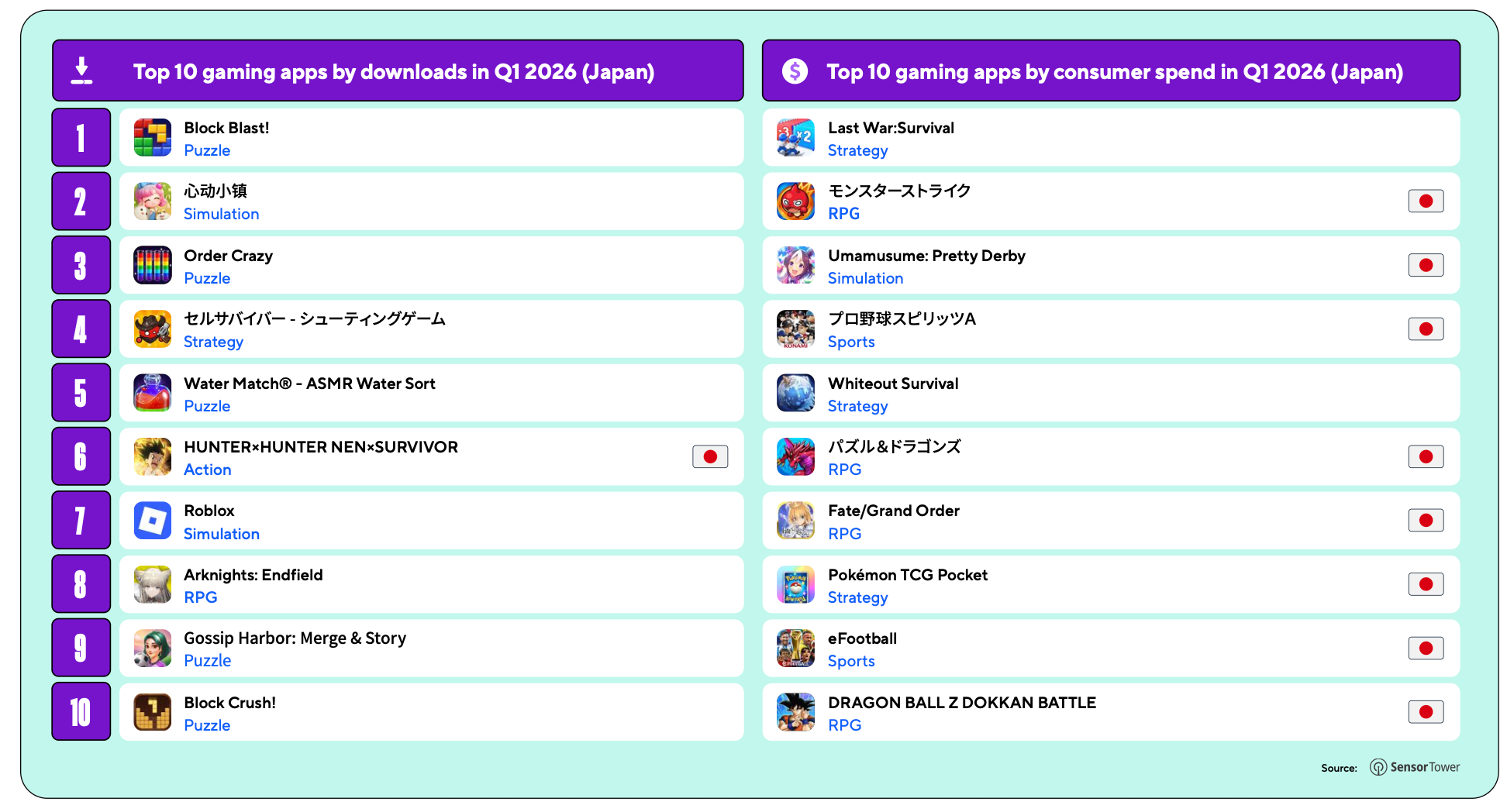
The top games by downloads in Q1’26: Block Blast!, 心动小镇, and Order Crazy. By consumer spend: Last War: Survival, モンスターストライク, and Umamusume: Pretty Derby.
Only one Japanese game made the top 10 by installs: HUNTER×HUNTER NEN×SURVIVOR. In the top 10 by consumer spend, there are eight.
The other verticals
Finance apps are growing quickly in Japan, with stock trading growing the fastest. Installs grew 90% in H1’26, largely thanks to the revamped NISA program, which is pushing younger people to invest in the stock market.
Entertainment apps added 4% in installs, with an average session of 32.84 minutes. Short drama services are drawing strong interest in the country.
Manga services hold the top two spots in Japan’s overall consumer spend chart. That said, the vertical rests on an adult audience. The chapters-unlock model doesn't work as well with younger readers, who are moving to vertical drama services and social video.