


Reports of the week:
CYGMA: The Cyprus Video Game Industry in 2025
Newzoo: The Gaming Market in 2026
Games and Numbers (August 12 — August 25, 2026)
Bain & Company: The Gaming Industry in 2026
CYGMA: The Cyprus Video Game Industry in 2025
This is the first industry report from the Cyprus Game Makers Association. The baseline market figures come from BCG, cross-checked against Ampere Analysis, Sensor Tower, Newzoo, and Circana.
The Cyprus mobile market is measured using AppMagic and Sensor Tower data; PC/console is measured using Alinea Analytics and figures from the publishers themselves. The company count comes from the Registrar of Companies and CYGMA’s own database; turnover and GDP contribution come from CYSTAT via C Business Advisors; and InvestGame prepared the deals data.
💜 I helped put the report together: gathered, analyzed, and cross-checked the data for the first three sections (global market, Cyprus market, companies & employment numbers). I'm very glad to contribute to a report that matters to Cyprus and the local games industry! Thanks to CYGMA for such an opportunity!
❗️All revenue figures are estimates, not company reporting. The D2C share of sales is an expert estimate.

From concept art to launch-day marketing, most game studios rely on contractors in multiple countries. Mellow makes it simple to hire, pay, and stay compliant with talent in 150+ countries — no legal entity required.
The Global Market
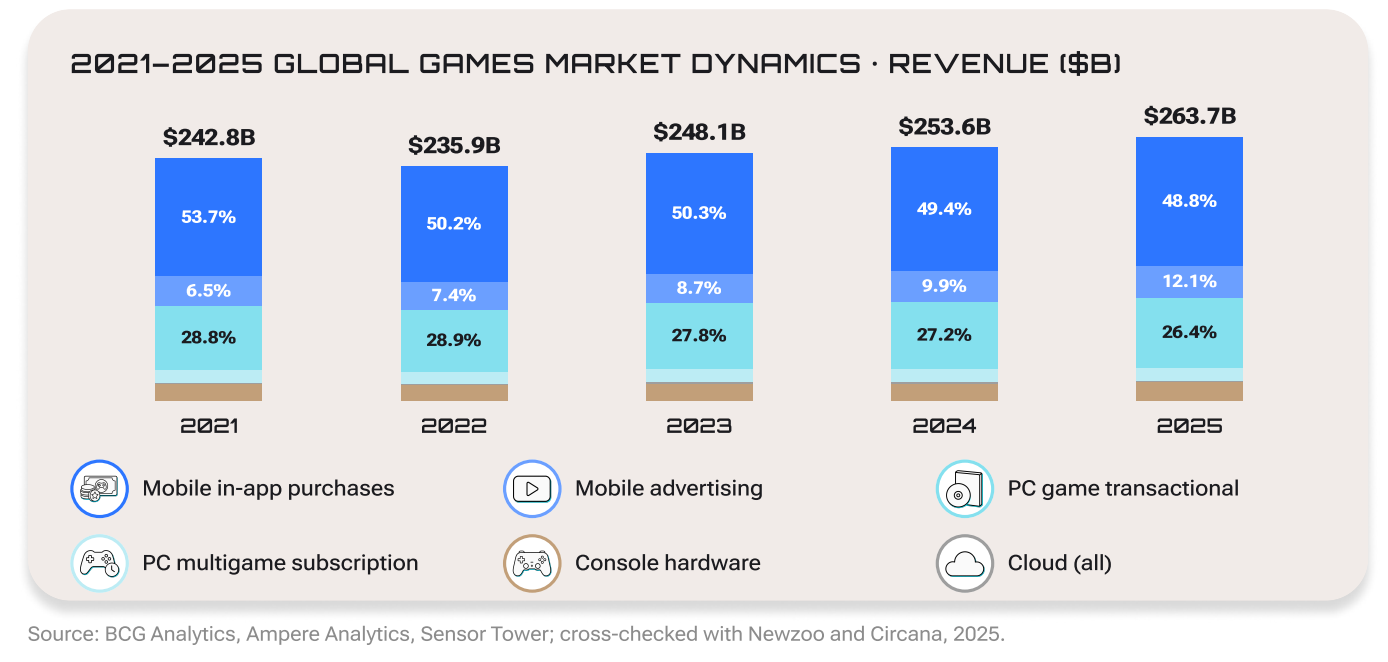
The global games market earned $263.7 billion in 2025 (+4% YoY).
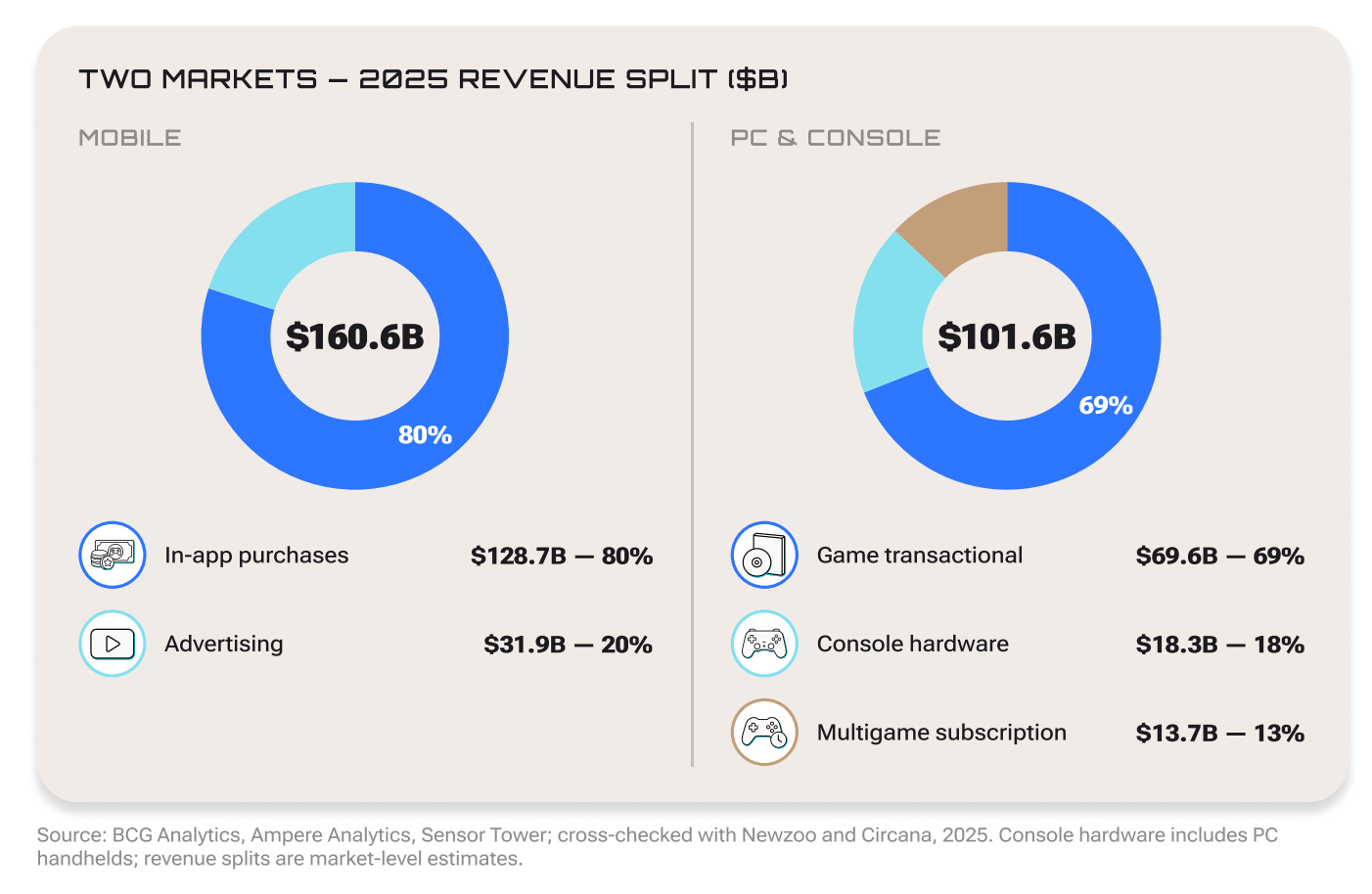
Mobile games brought in $160.6 billion (61% of the market), PC and console $101.6 billion (38%), and cloud $1.5 billion.
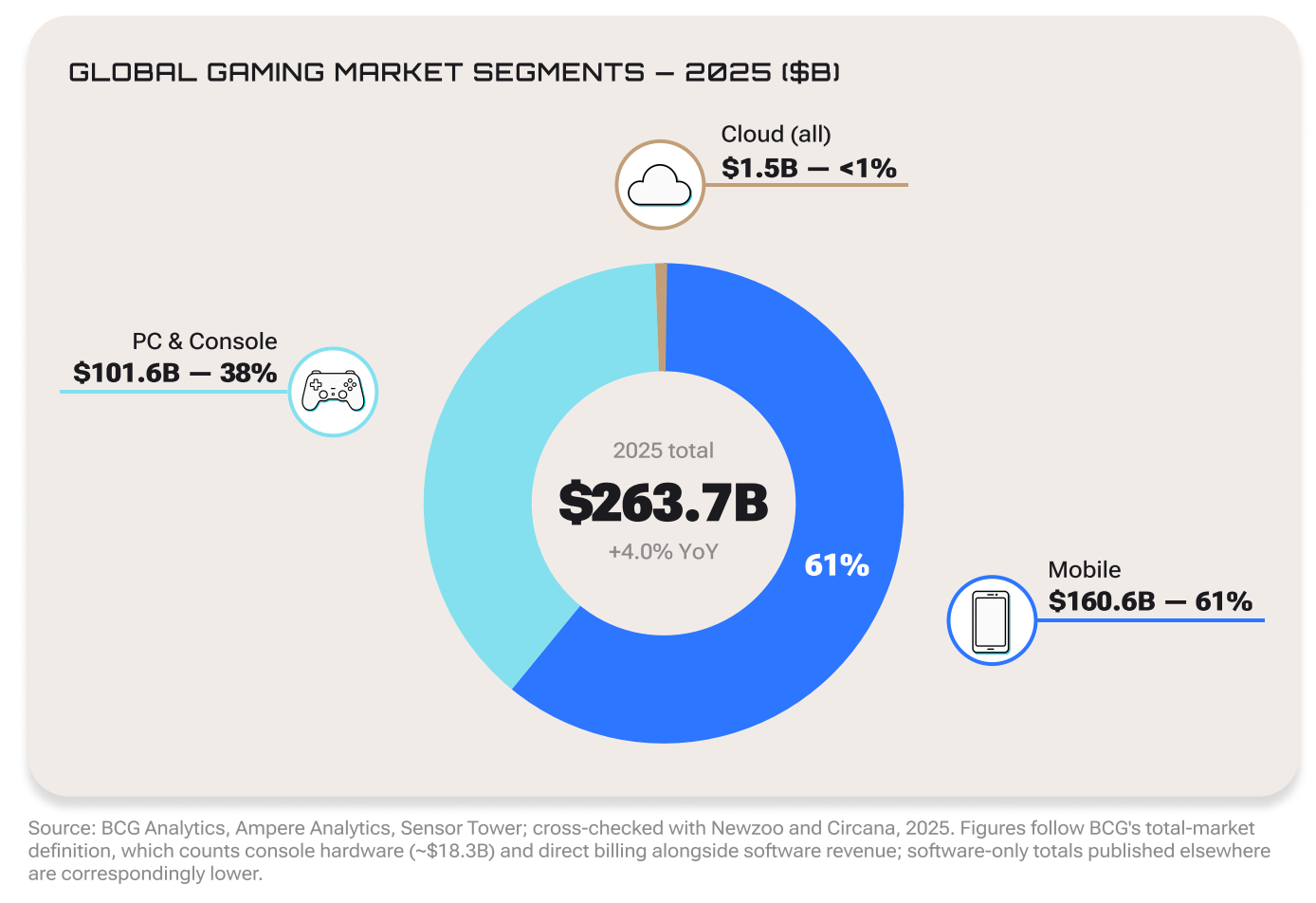
In mobile, 80% of revenue ($128.7 billion) comes from IAP; the remaining $31.9 billion comes from advertising.
On PC and console, the structure is different: game and content sales are $69.6 billion (69%), hardware $18.3 billion (18%), and subscriptions $13.7 billion (13%).
The Cyprus Market
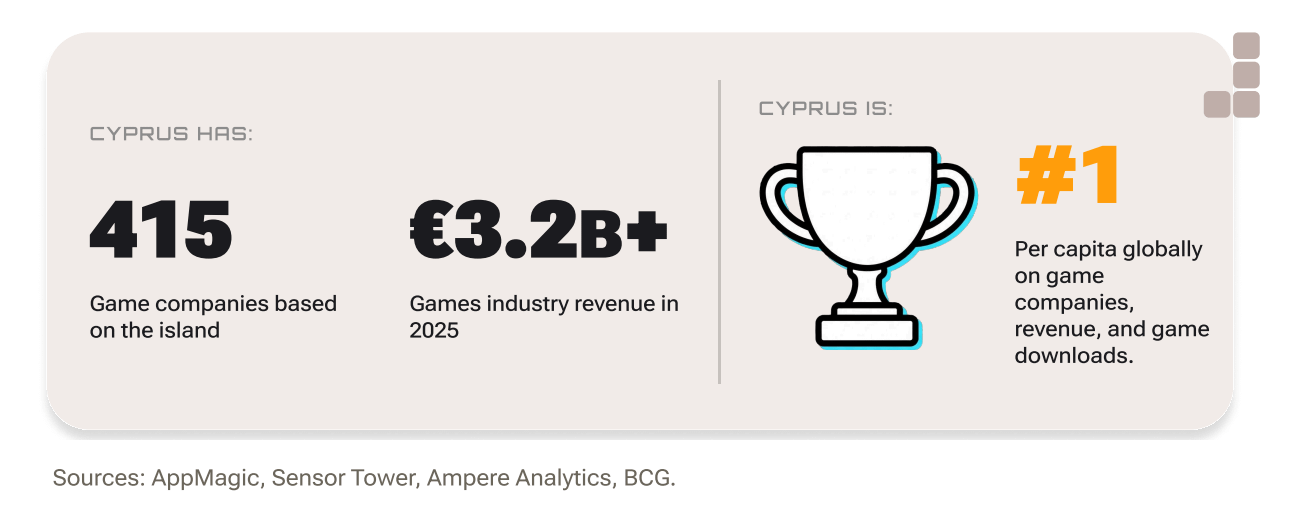
In 2025, 415 games companies operated in Cyprus, with combined revenue of more than €3.2 billion.
With a population of just over a million, it ranks first in the world for companies, revenue, and mobile downloads per capita.
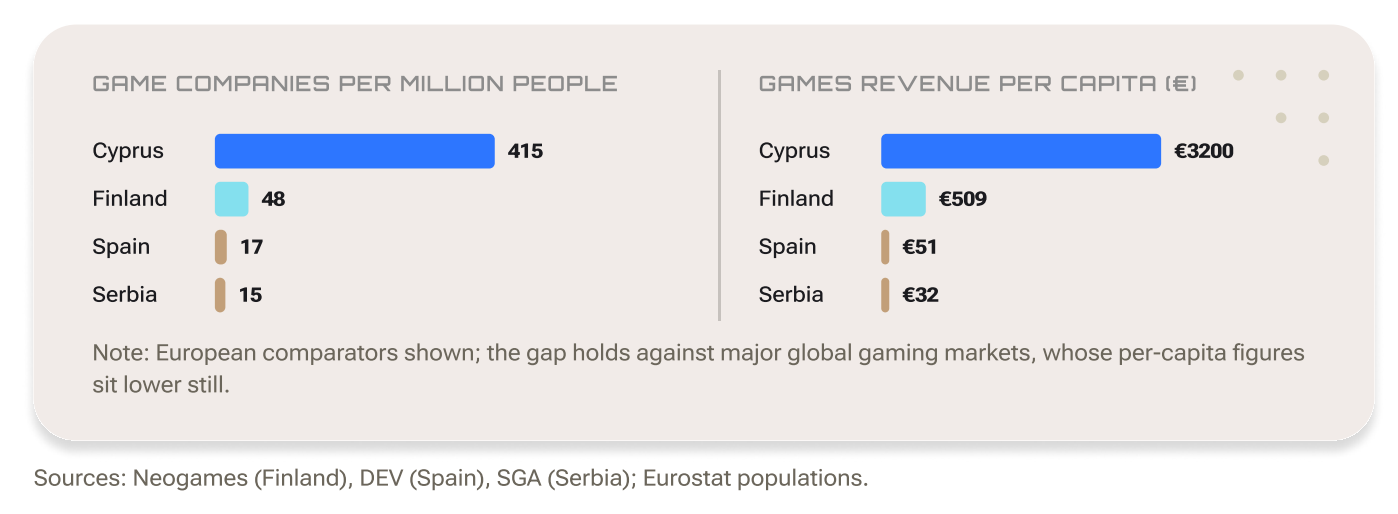
For comparison, Finland has 48 games companies per million people, Spain 17, and Serbia 15. On revenue per person, the gap is even wider: €3,200 for Cyprus against €509 for Finland, €51 for Spain, and €32 for Serbia.
Over the five years (2019 - 2024), the sector’s contribution to national GDP grew from ~€300 million to €1.15 billion - from 1.3% to 3.3% of GDP.
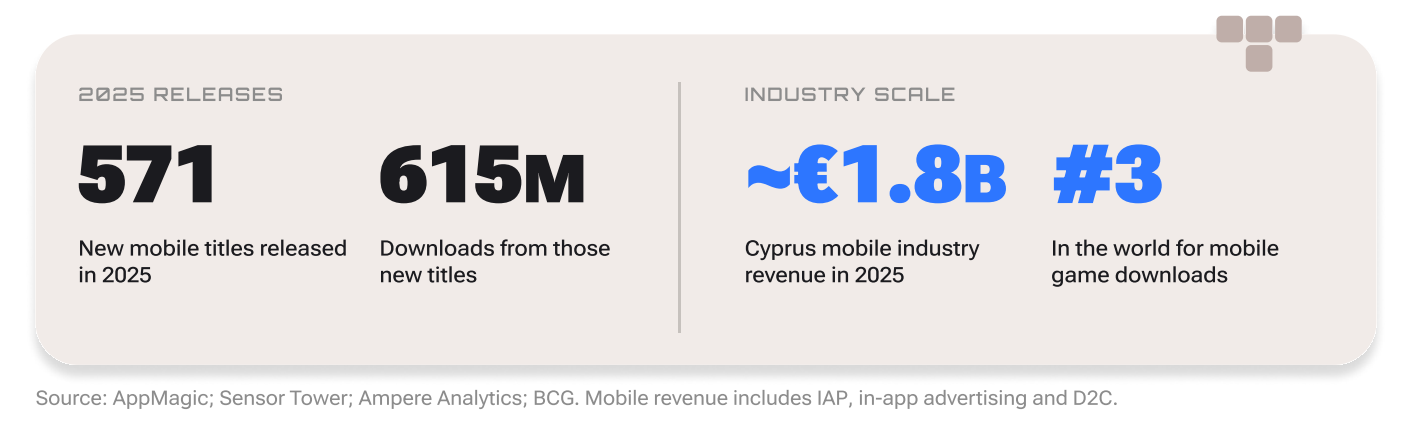
Mobile games remain the main engine. In 2025, Cyprus studios released 571 new mobile titles; those titles were downloaded 615 million times, and the island’s total mobile revenue was ~€1.8 billion.
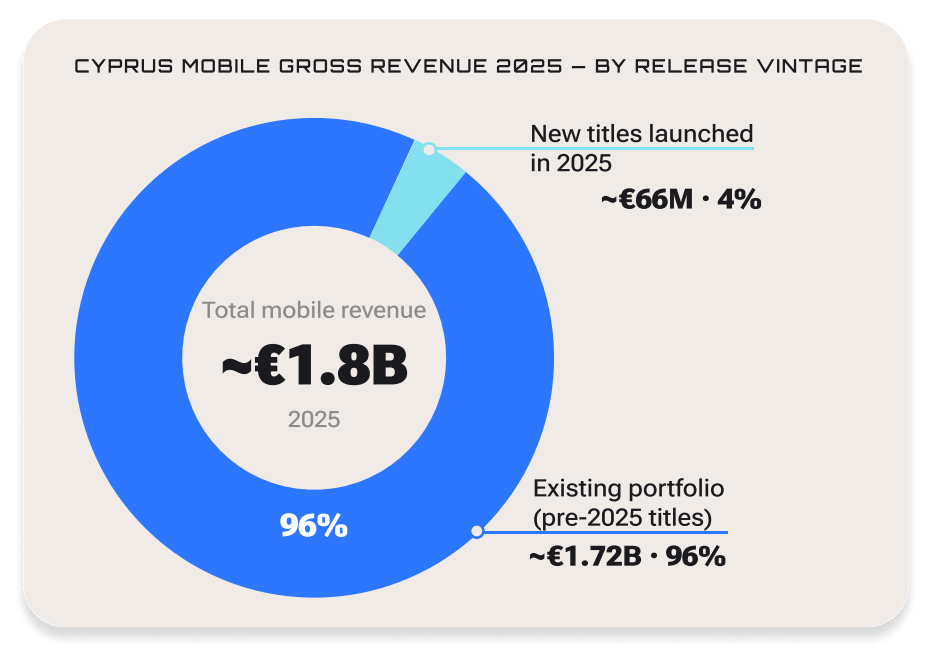
Only 4% of that revenue (~€66 million) came from 2025 releases. Older projects generated the other €1.72 billion.
❗️That is a normal picture for a mature mobile market, but it also means Cyprus has not escaped the problems other countries face in launching new mobile projects.
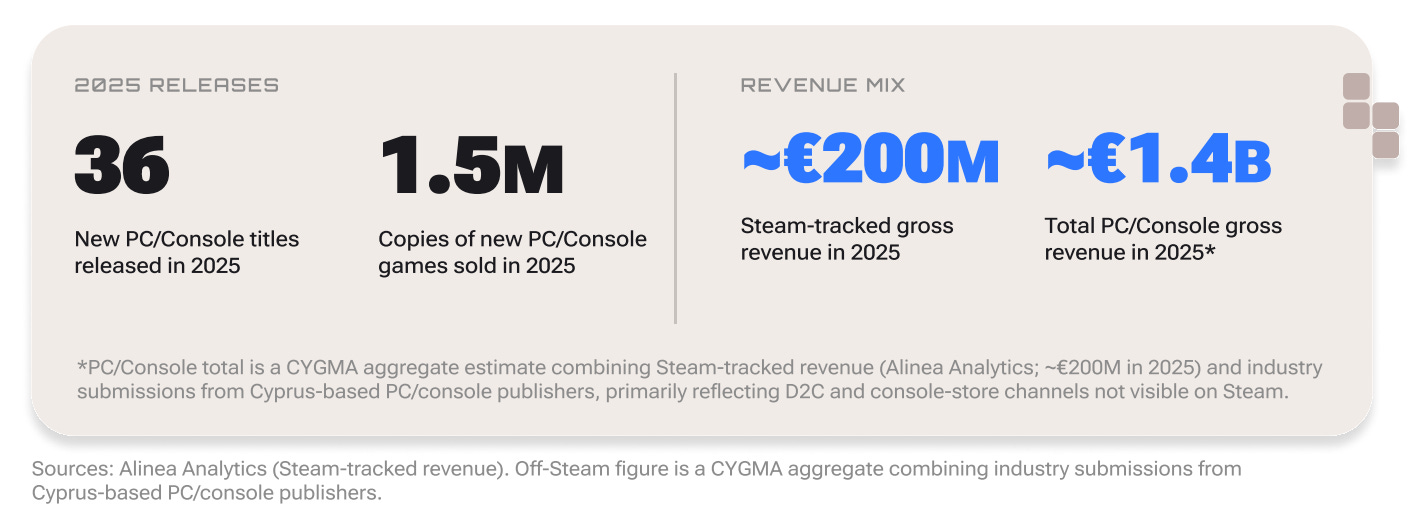
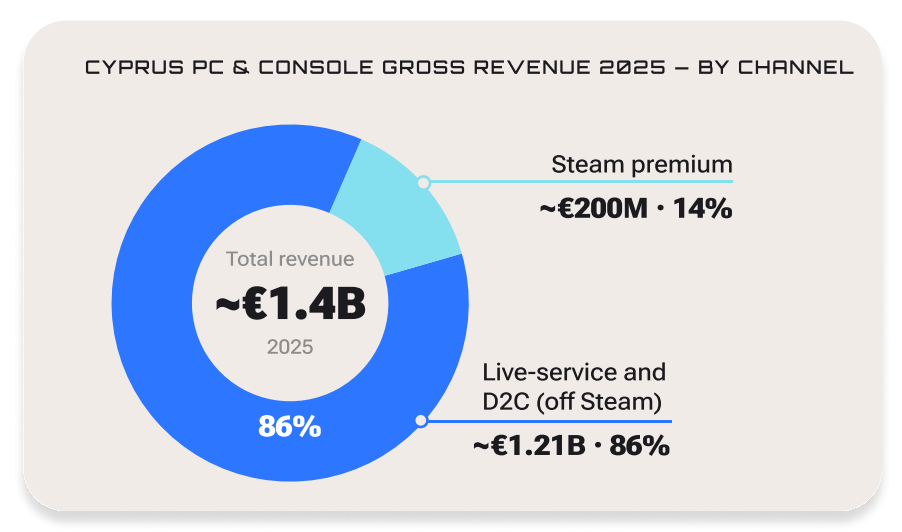
On PC and console, 36 new games shipped and around 1.5 million copies were sold. Total gross revenue for the segment was ~€1.4 billion, but only 14% of that (around €200 million) went through Steam. The other €1.21 billion came from multiplayer games running their own client (like World of Tanks) and from D2C.
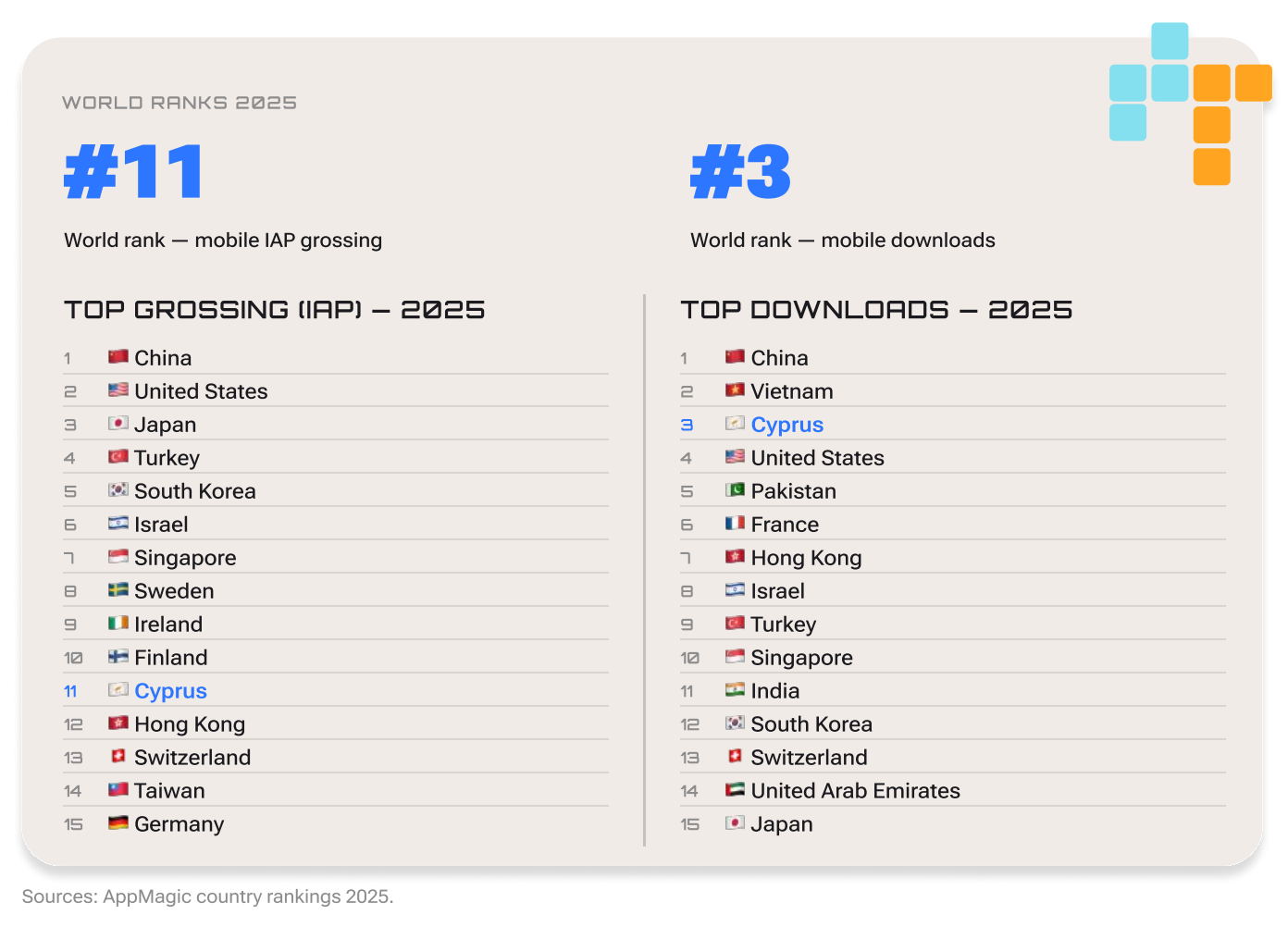
Cyprus ranks third in the world for mobile downloads, behind only China and Vietnam. For mobile IAP revenue, it ranks eleventh, between Finland and Hong Kong.
The global mobile D2C market in 2025 is estimated at around €15 billion, roughly 15% of everything spent inside mobile games.
Companies and Teams
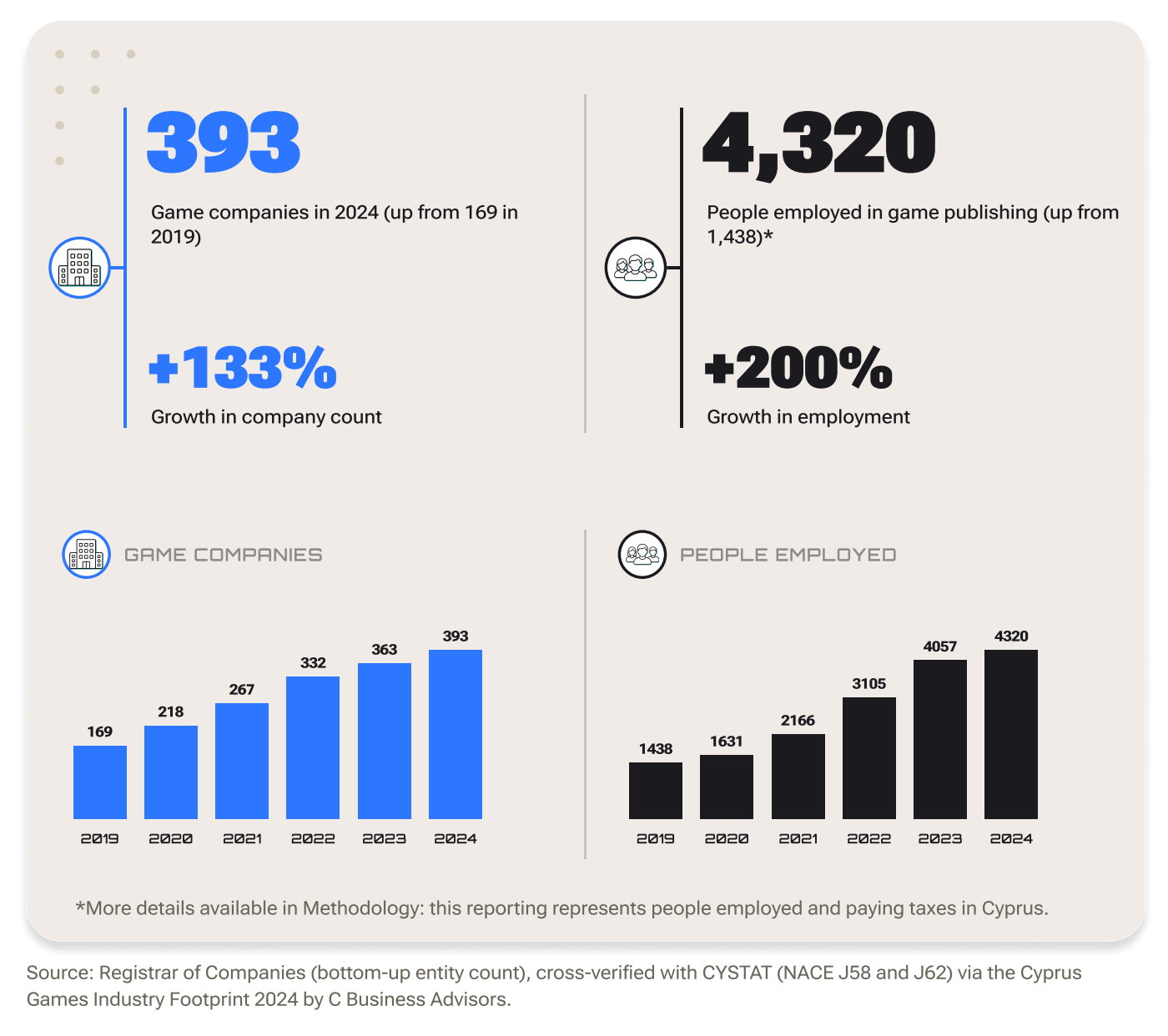
The number of registered games companies grew from 169 in 2019 to 393 in 2024 (+133%). Over the same period, the number of people employed in the games industry grew from 1,438 to 4,320 (+200%).
Growth peaked in 2022: headcount rose 43% that year, and the company count rose 24.3%. By 2024, the pace was more modest, at +8.3% companies and +6% people.
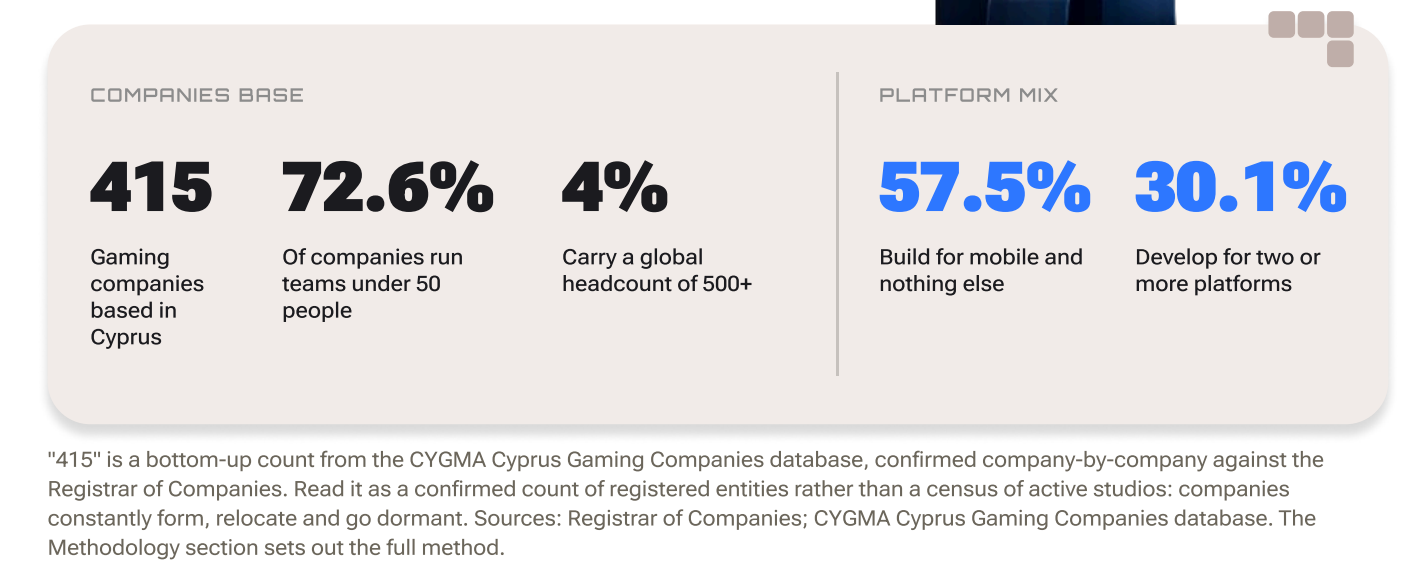
According to CYGMA’s own database, 415 companies were based in Cyprus in 2025.
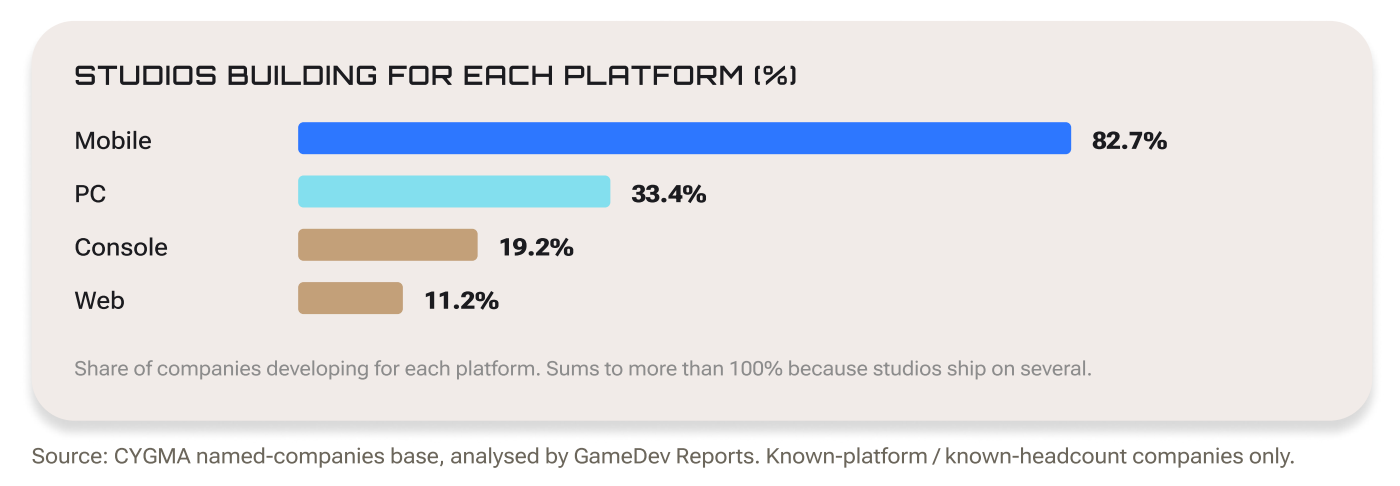
By platform, 82.7% of Cyprus studios build mobile games, 33.4% PC, 19.2% console, and 11.2% web.
At the same time, 57.5% of companies work only on mobile games, while 30.1% work on two or more platforms.
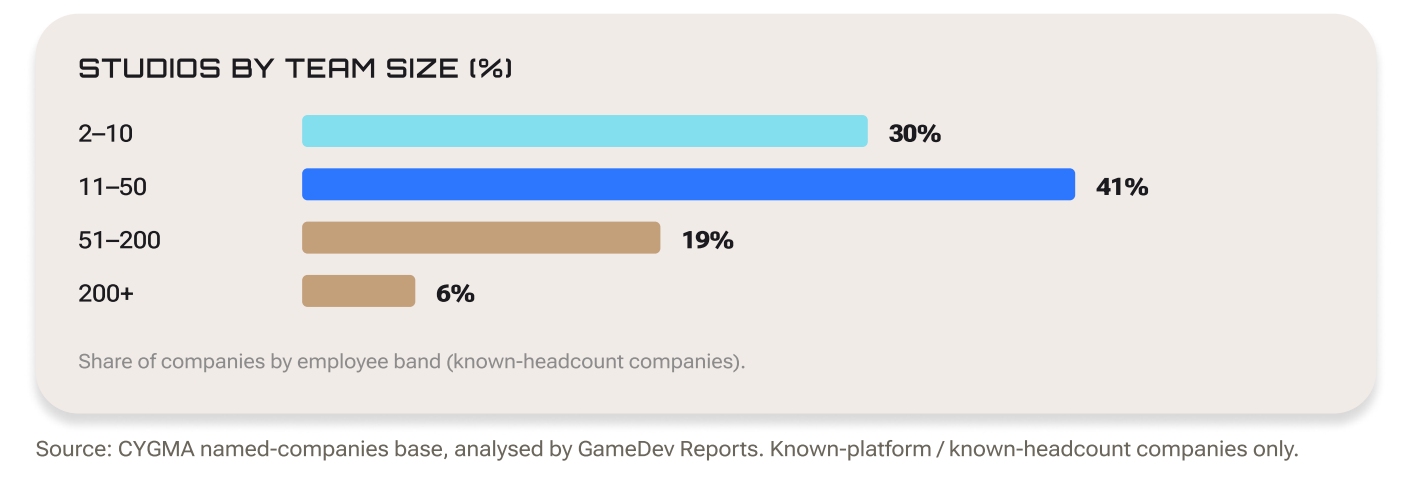
Teams at Cyprus companies are mostly small. 41% of companies have between 11 and 50 people, and another 30% have between two and ten. Only 6% have more than 200 staff.
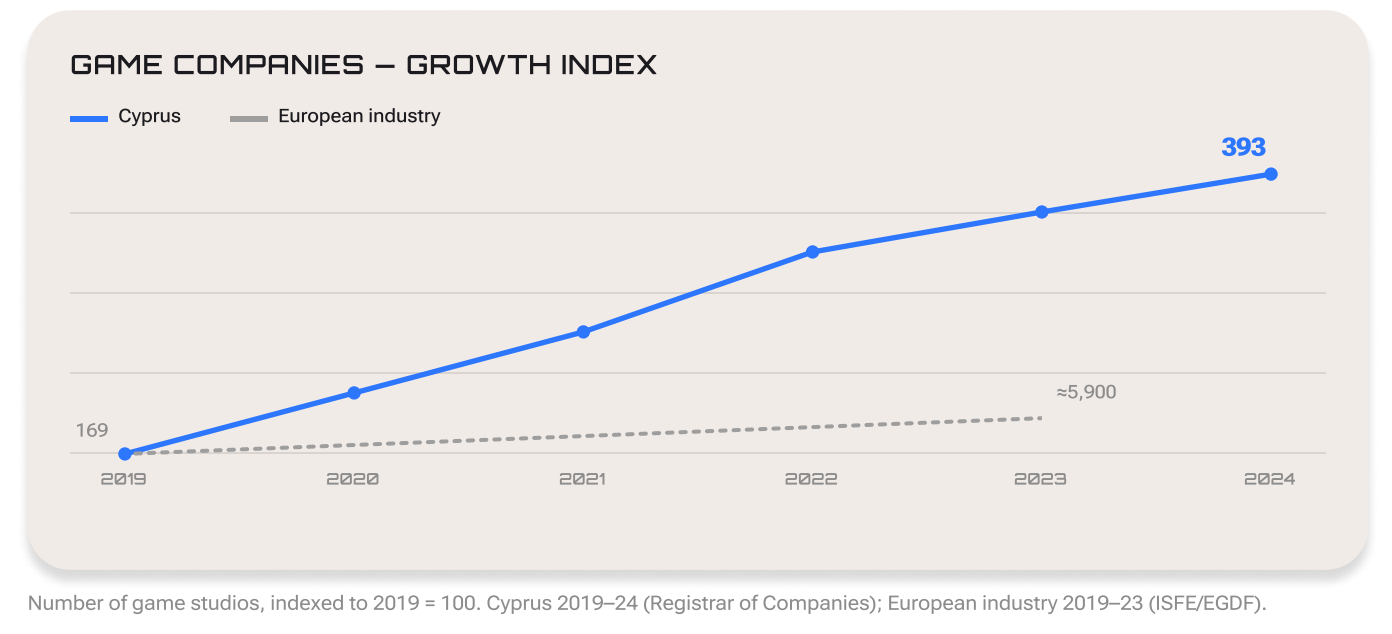
For comparison, all of Europe has around 6,000 studios and publishers, and that number is growing at roughly 4% a year. The Cyprus industry is growing faster, at about 18% a year.
From concept art to launch-day marketing, most game studios rely on contractors in multiple countries. Mellow makes it simple to hire, pay, and stay compliant with talent in 150+ countries — no legal entity required.
Investment, M&A, and UA Financing
Friends at InvestGame prepared the data for this section.
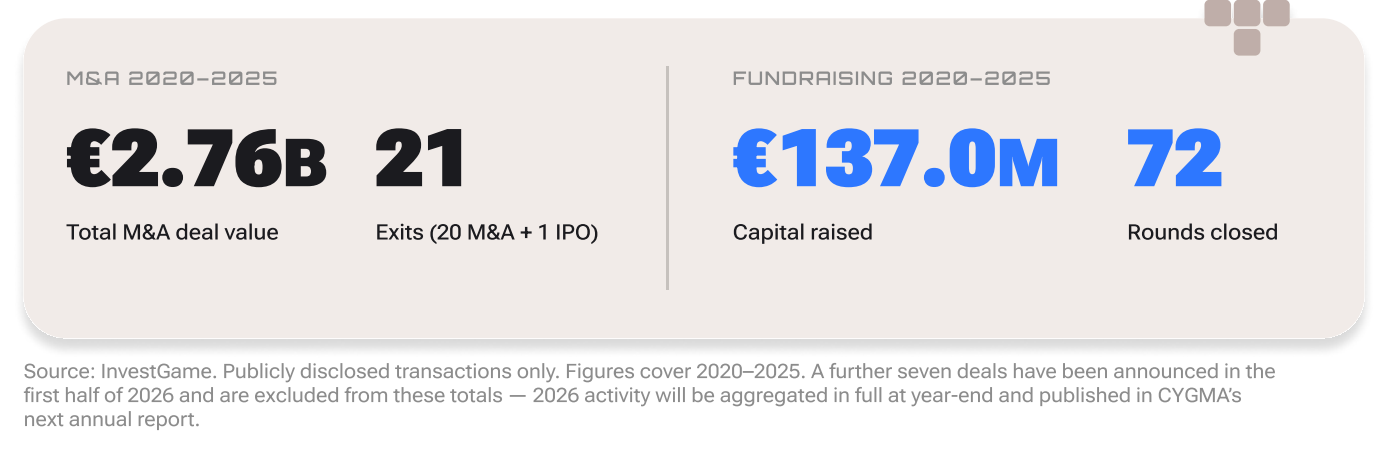
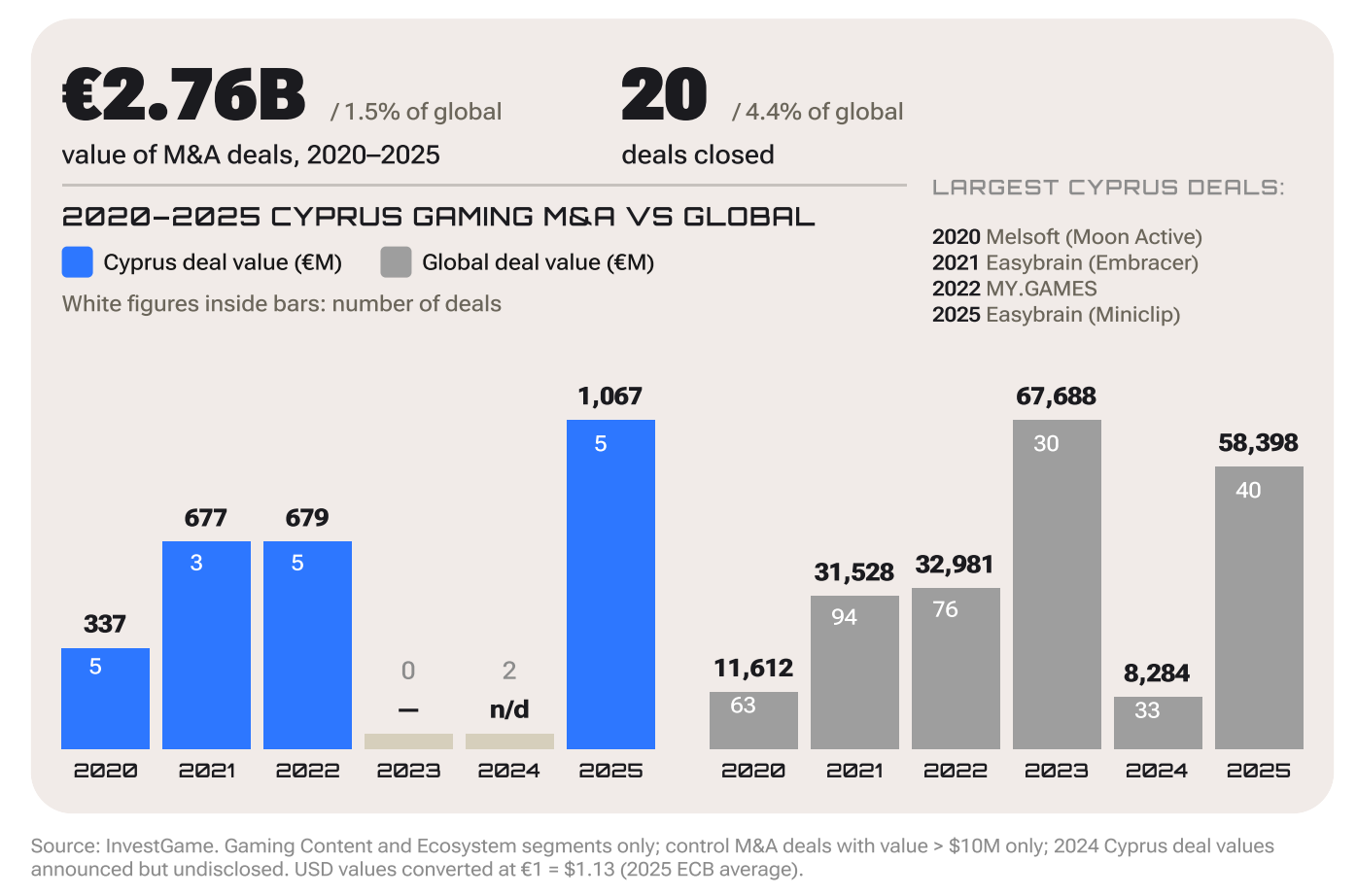
Between 2020 and 2025, Cyprus companies took part in M&A deals worth €2.76 billion across 21 exits (20 M&A and one IPO).
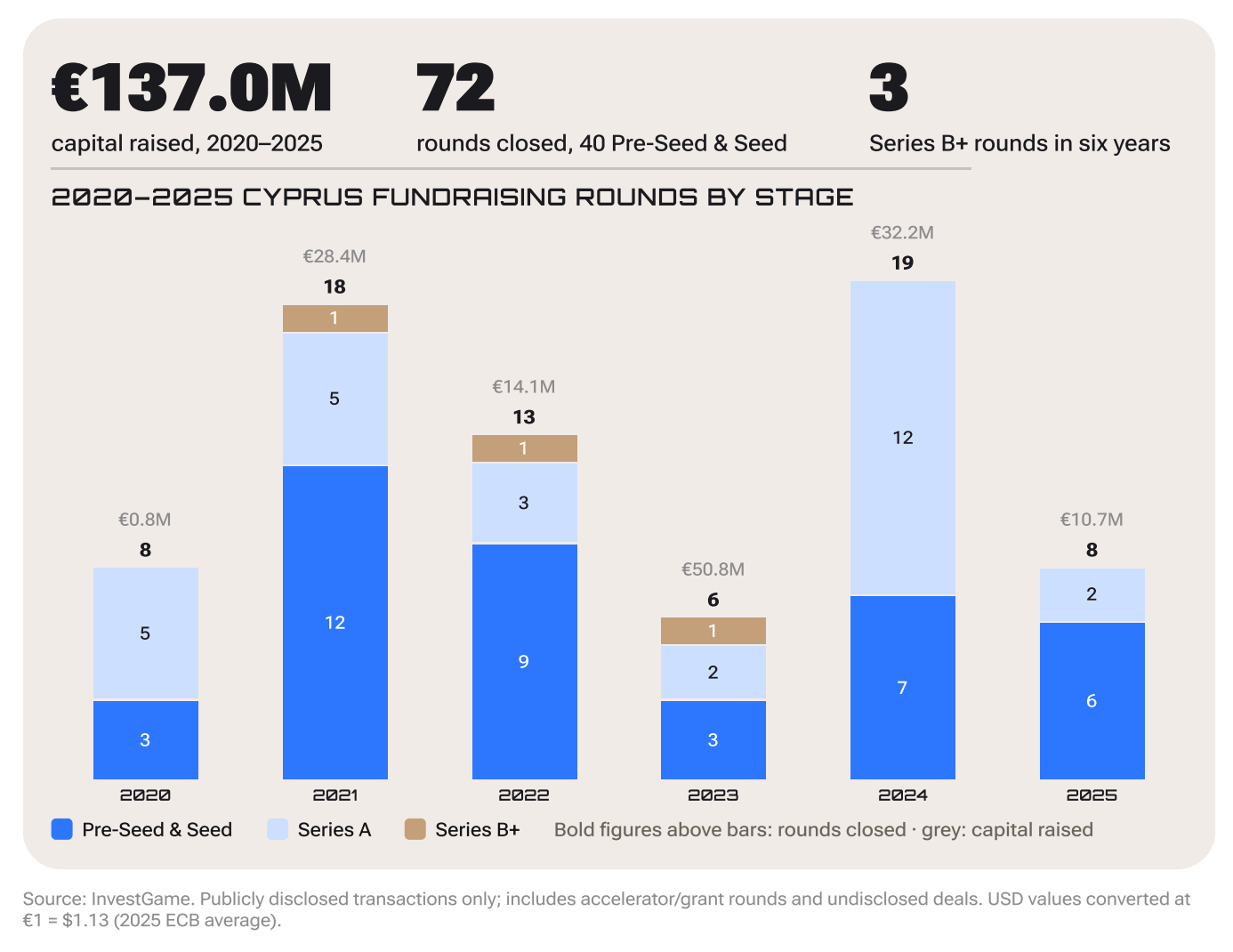
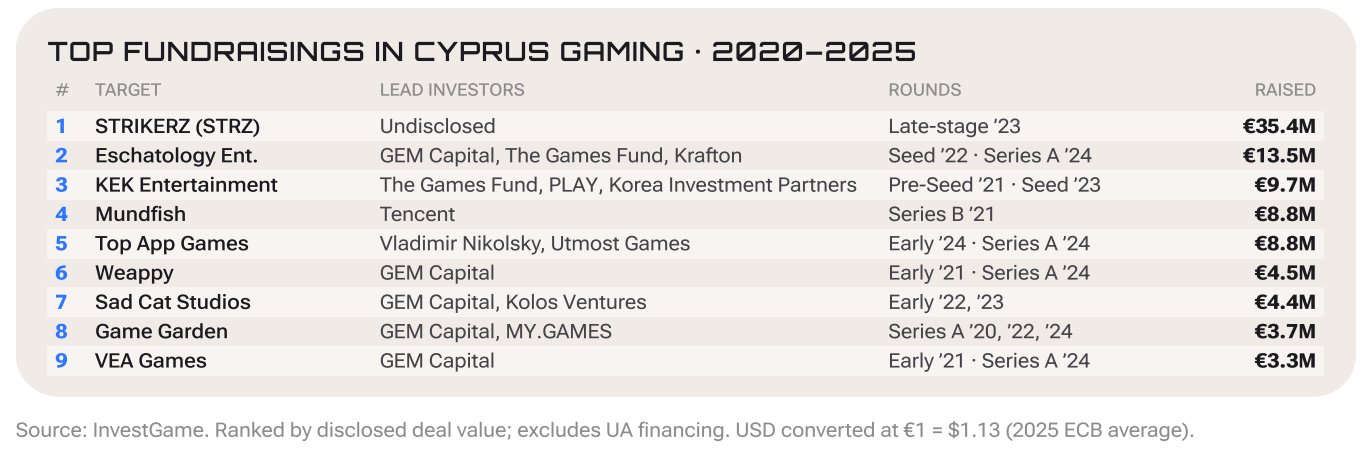
Over the same period, companies raised €137 million across 72 rounds at various stages.
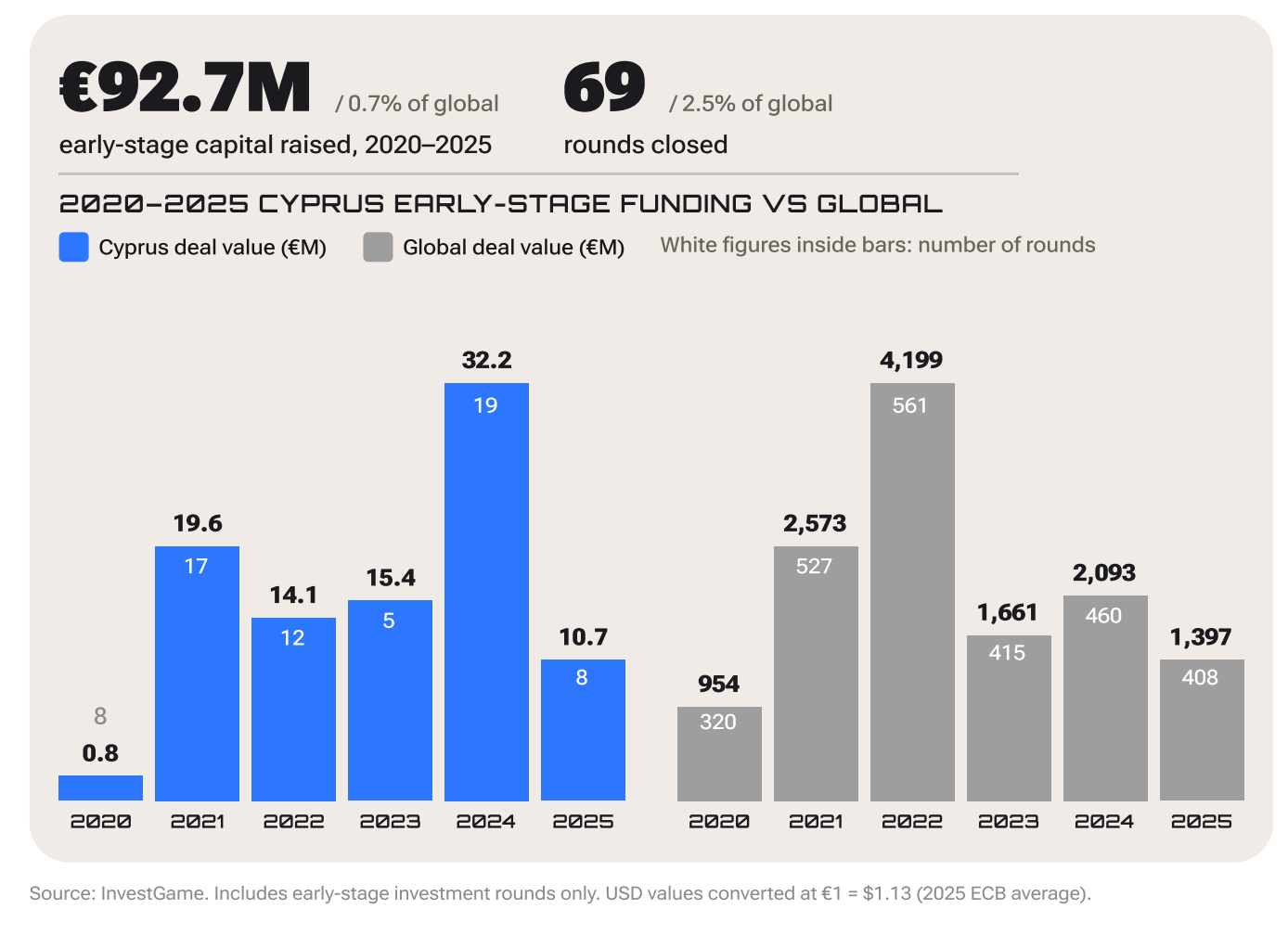
Early-stage deals (pre-seed and seed) accounted for €92.7 million (0.7% of the global total) across 69 rounds (2.5% of the global total).
Globally, that is 4.4% of all games M&A deals above $10 million, but only 1.5% of their value. There are plenty of deals, but most of them are small.
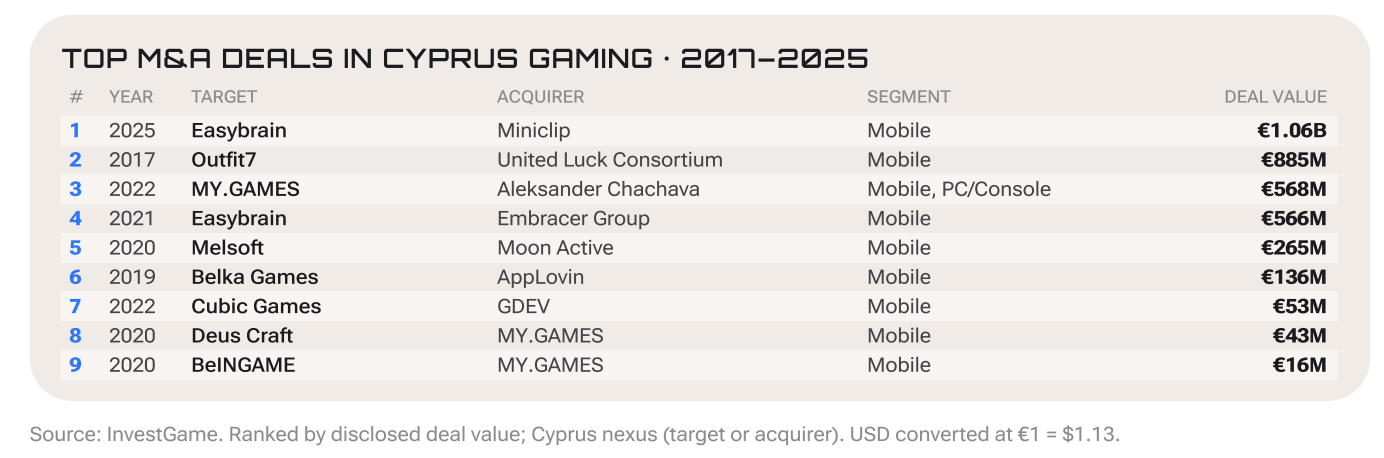
The largest deals: Miniclip’s purchase of Easybrain for €1.06 billion in 2025, the sale of Outfit7 to the United Luck consortium for €885 million in 2017, and the MY.GAMES reorganization at €568 million in 2022.
The largest round in six years is Strikerz’s €35.4 million in 2023. There have been only three Series B or later rounds in that whole time.
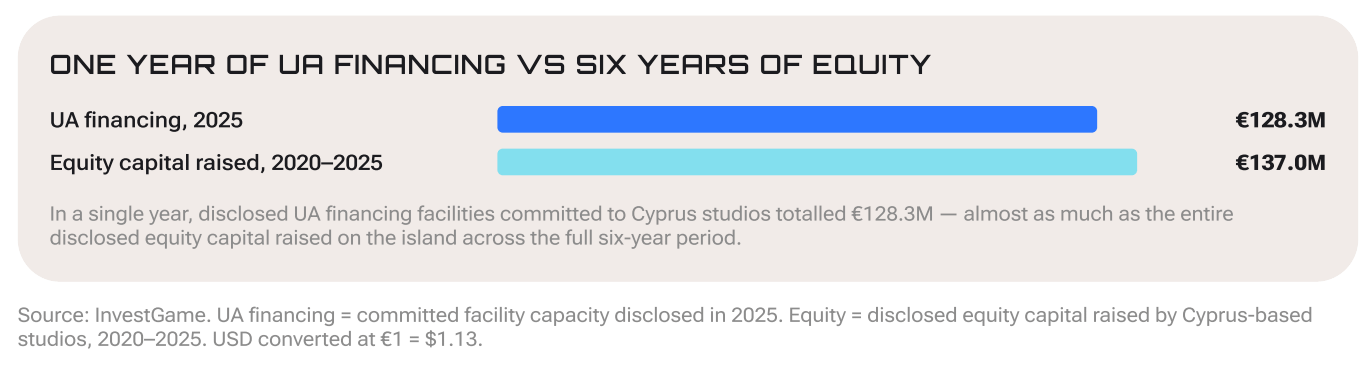
UA financing, by contrast, took off. In 2025, Cyprus studios received €128.3 million across five deals - almost as much as was raised through investment rounds over six years.
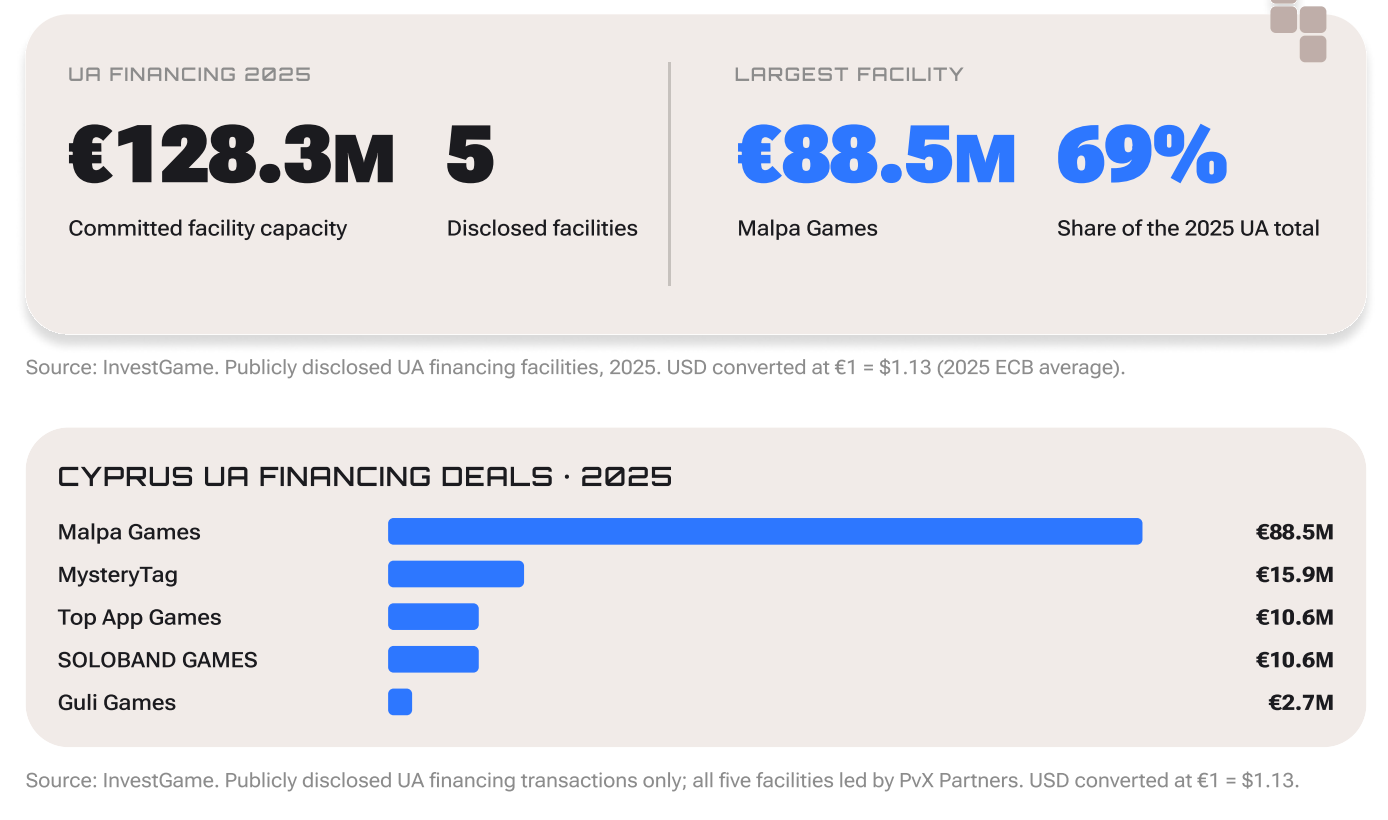
Of that, €88.5 million went to Malpa Games, and PvX Partners led all five deals.
Tax Incentives
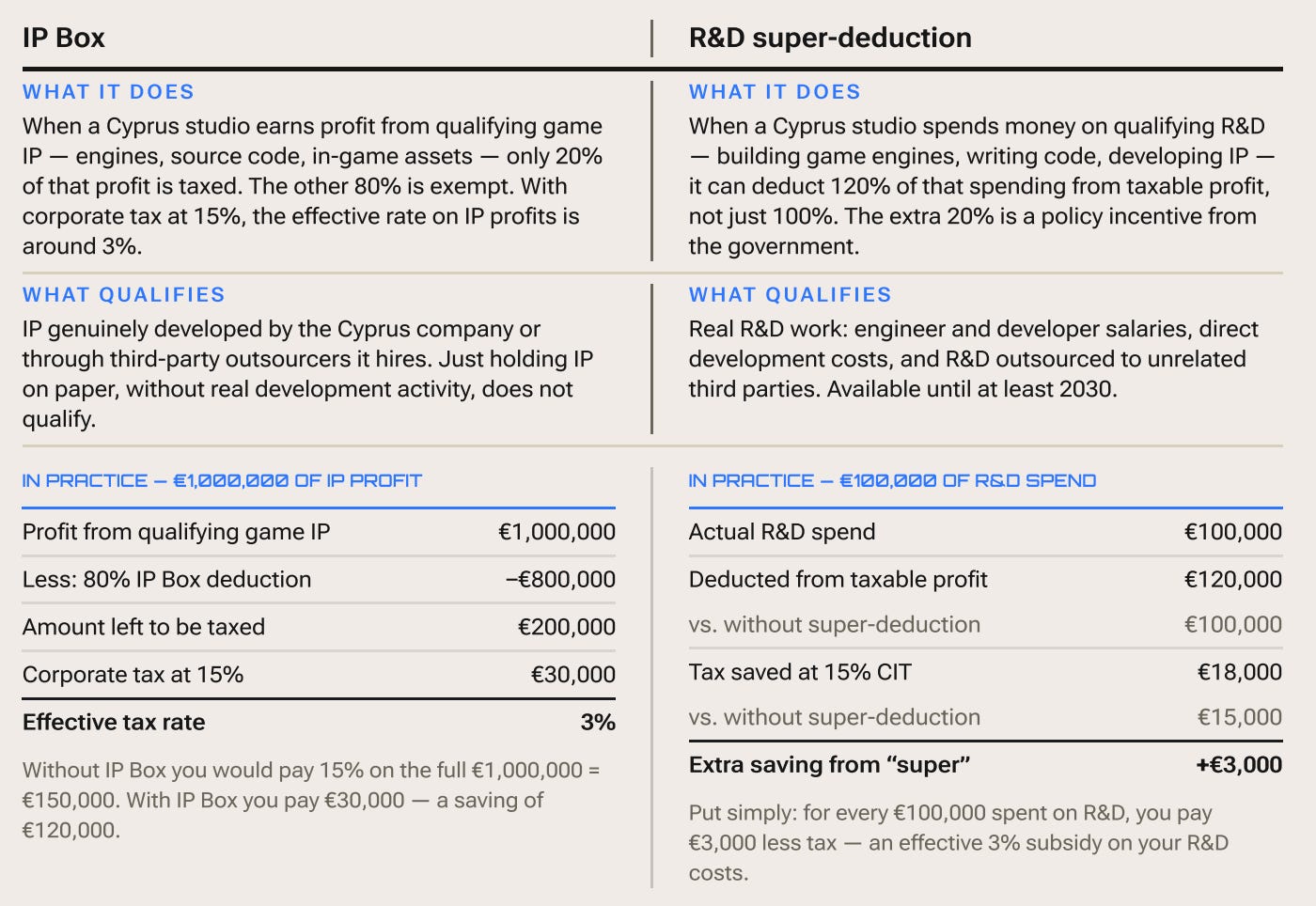
The IP Box exempts 80% of profit from game IP from tax. With the corporate tax rate at 15% from 1 January 2026, the effective rate is around 3%.
The R&D super-deduction allows 120% of development spend to be written off, meaning that for every €100,000 of development spend a company pays €3,000 less tax. Separately, employees earning more than €55,000 a year get a 50% income tax exemption for 17 years. The IP Box and the R&D super-deduction cannot be combined.
Newzoo: The Gaming Market in 2026
Newzoo’s market revenue represents consumer spending on gaming software and services, including full-game purchases, in-game spending, and console subscription services. It excludes taxes, second-hand trade, advertising, hardware, peripherals, B2B services, and gambling.
The market
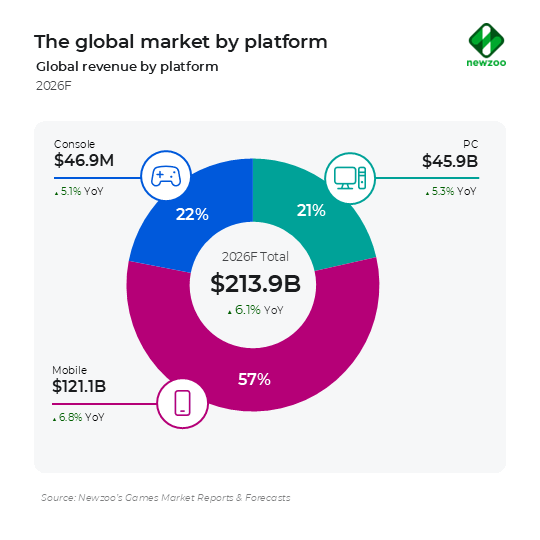
According to the current forecast, the gaming market will grow to $213.9 billion in 2026 (+6.1% YoY). All three platforms and every major region are growing.
❗️Newzoo’s final estimate puts the 2025 market at $201.6 billion, above its September 2025 forecast of $188.8 billion. Newzoo attributes the difference primarily to stronger-than-expected PC performance and mobile revenues, including D2C, mini-game, and Tencent revenues.
Mobile games remain the industry's largest segment. In 2026, they should earn $121.1 billion (+6.8% YoY). For the first time in a long while, mobile revenue leads the growth. Key drivers include deeper monetization of existing players, Chinese publishers expanding abroad, and the development of D2C channels. Downloads, meanwhile, keep declining.

Managing a distributed dev team shouldn’t mean managing a compliance headache. Mellow’s Contractor Management gives you ready-made contracts, IP compliance, and automated payouts for contractors in 150+ countries — for $35/month per contractor.
❗️According to Sensor Tower’s recent H1’26 report, mobile IAP revenue fell 2.0% YoY (to $40 billion), and downloads dropped 11.9%. But Sensor Tower does not count D2C, third-party stores, or Android revenue in China: exactly the channels Newzoo expects the growth to come from.
Console segment revenue, per Newzoo’s expectations, will be $46.9 billion (+5.1% YoY). The main driver is the November release of Grand Theft Auto VI, which should lift full-game sales revenue by 17.5%. That said, if the game is delayed, there will be no growth, and the segment will most likely close the year down.
The PC market will grow to $45.9 billion (+5.3% YoY). For comparison, the PC segment grew 12% in 2025: the highest annual rate in Newzoo’s entire history of observations. Microtransactions are expected to gain share in the revenue mix. Analysts expect China to drive most PC growth.
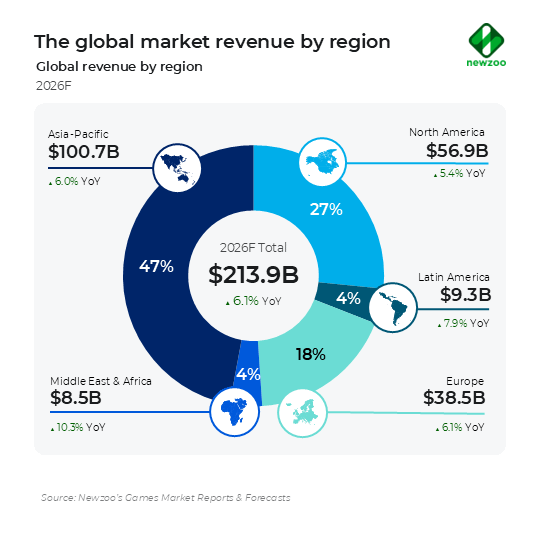
Asia-Pacific, per the forecast, will account for $100.7 billion in revenue (+6% YoY), or 47% of the entire market. North America’s revenue will be $56.9 billion (+5.4% YoY), and Europe’s $38.5 billion (+6.1% YoY).
The Middle East and Africa are growing fastest, at $8.5 billion (+10.3% YoY). Latin America will grow 7.9% in 2026, with the region’s revenue reaching $9.3 billion. Together, though, these two regions account for only 8% of the global market.
China and the US will account for 52% of all consumer spending on games in 2026.
Players
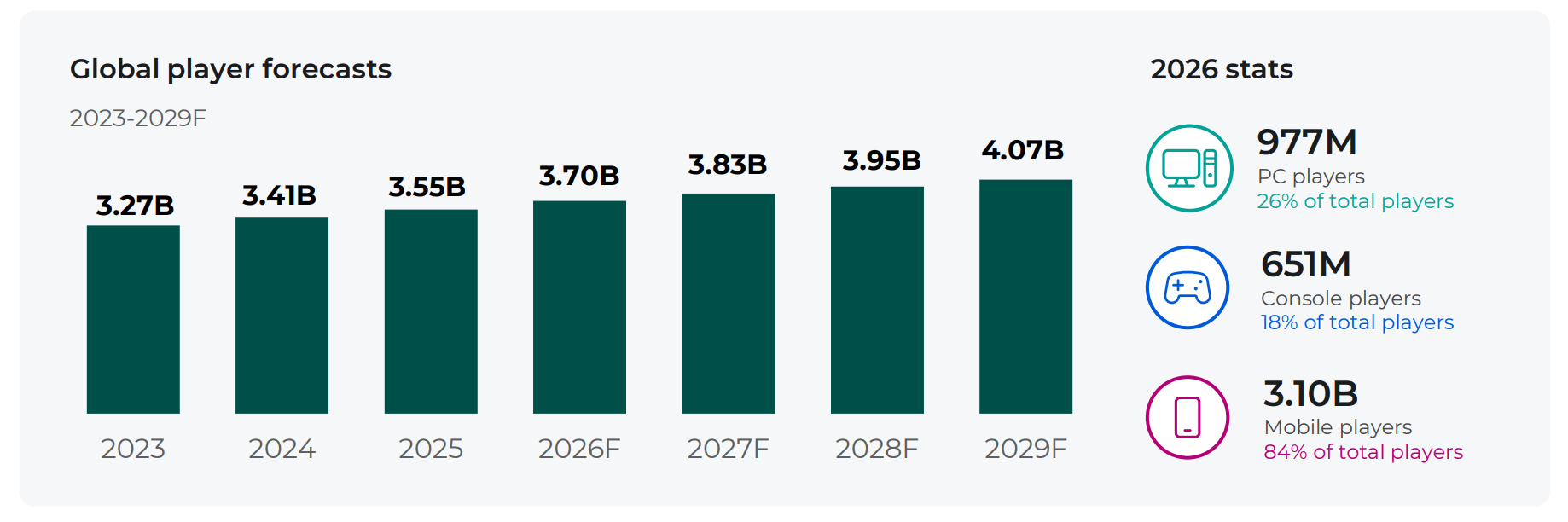
In 2026, there should be 3.7 billion players worldwide (+4.4% YoY). By 2029, that number should grow to 4.07 billion, at a 3.2% compound annual growth rate.
3.1 billion people play mobile games, which is 84% of all players. 977 million people play on PC (26%), and 651 million on consoles (18%).
Game penetration among the online audience will rise from 61.5% to 62.0%. Industry growth largely comes from the growth in internet users: their number will rise to 5.97 billion (+3.5% YoY).
Newzoo notes that market growth from new users is limited. The work will have to happen within the existing audience base.
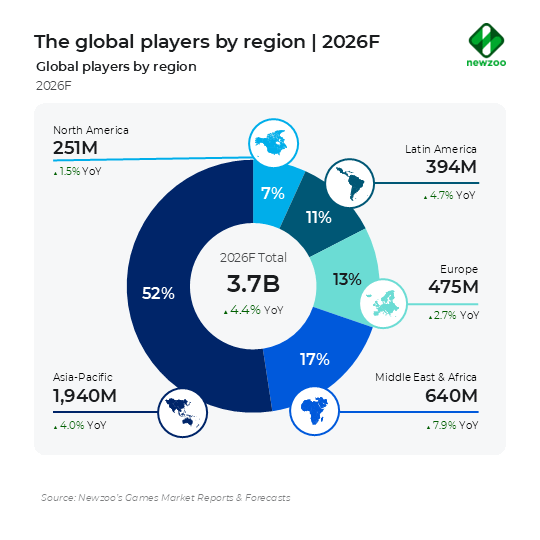
APAC is the largest region by audience (1.94 billion players; +4% YoY). Next are MEA (640 million; +7.9% YoY) and Europe (475 million; +2.7% YoY).
Latin America has 394 million players (+4.7% YoY), and North America has 251 million (+1.5% YoY).
❗️North America grows the slowest of all regions by audience, but the region’s revenue is $56.9 billion: roughly $227 per player per year. In MENA, with 640 million players, it comes out to about $13 per person. The region is growing fast in both money and people, but the gap in absolute numbers is enormous.
Games and Numbers (August 12 — August 25, 2026)

PC/Console games
Meccha Chameleon sold 20 million copies in two months. It’s one of the most successful releases on Steam this year.
ARC Raiders by Embark Studios and Nexon has sold 16.3 million copies. The game brought in $114.9 million in the second quarter and sold an additional 800,000 units, bringing its total to around $551 million since its October 2025 launch.
Pokémon Pokopia by Nintendo and The Pokémon Company sold over 5 million copies in just over four months. Roughly one in five Nintendo Switch 2 owners has a copy of the exclusive - 23.68 million consoles had been sold as of the end of June.
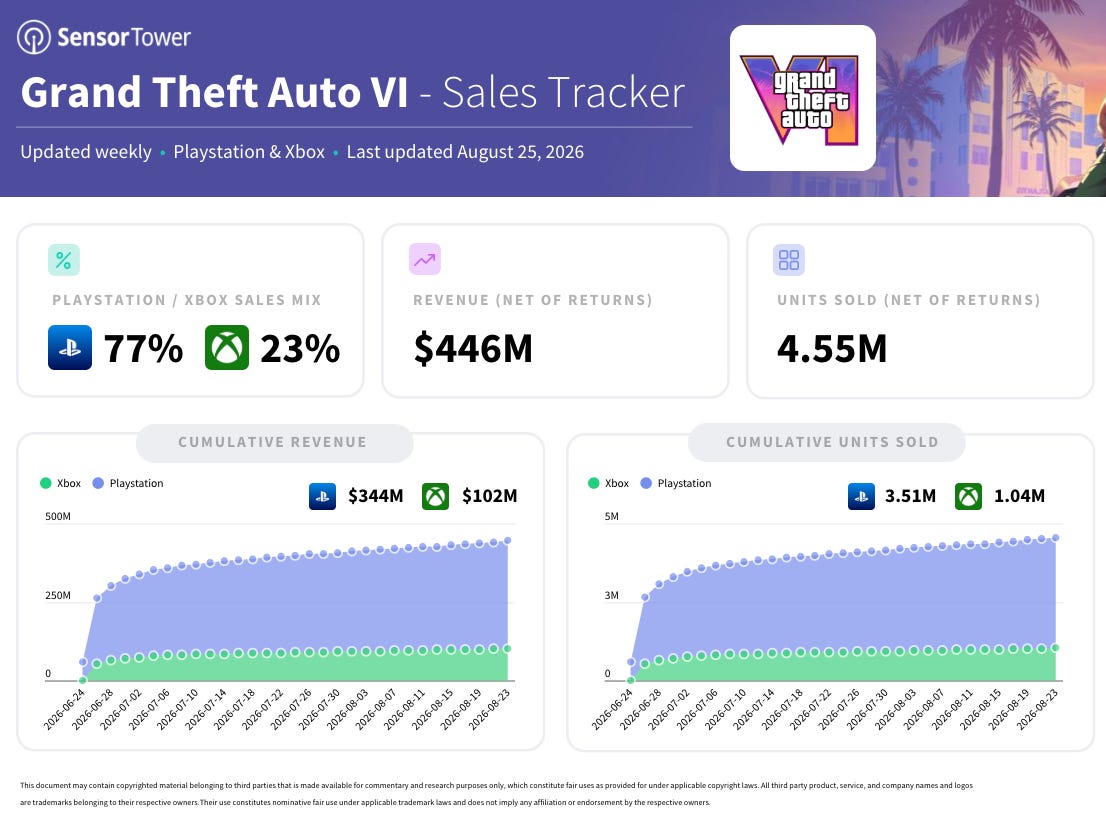
GTA VI pre-orders have reached 4.55 million units and $446 million in revenue. Per Sensor Tower, 77% of pre-orders came from PS5, and nearly 90% of buyers are taking the $100 Ultimate Edition.
007 First Light by IO Interactive and Amazon MGM Studios sold 4 million copies in its first three months. It ranks among the fastest-selling releases of 2026. The Nintendo Switch 2 version arrives later this summer.
From concept art to launch-day marketing, most game studios rely on contractors in multiple countries. Mellow makes it simple to hire, pay, and stay compliant with talent in 150+ countries — no legal entity required.
Big Walk by House House and Panic passed 1 million copies sold in under a week. The studio’s previous game, Untitled Goose Game, took three months to get there. That figure excludes free copies from PS Plus.
Machine Party by Mike Klubnika and GDeavid sold more than 1 million copies in two weeks. The collection of co-op survival mini-games, published by Oro Interactive, is selling at the same pace as the author’s previous hit Buckshot Roulette, which reached 2 million copies in three months.
ReStory sold over 300 thousand copies in the week after release. The retro electronics repair sim recouped its costs in the first 12 hours, and by August 10 gross revenue had reached $3 million.
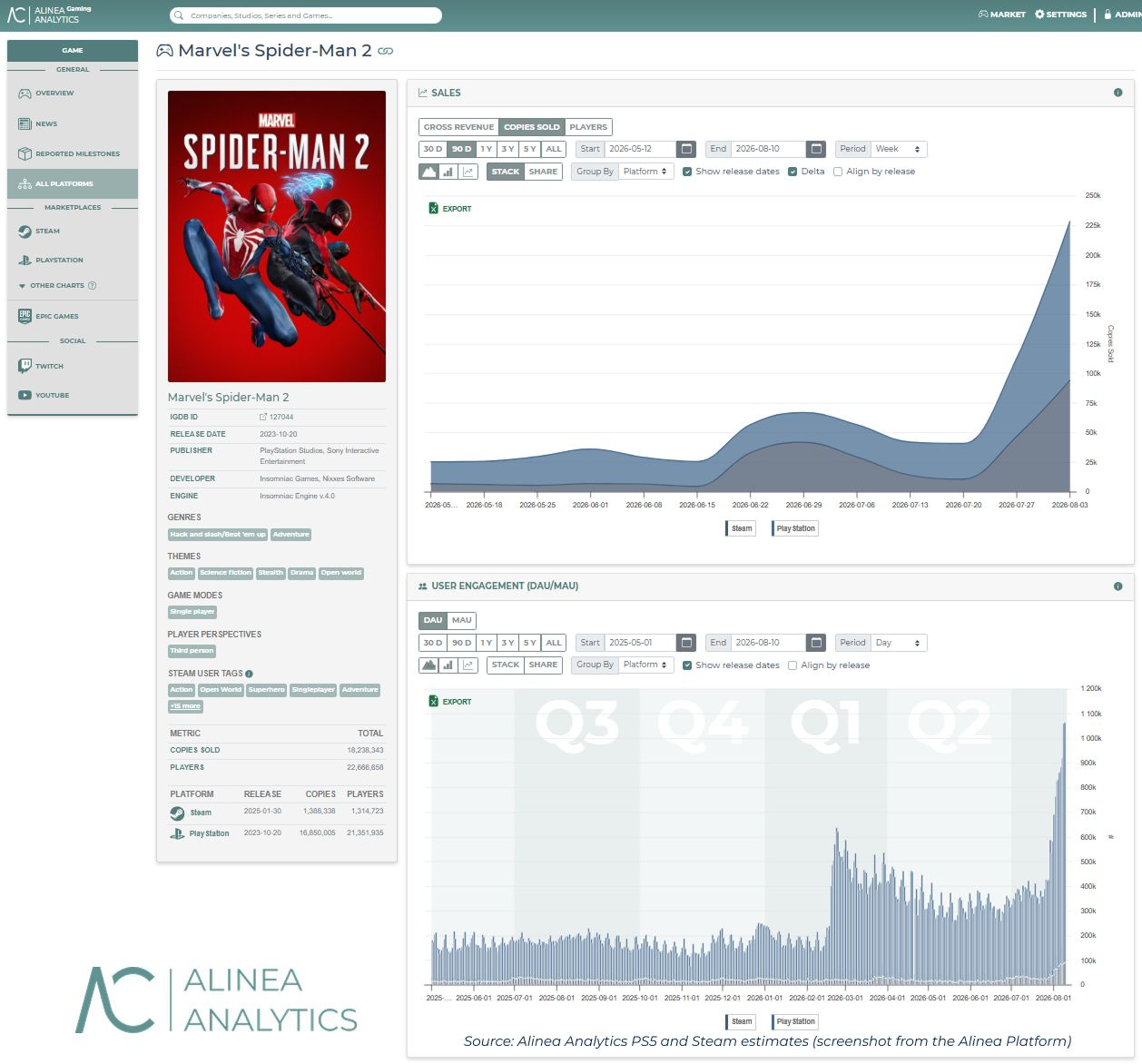
The premiere of Spider-Man: Brand New Day helped Marvel’s Spider-Man 2 sell another 316 thousand copies. Daily players topped 1 million for the first time since October 2023, and the PlayStation sales rate climbed from 6.3 thousand to 15 thousand copies a day. Over three years, the game has sold 18.2 million copies and generated $1.2 billion.
A free giveaway brought over 7 million new players to Moonlighter in five days. That matches the entire player base the game by Digital Sun and 11 bit Studios built in its first seven years. Peak concurrents hit 14.2 thousand. Moonlighter 2: The Endless Vault launches on September 2, 2026.
The Rogue Prince of Persia has passed 1 million players. The game entered early access in May 2024.
Arco has broken even after selling more than 100,000 copies. It took the Mesoamerican fantasy tactical RPG, published by Panic, two years to reach that mark. Most sales came through Steam, with a notable share of players on Steam Deck.
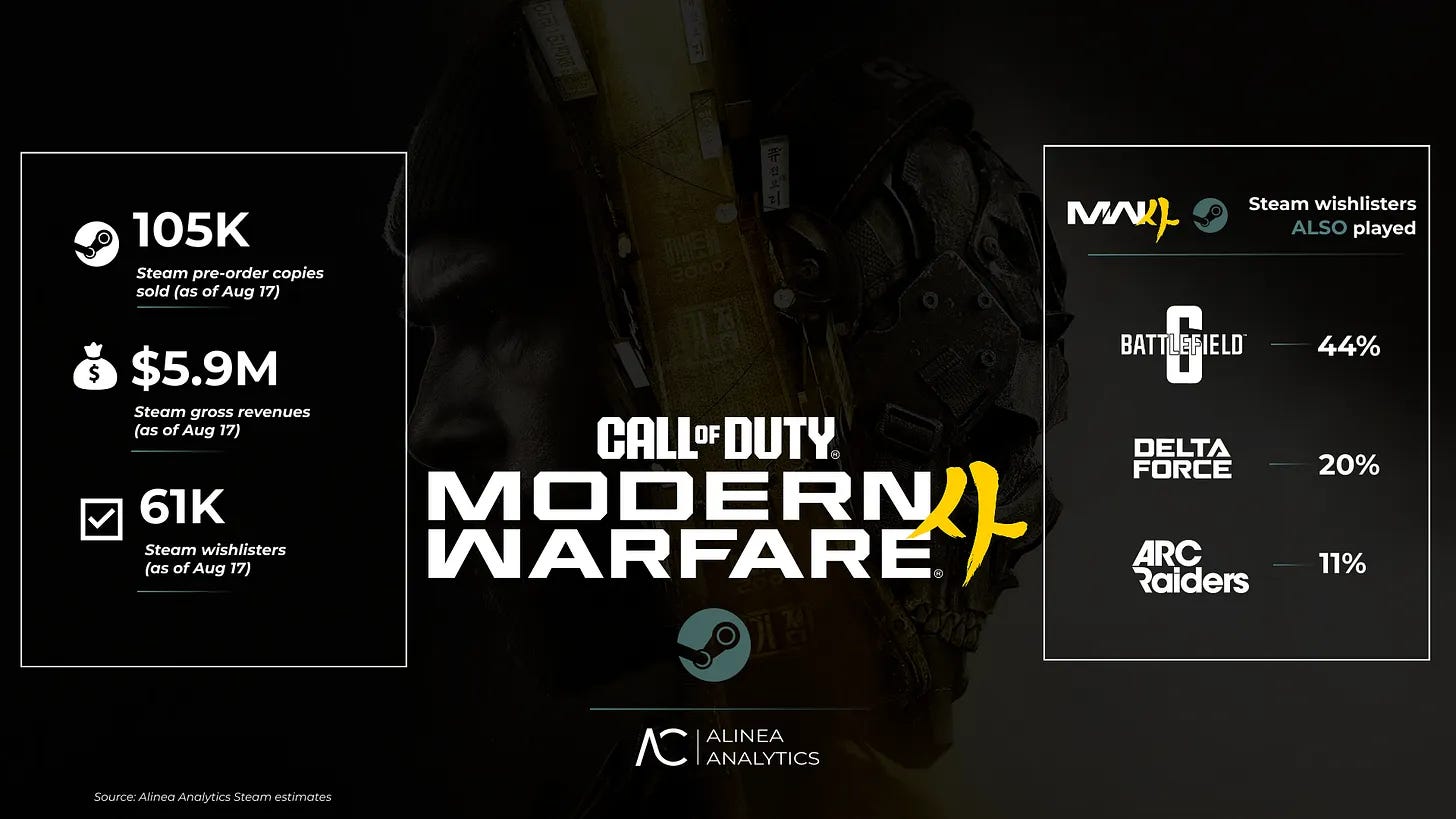
Call of Duty: Modern Warfare 4 has already made almost $6 million from Steam pre-orders. The Infinity Ward title has collected 105,000 pre-orders and 61,000 wishlists, a fifth of which come from China. It launches on October 23, 2026.
Control Resonant by Remedy has collected over 1.5 million wishlists. The game ranked top-3 in PlayStation pre-orders in the US, Germany, and Brazil, while Alan Wake 2 has finally reached 3 million copies sold.
Onimusha: Way of the Sword has reached 2 million wishlists. Capcom’s first new entry in the series in 20 years sits 19th among Steam’s most anticipated games and launches on September 4, 2026.
Exodus has been wishlisted more than 500 thousand times. The sci-fi action RPG by Archetype Entertainment arrives in early 2027.
Bain & Company: The Gaming Industry in 2026
Player behavior data was collected in June 2026; the company ran the survey itself. It covered 5,339 gamers worldwide: in the US, the UK, Germany, France, Japan, Brazil, India, and Saudi Arabia.
The market
The market estimate is built on data from IDC, PwC, Omdia, and S&P Capital IQ. The forecast is as of December 2025 and excludes hardware sales, advertising revenue, and esports.
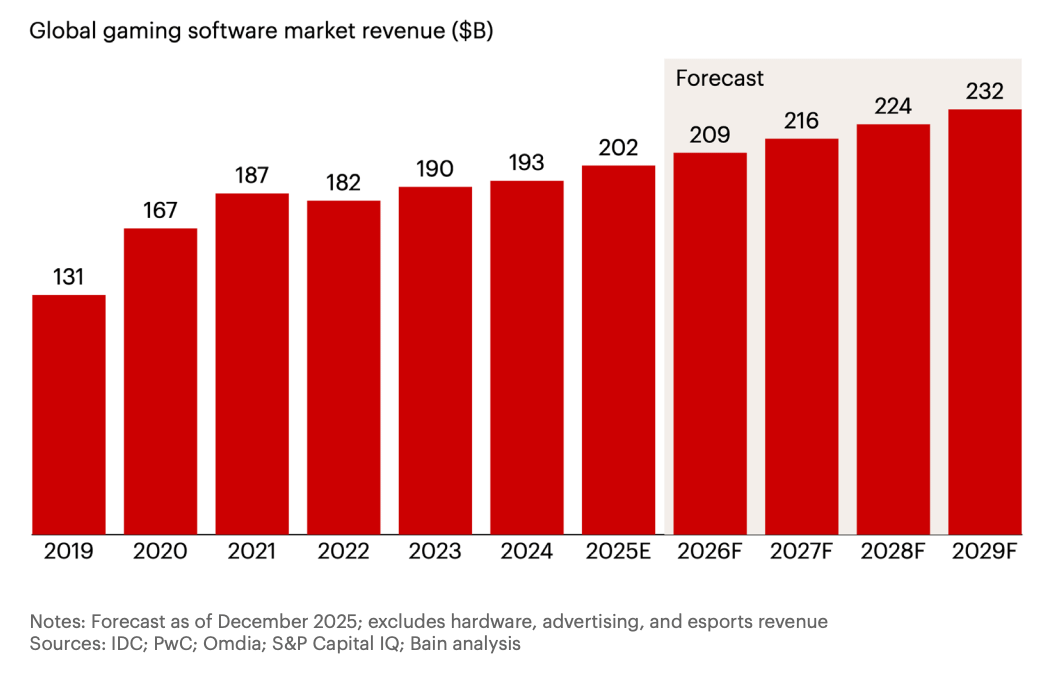
Gaming software revenue was $202 billion in 2025. Over the past four years, by the company’s estimates, the market grew about 3% annually, and Bain & Company assumes the same pace for the next four: by 2029, industry revenue should reach $232 billion.
A word from our sponsor

Game studios run on contractors — artists, composers, QA testers, translators — often spread across a dozen countries. That’s a lot of contracts, tax rules, and IP clauses to track. Mellow handles all of it: compliant contracts, automated payments, and IP protection built in, for contractors in 150+ countries.
In 2026, the forecast puts the market at $209 billion. For comparison, Newzoo expects the market to reach $213.9 billion this year, with 6.1% growth. On growth rates, the two estimates differ by nearly twice.
❗️Bain & Company has noticeably lowered its own forecast. In its 2024 report, the company valued the 2023 market at $196 billion and expected 6% annual growth to $257 billion by 2028. Now 2023 has been restated at $190 billion, and the estimate for 2028 is $224 billion. Over two years, the 2028 forecast has come down by $33 billion.
Gaming’s share of total media consumption has plateaued. Analysts write that the industry has already captured most of the audience, and people have no free time left.
Audience and its preferences
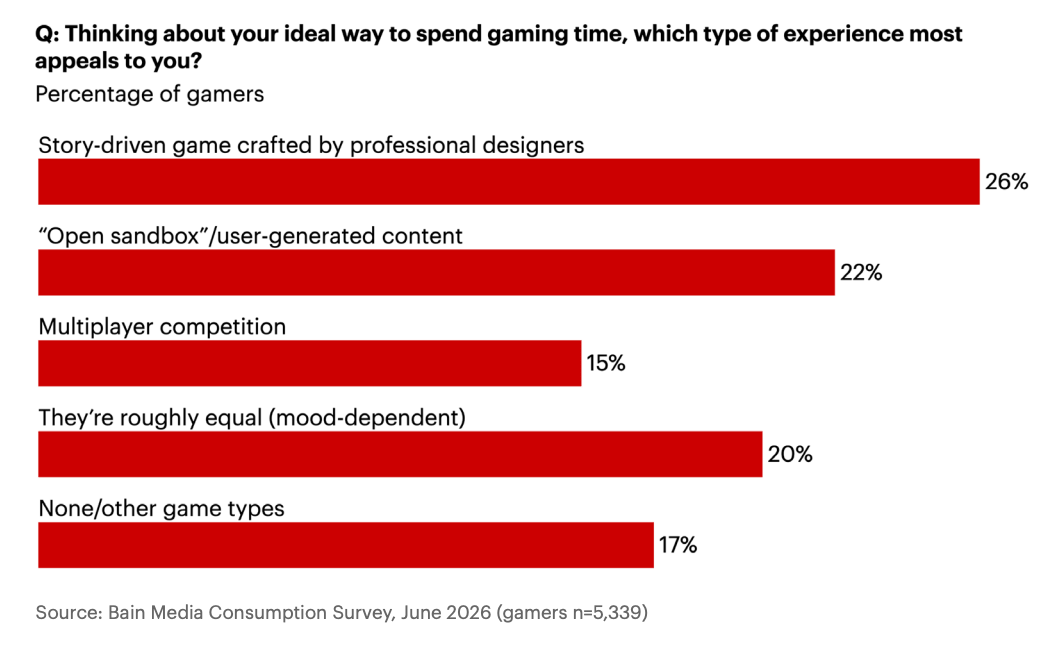
Players like different games. 26% prefer story-driven games from professional studios; 22% like UGC projects and sandboxes; and 15% like competitive multiplayer projects. The market is fragmented.
Three-quarters of gamers were looking for what to play next at the time of the survey. Most of them, though, don’t plan to go beyond their usual genres.
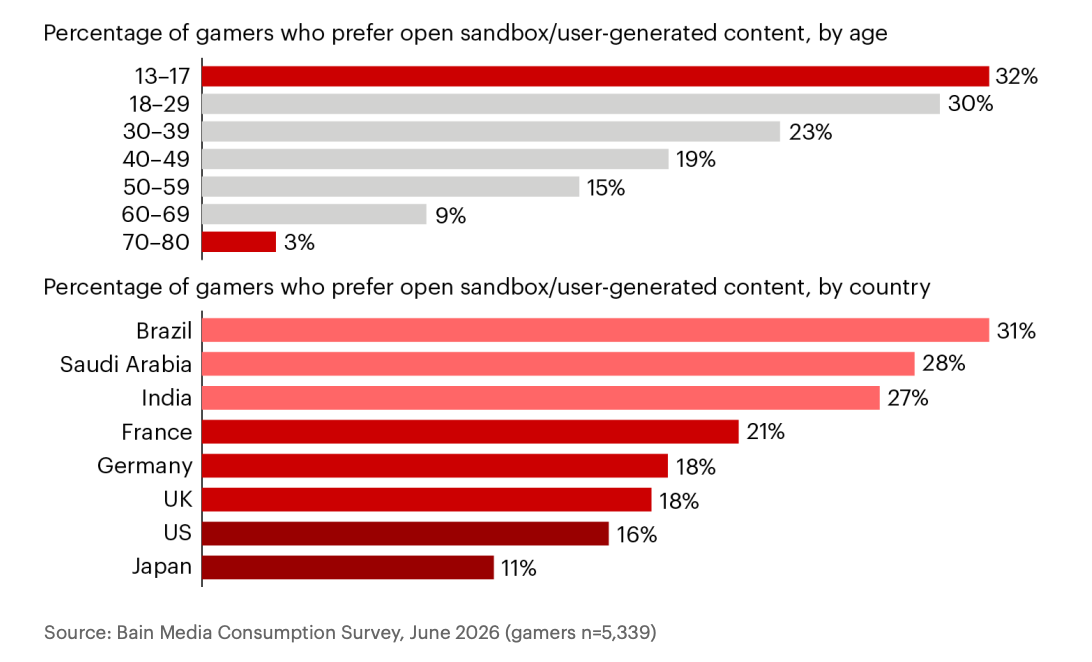
Interest in sandboxes and UGC declines sharply with age. Among teens ages 13 to 17, 32% choose them; among people ages 50 to 59, 15%; and among those over 70, 3%.
By country, sandboxes and UGC are most popular in Brazil (31%), Saudi Arabia (28%), and India (27%). They are least popular in Japan (11%) and the US (16%).
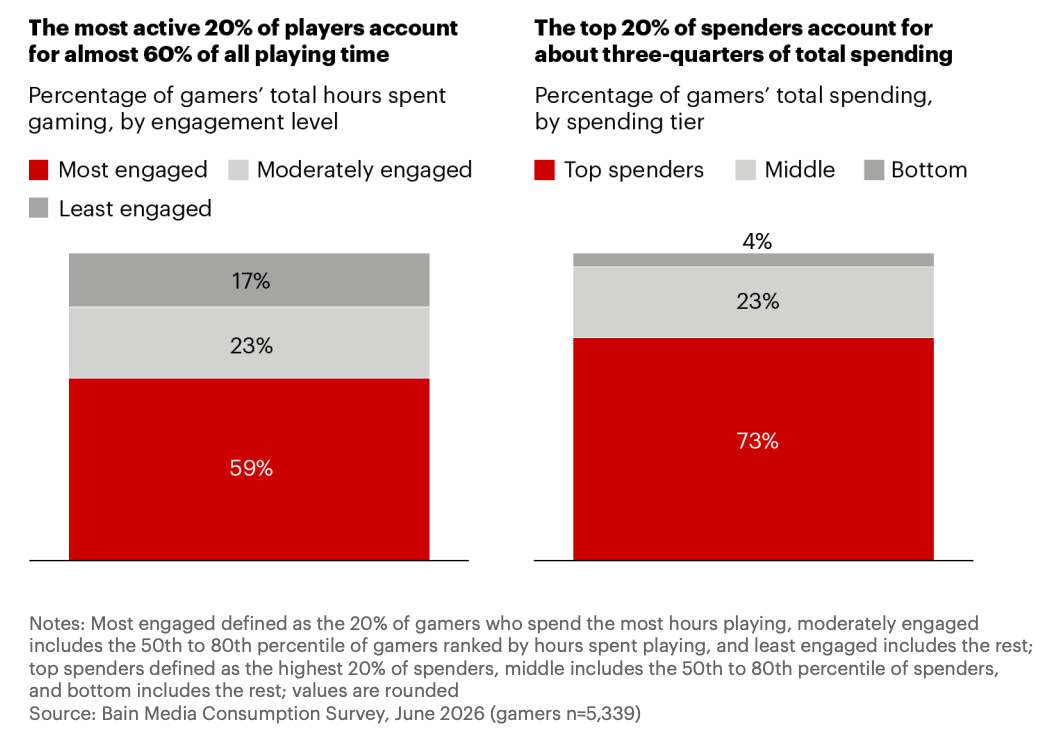
The most active 20% of players account for 59% of all playing time. The top 20% of spenders bring in 73% of all the money.
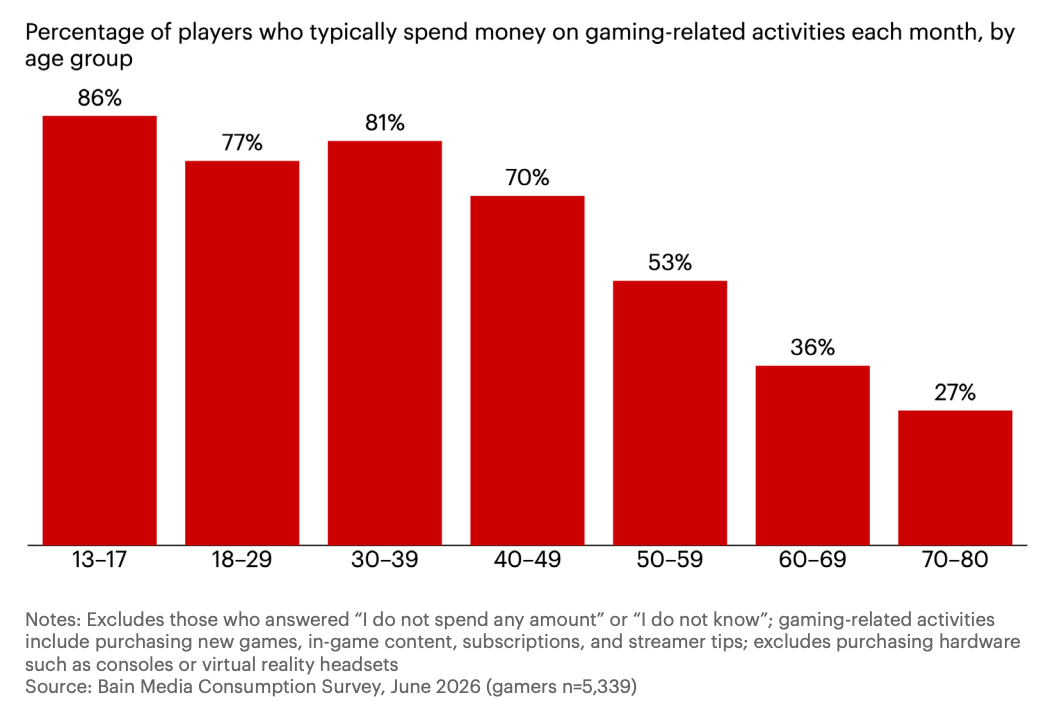
Per the survey, teenagers spend money in games most often: 86% of players ages 13 to 17 spend money on games in a typical month. Among people ages 50 to 59, the share falls to 53%, and among the 60 to 69 audience, to 36%. The relationship isn’t entirely linear, though: players ages 30 to 39 pay more often (81%) than the 18 to 29 audience (77%).
People who create game content for others spend money twice as often as everyone else.
Focus and AI
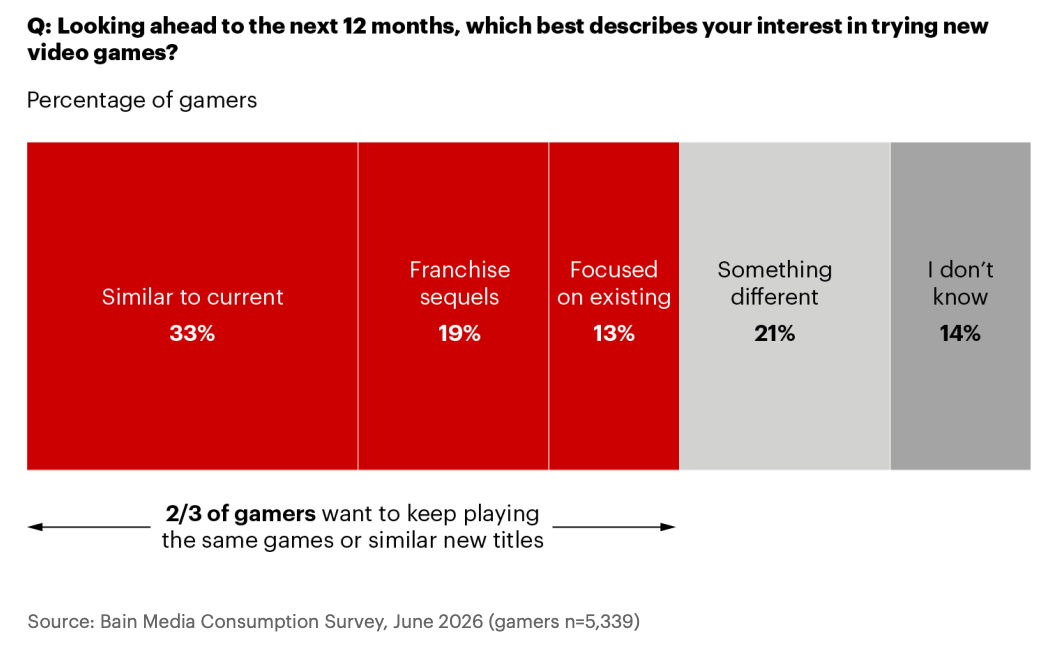
Two-thirds of gamers want roughly the same thing over the next 12 months as they have now: 33% are looking for games similar to their current ones, 19% are waiting for sequels to favorite franchises, and 13% plan to play only what they already play. Only 21% want something fundamentally new.
Bain & Company reviewed 100 games released since 2023. Among projects with a clear target audience, 83% were commercially successful; among projects without one, 50% were.
❗️Bain & Company sorted the games by themselves into those with a clear target audience and those without. The analysts acknowledge that far less publicly available data exists on failures than on successes.
As an example, the analysts point to Baldur’s Gate 3 and Concord: two large bets placed at roughly the same time. The first game sold more than 20 million copies and earned $657 million on Steam in 2023. The second launched into an overheated hero-shooter market and ended in a loud failure.
As another example of successful focus, Bain & Company points to Jagex. The studio sold off some of the teams it had acquired earlier, cut its project slate, and rebranded as Jagex: The RuneScape Company. The company removed RuneScape’s microtransaction system and focused on long-term growth. It also started working with a portfolio of products inside the universe: RuneScape: Dragonwilds sold more than a million copies in its first year.
AI, in the analysts’ view, doesn’t fix these problems. It speeds up production, but unfocused studios fail faster.
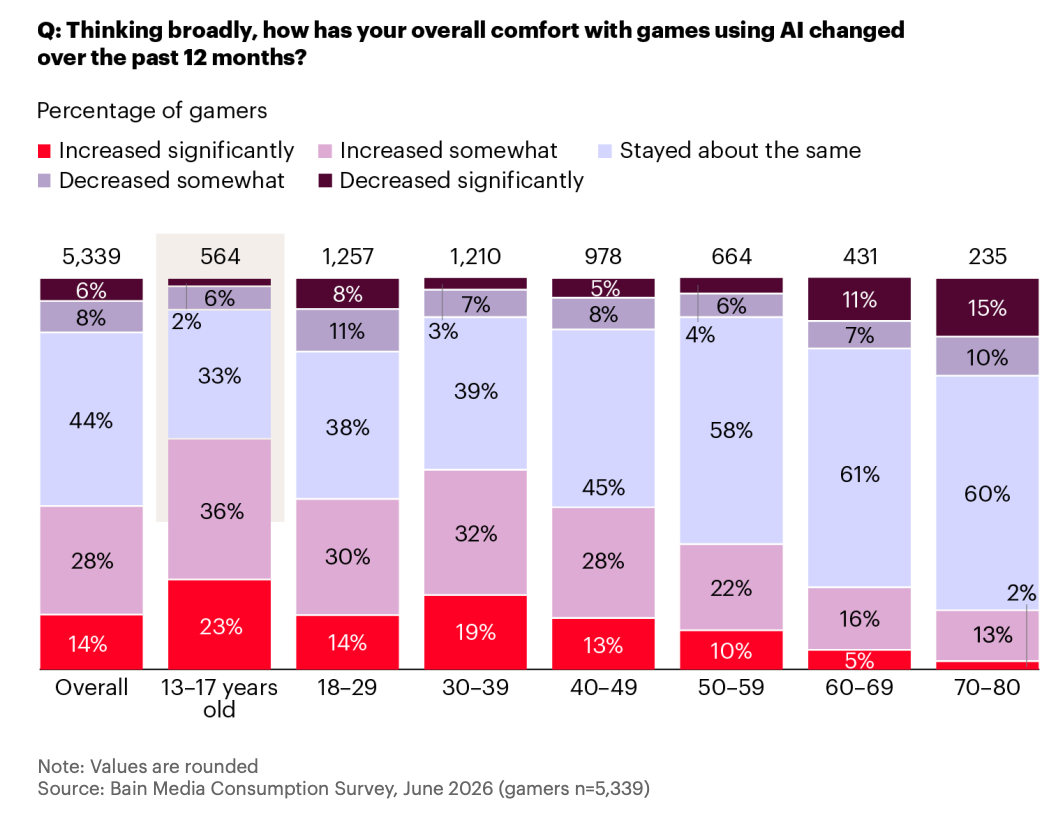
42% of players are more comfortable with the use of AI in games than they were a year ago. 44% did not change their opinion, and only 14% became less comfortable.
Among teens ages 13 to 17, 59% became more comfortable with AI. In the 70 to 80 group, though, 25% became less comfortable.
Personalization
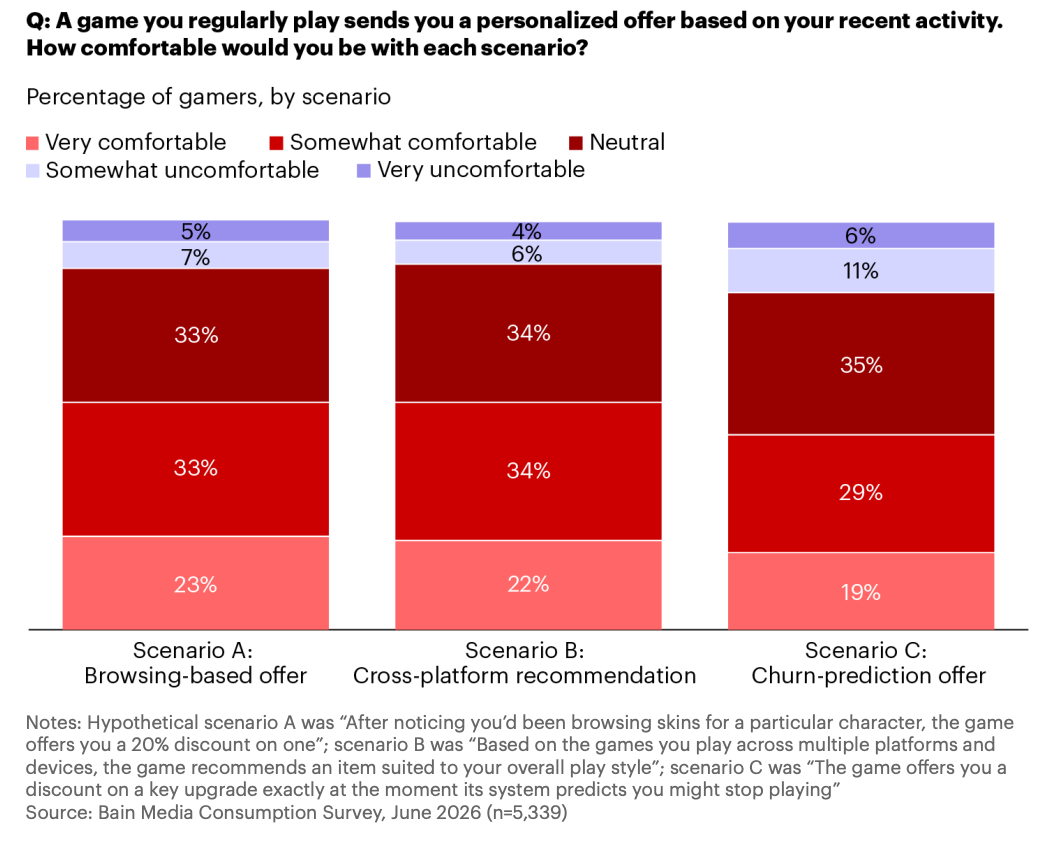
Players aren’t against personalized offers. For a personalized discount on a skin the person recently browsed, 56% feel positive about it, and another 33% are neutral. The worst-received offer is one a game sends when an algorithm predicts the player is about to leave: 17% of respondents said they feel uncomfortable at that moment.
Bain & Company identifies five areas for personalization: the in-game store and offers, lapsed player reengagement, onboarding, in-game content discovery, and cross-promotion between one publisher’s projects.
Distribution and D2C
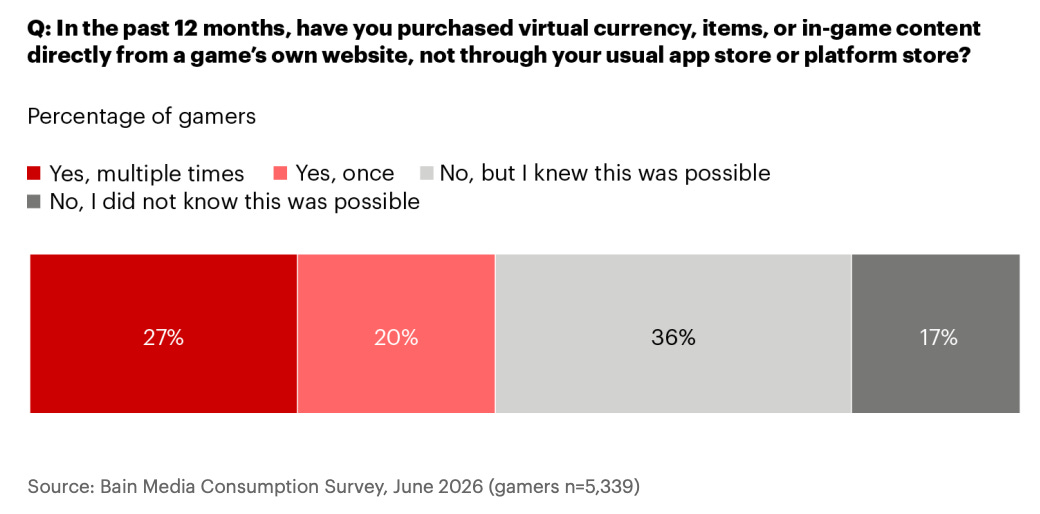
Nearly half of gamers purchased currency, items, or content directly on a game’s website at least once in the past 12 months. 27% did so several times, and 20% did so once.
The share of D2C buyers among mobile players and among PC and console players is roughly the same. Among teens ages 13 to 17, 40% made several direct purchases over the year.
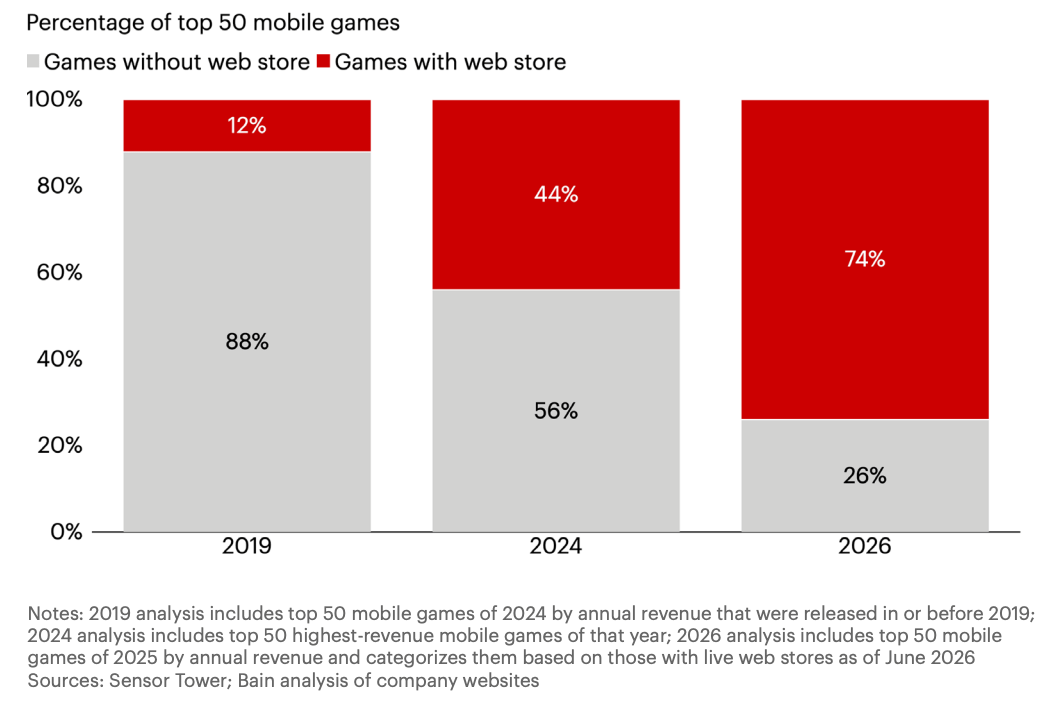
Three-quarters of the top 50 mobile games by revenue have their own web stores. In 2019, 12% did; in 2024, 44% did.
Every transaction moved to direct sales gives the publisher an additional 15% to 30% margin.
A word from our sponsor
Game studios run on contractors — artists, composers, QA testers, translators — often spread across a dozen countries. That’s a lot of contracts, tax rules, and IP clauses to track. Mellow handles all of it: compliant contracts, automated payments, and IP protection built in, for contractors in 150+ countries.
Bain & Company cites a report from GDC and Appcharge, which puts D2C revenue in mobile games at about $17 billion, or roughly 15% of the mobile IAP market. At Modern Times Group and Playtika, the share of direct sales grew from about 25% to 40% of revenue over the year.
❗️The $17 billion estimate is arguable. It is built on assumptions about how incremental D2C revenue really is.
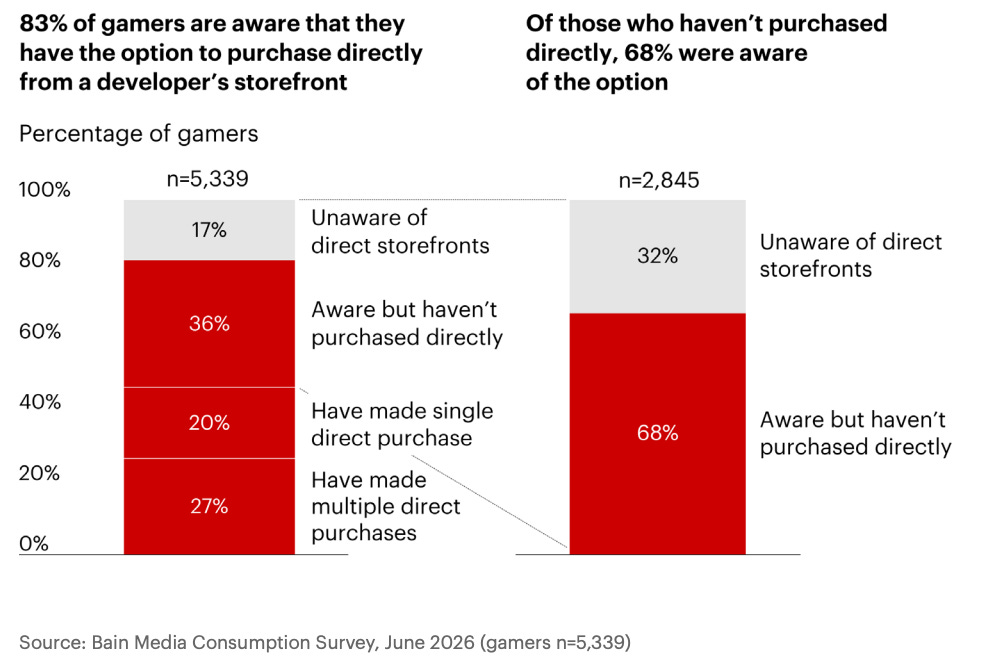
83% of gamers know that buying directly from a developer is even an option. Among those who have never bought that way, 68% knew about it. The problem with web stores, it seems, isn’t awareness but conversion. Buying in-app is simply more convenient.
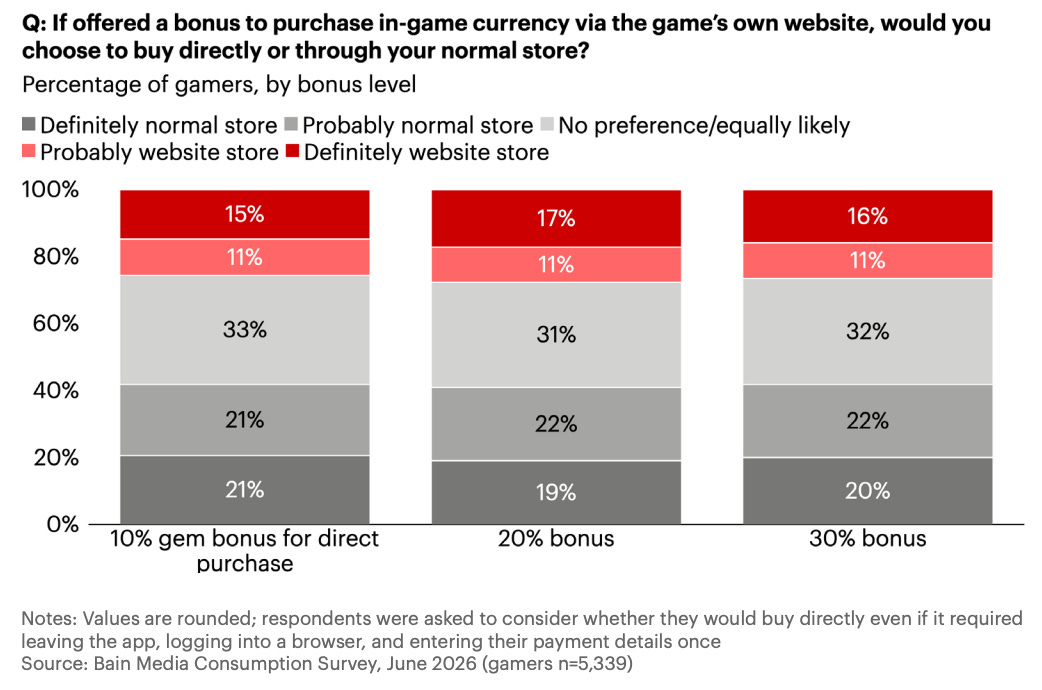
Raising the bonus for a web-store purchase from 10% to 30% has almost no effect on behavior. It moves the share of those who would definitely choose the game’s website by a single percentage point: from 15% to 16%.
Among those who have already bought several times directly, though, 84% say a personalized offer would raise their chances of making a purchase.
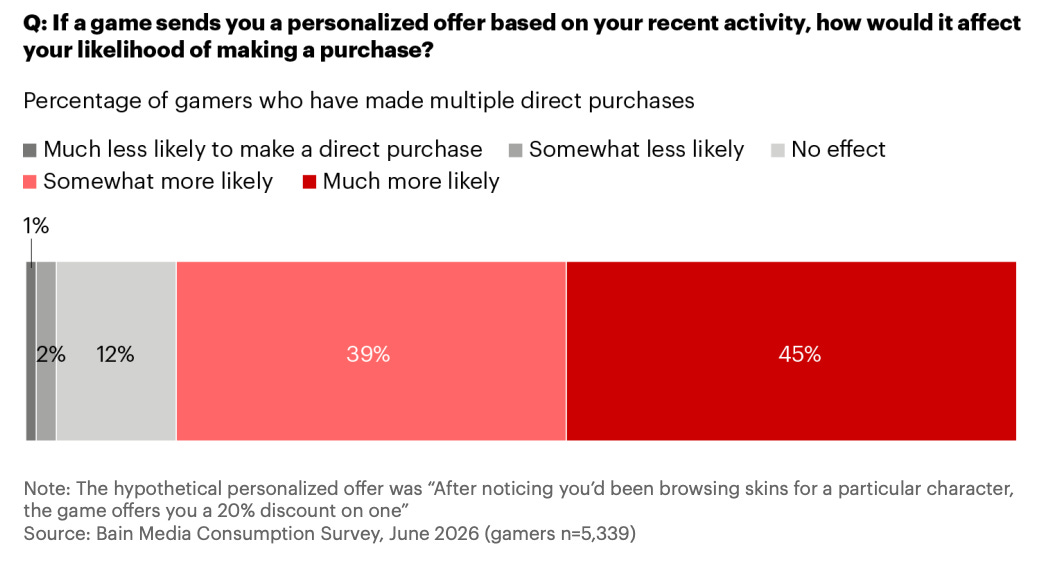
84% of users who buy in web shops noted that personalized offers would increase their likelihood of making a purchase. That is 2.5 times more often than among regular players.
Bain & Company notes that for a midsize developer or publisher, the savings on platform fees pay for building a web store in about a year.