


Reports of the week:
Newzoo: The Gaming Market in 2026
Values Value & InGameJob: European Gaming Job Market in 2026
Video Games Europe & EGDF: The European Gaming Market in 2025
Newzoo: The Gaming Market in 2026
Newzoo counts sales of physical and digital game copies, in-game purchases, subscriptions, and mobile platform revenue. The estimate excludes advertising, console and peripheral sales, B2B services, gambling, and betting. All figures are given before taxes.
❗️I already covered the headline forecast numbers in August, when Newzoo released the preview. Here is what the preview didn't cover: spenders, platform details, genres, and the Q1’26 financial results. Plus a comparison with what Newzoo wrote exactly a year ago and in June.
The market and the forecast
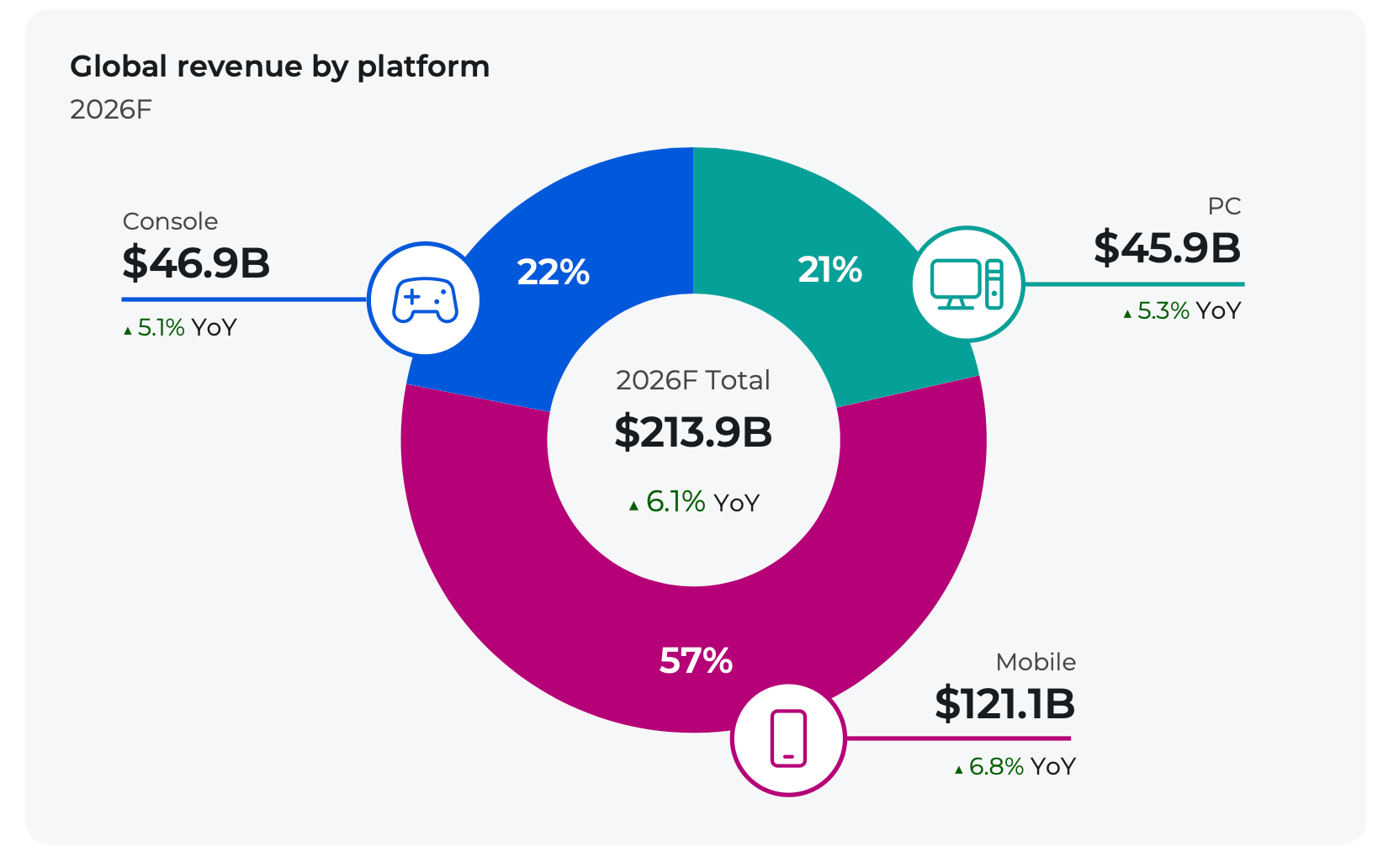
The gaming market will grow to $213.9 billion in 2026 (+6.1% YoY). Newzoo expects it to reach $225 billion in 2027, $234.4 billion in 2028, and $242.8 billion in 2029.

From concept art to launch-day marketing, most game studios rely on contractors in multiple countries. Mellow makes it simple to hire, pay, and stay compliant with talent in 150+ countries — no legal entity required.
Growth is slowing, though. Between 2023 and 2026, the market grew 6.3% a year on average, and between 2026 and 2029, Newzoo expects 4.3%.
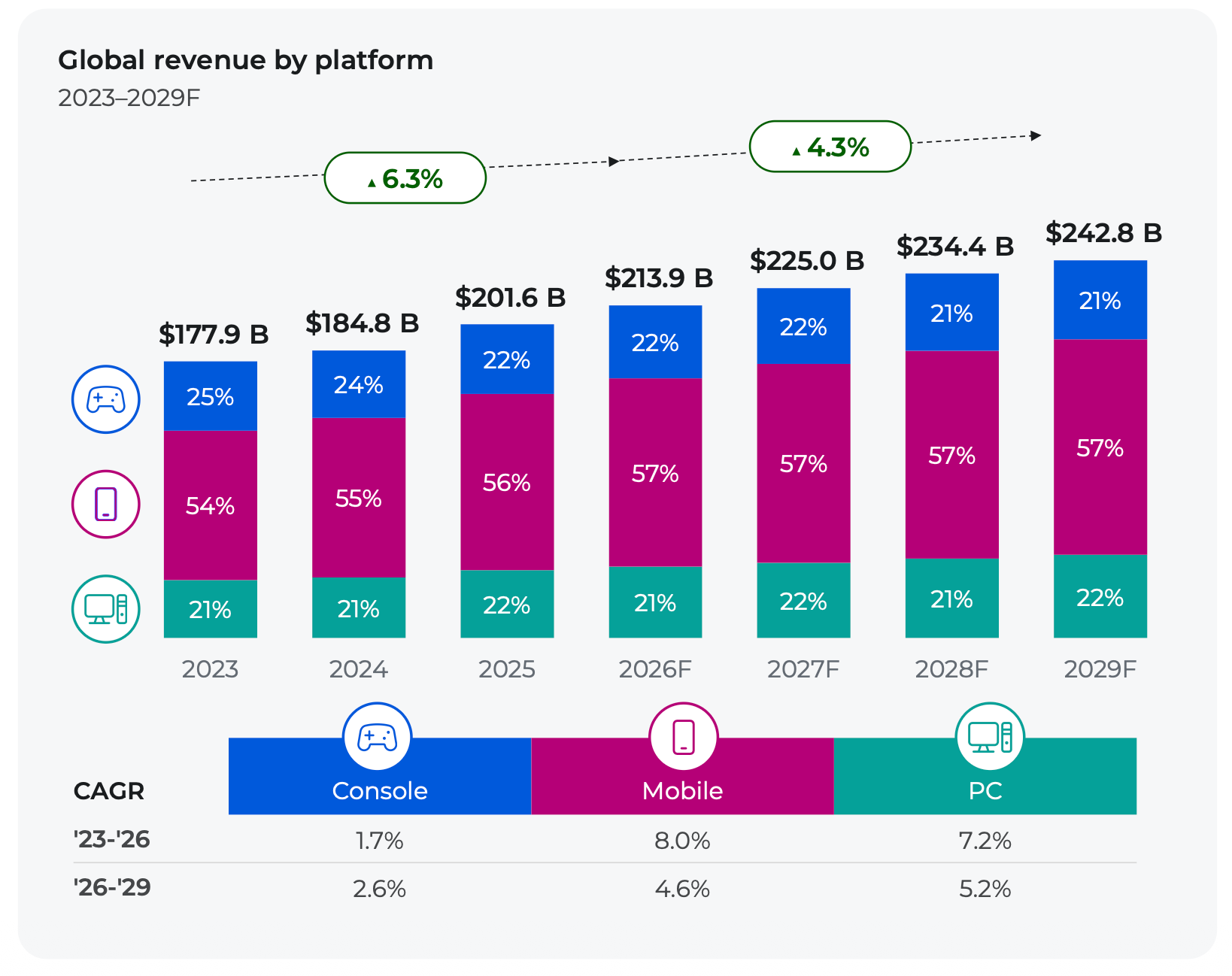
By average annual growth between 2026 and 2029, PC will grow fastest (+5.2%), mobile is forecast at 4.6% a year, and console at 2.6%. Mobile’s growth rate has nearly halved; PC is losing pace as well, but console should grow faster than in previous years.
❗️In the report released a year ago, in September 2025, Newzoo expected market revenue of $188.8 billion (+3.4% YoY), and the final estimate came in at $201.6 billion (+9.1% YoY). Mobile grew beyond the original expectations: $113.3 billion instead of $103 billion. PC was expected at $39.9 billion and came in at $43.6 billion. Console, by contrast, was overestimated: the forecast was $45.9 billion (+5.5% YoY), and the actual figure was $44.7 billion (+2.8% YoY).
Players and spenders
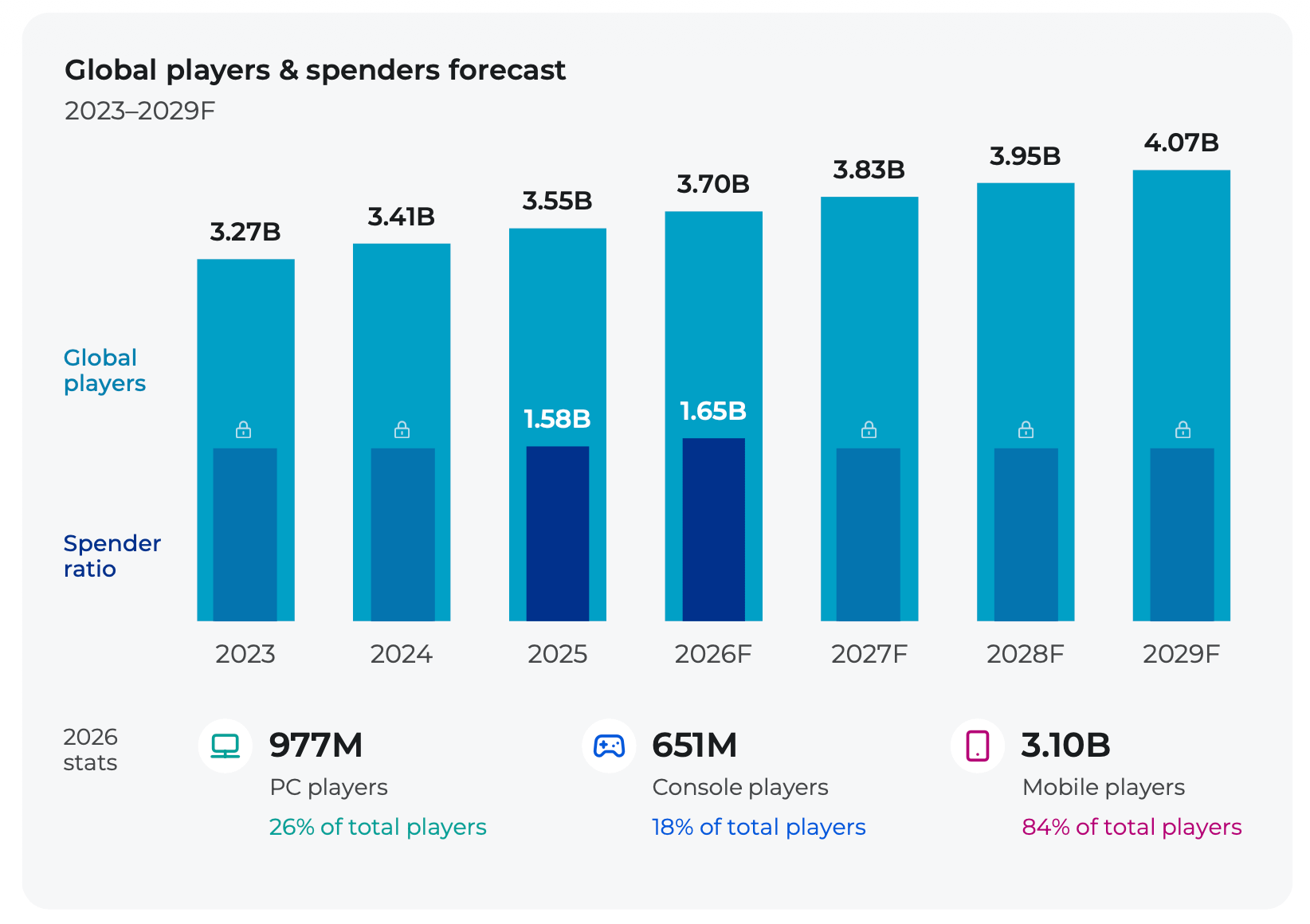
Newzoo expects 1.65 billion spenders in 2026 (+4.7% YoY) against 3.7 billion players. Spenders make up 44.6% of the total audience; in 2015, that share was 39.4%. A year ago, Newzoo put the number of spenders at 1.6 billion (44% of the audience).
ARPPU in 2026 is $129.6 (+1.4% YoY). Newzoo notes that player-to-spender conversion is not growing, so expect deeper monetization of the existing user base.
In last year’s report, the average spend per spender for 2025 was put at $119.7. The 2026 forecast is now $129.6 with growth of only 1.4% YoY, so Newzoo appears to have raised its 2025 baseline as well.
Newzoo expects spenders to grow 3.4% a year through 2029, and players 3.2%.
Over the year, the total audience grew from 3.578 billion to 3.70 billion people. Mobile players grew from 2.985 billion to 3.1 billion, PC players from 936 million to 977 million, and console players from 645 million to 651 million.
PC
977 million people play on PC (+3.5% YoY); in 2025, growth was 4.4%.
PC has the highest spender conversion of any platform: 55%.
Steam’s audience will grow 5%, and the Epic Games Store’s 4.7%, so both outgrow the platform as a whole. A year ago, Newzoo said the same thing about Steam, but without the figures. South Korea, Vietnam, and Indonesia now drive growth in Steam’s user base, while China and Japan contribute less.
Epic reported 317 million users in 2025, against 295 million a year earlier (+7.5%). That figure covers all of Epic’s platforms, though, not EGS on PC alone.
The share of microtransactions in the PC revenue mix will grow in 2026, per Newzoo’s forecast. In 2025, the largest part of the segment’s growth came from game sales (+25% YoY), while microtransactions grew more modestly (+9.1% YoY).
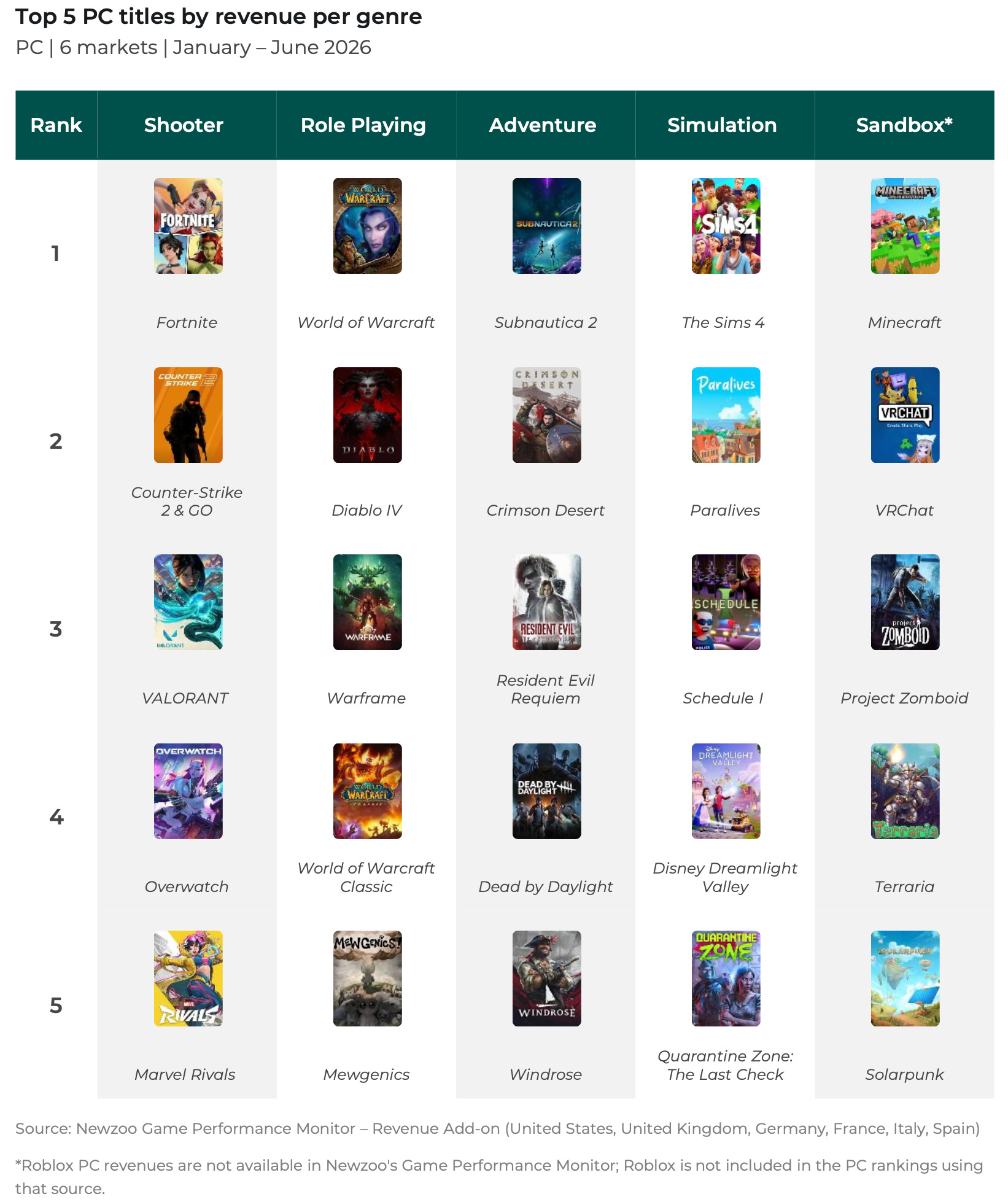
Among new premium releases, Forza Horizon 6 earned the most on PC in H1’26. Subnautica 2, Crimson Desert, and Resident Evil Requiem follow.
Live-service projects were mostly flat or down in H1’26 vs. H1’25. Only World of Warcraft, Diablo IV, Overwatch, Roblox, and Tencent’s international titles grew.
Newzoo sees hardware availability as the main risk for the PC segment. Since January 2025, DDR4 memory has risen roughly 3.3x in price, and DDR5 5x.
Console
651 million people play on consoles (+3.0% YoY). For comparison, the audience grew only 0.5% in 2025, though Newzoo expected +2.5% a year ago.
The segment will only pass its original 2025 revenue expectations in 2026, and only thanks to GTA VI.
Growth mostly comes from PlayStation, followed by Xbox and Nintendo. Switch 2’s user base is growing, but the decline of the original Switch’s audience eats up almost all of the gain: in 2025, the number of active players across the two platforms fell 0.8%. And that is with 15 million Nintendo Switch 2 units sold in the first seven months.
The main console growth markets in 2026 are Japan and China. After the Switch 2 launch, Japan grew for the first time following two years of decline.
Console digital revenue fell YoY in H1’26 across all six Western markets Newzoo tracks. That is not because players suddenly fell in love with physical copies, though: F2P projects and annual franchises declined in revenue more than new releases brought in.
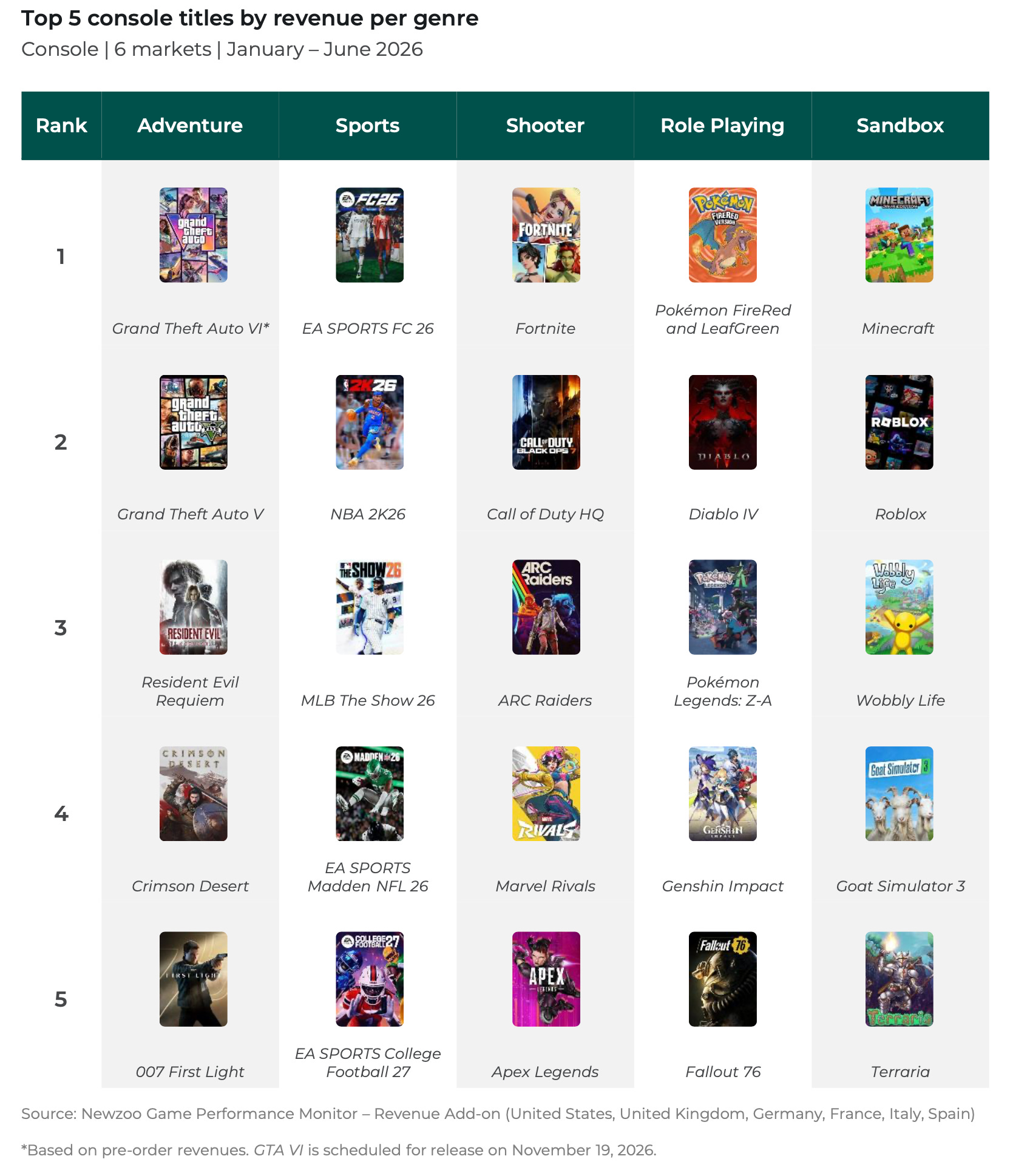
Console microtransactions fell 4.6% YoY in 2025, mostly because of Fortnite and Call of Duty. That still didn't stop Fortnite from leading the Shooter category in H1’26 on both console and PC.
Without the GTA VI release, the console segment likely would have declined vs. last year.
Multi-game subscription revenue is growing, though. And that is despite Game Pass Ultimate price cuts and the loss of day-one access to Call of Duty. In 2025, subscriptions grew 10.2% YoY, with PlayStation Plus as the main driver.
Newzoo believes the console install base will not grow any further. It expects the tenth console generation in late 2027, but is confident that, given the price, most will buy it only if they already own a console.
❗️In June, Newzoo wrote that a new generation launching in late 2027 looked unrealistic, and that the current generation would stay on the market longer. In the current iteration of the report, a 2027 release is modeled, but with no effect on the size of the install base.
Mobile
3.1 billion people play mobile games (+3.9% YoY). Net audience growth is 117.8 million people, and 80% of that comes from Central and Southern Asia, Southeast Asia, the Middle East, and Africa.
The iOS audience will grow faster than the Android audience in 2026 (+5.5% vs. +3.4%), lifting the platform’s share to 25.6%. In absolute terms, Android is still bigger, though: 2026 will add 76.3 million more Android owners against 41.6 million new iPhone owners.
❗️A year ago, Newzoo described the exact opposite picture: iOS was losing share in both developed and emerging markets, while Chinese smartphone makers were actively taking Europe, MENA, and Southeast Asia.
The mobile audience grows fastest in Sub-Saharan Africa (+9.4%) and Central and Southern Asia (+5.6%). China will grow 0.9% in 2026, and Japan will become the first market that, per Newzoo’s forecast, starts to decline (-0.2%).
Downloads have been falling since 2020, and in 2025 the decline reached every region. According to AppTweak, downloads fell 25% YoY in H1’26.
Acquisition costs are rising with no efficiency gains. Cost per install rose 30%, to $0.56, and the paid-to-organic ratio climbed 61% (Adjust data).
EMEA’s share of Chinese publishers’ revenue grew from 19% in 2019 to 37%.
D2C is becoming the norm: by Q1’26, four of the five publishers Newzoo tracks drew at least 39% of their gaming revenue directly from consumers. A year ago, Newzoo wrote that D2C was reshaping the revenue mix but not driving segment growth.
China and North America will remain the growth leaders (half of all revenue growth will come from these two markets), and, at the same time, account for half (52%) of the entire global games market through 2029.
Regions
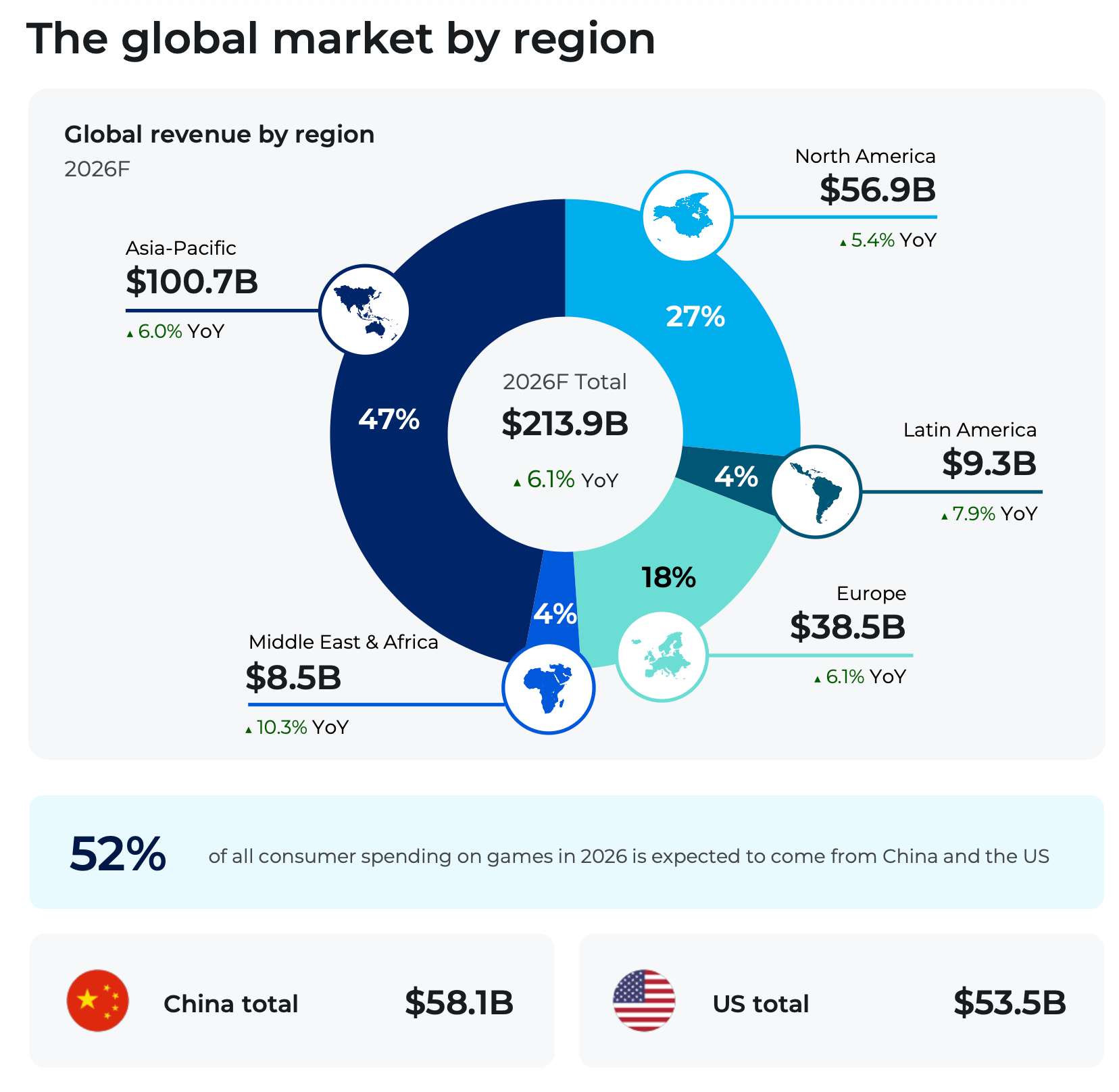
The Middle East and Africa remain the fastest-growing region for the third year running. In 2025, Newzoo expected the region to reach $7.1 billion (+7.5% YoY), and it actually grew 15% to $7.7 billion. Further growth to $8.5 billion (+10.3% YoY) is expected in 2026.
Europe grew 10.7% in 2025, to $36.3 billion. PC revenue there rose 15.7%, and mobile revenue 15.5%. By the end of 2026, the region will grow to $38.5 billion (+6.1% YoY).
Asia-Pacific grew 9.9% in 2025, to $95 billion, on the back of Japan and South Korea. In 2026, growth to $100.7 billion (+6.0% YoY) is expected.
North America is growing the slowest of all regions for the second year running: +5.7% in 2025, and +5.4% in 2026.
Genres in H1’26
Newzoo collects PC and console data across six markets (the US, the UK, Germany, France, Italy, and Spain), and mobile data across 72 markets using AppTweak data.
The top five PC genres by revenue are Shooter, Role Playing, Adventure, Simulation, and Sandbox. The leaders within those genres are Fortnite, World of Warcraft, Subnautica 2, The Sims 4, and Minecraft.
On console, Grand Theft Auto VI already leads the Adventure genre: on pre-orders alone, and two months before release. Grand Theft Auto V takes second place.
From concept art to launch-day marketing, most game studios rely on contractors in multiple countries. Mellow makes it simple to hire, pay, and stay compliant with talent in 150+ countries — no legal entity required.
Fortnite remains first in Shooter on both PC and console.
Sandbox made the top five genres on both platforms. Roblox is not in the PC ranking, though: Newzoo has no data on its PC revenue.
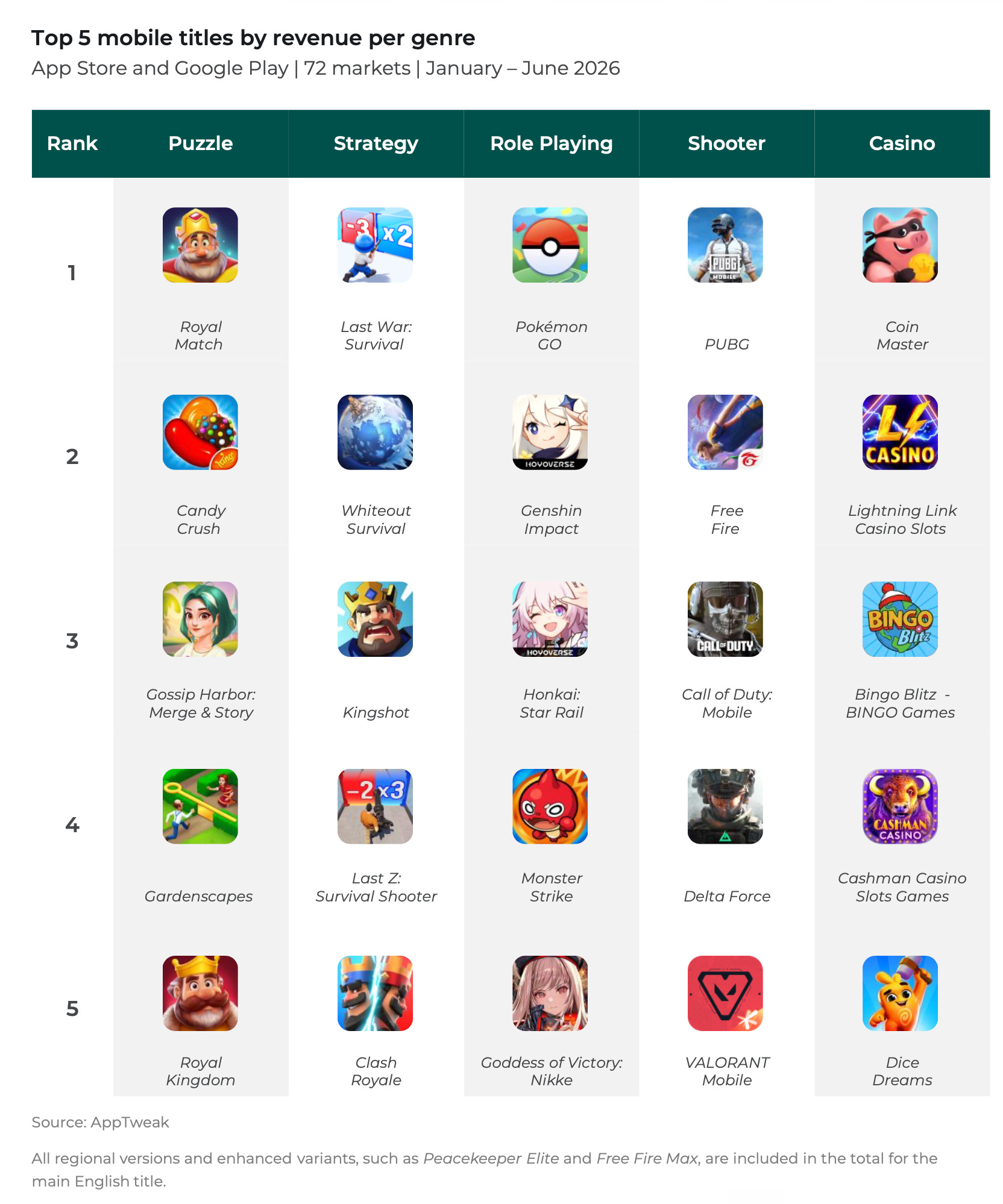
The mobile genre lineup is completely different. Puzzle (led by Royal Match) and Casino (Coin Master) sit alongside Strategy (Last War: Survival), Role Playing (Pokémon GO), and Shooter (PUBG).
Q1’26 financial results
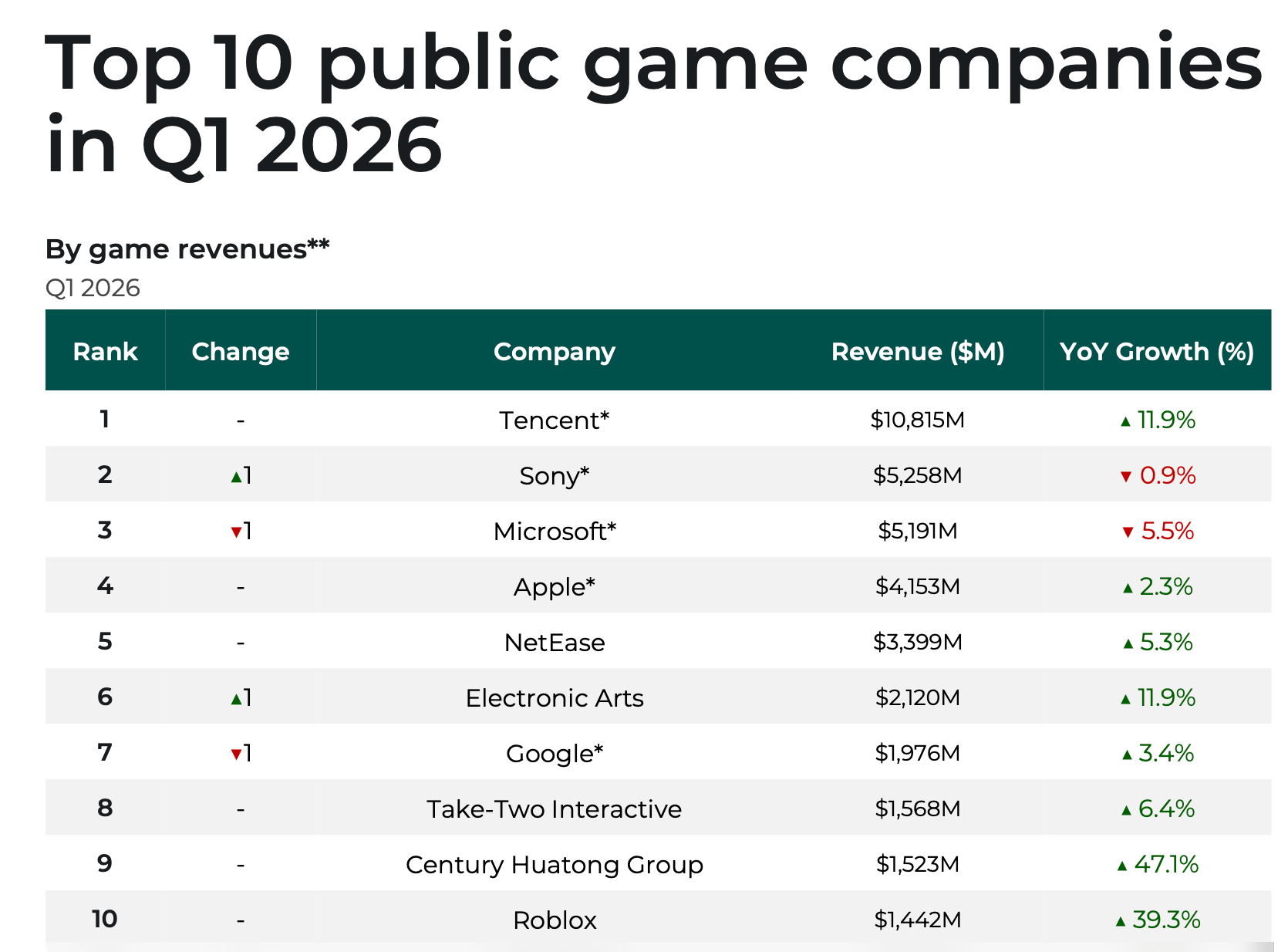
The top 10 public companies earned $37.4 billion on games (+6.7% YoY). Across the wider group of companies Newzoo tracks, growth was 6.8%.
The leaders by game revenue: Tencent ($10.815 billion, +11.9% YoY), Sony ($5.258 billion, -0.9% YoY), and Microsoft ($5.191 billion, -5.5% YoY).
The fastest growers in the top 10 are Century Huatong (+47.1% YoY, $1.523 billion) and Roblox (+39.3% YoY, $1.442 billion).
Tencent’s domestic revenue grew 6.3%, driven by Delta Force, Peacekeeper Elite, Honor of Kings, and VALORANT Mobile. International revenue added 13.3%, largely thanks to Clash Royale.
PS5 shipments fell to 1.5 million in Q1’26, against 2.8 million in Q1’25. That is the worst quarter in the console’s history.
Game Pass subscribers fell to 30 million, per Newzoo’s estimates. Microsoft last disclosed the figure in February 2024, when it was 34 million. Xbox acknowledged that the October price increase cost the service some subscribers.
Values Value & InGameJob: European Gaming Job Market in 2026
The data comes from the Big Games Industry Employment Survey, now in its tenth edition, with 1,800 respondents from 90 countries. The material covers Europe, which is split into EU countries (plus the UK and Switzerland) and the rest of Europe. Tanja Loktionova added several figures from the InGame Job job board and from open sources. This is a press preview; the full report will be released in November 2026 and will be free to download.
A word from our sponsor

Game studios run on contractors — artists, composers, QA testers, translators — often spread across a dozen countries. That’s a lot of contracts, tax rules, and IP clauses to track. Mellow handles all of it: compliant contracts, automated payments, and IP protection built in, for contractors in 150+ countries.
Loyalty and Sentiment
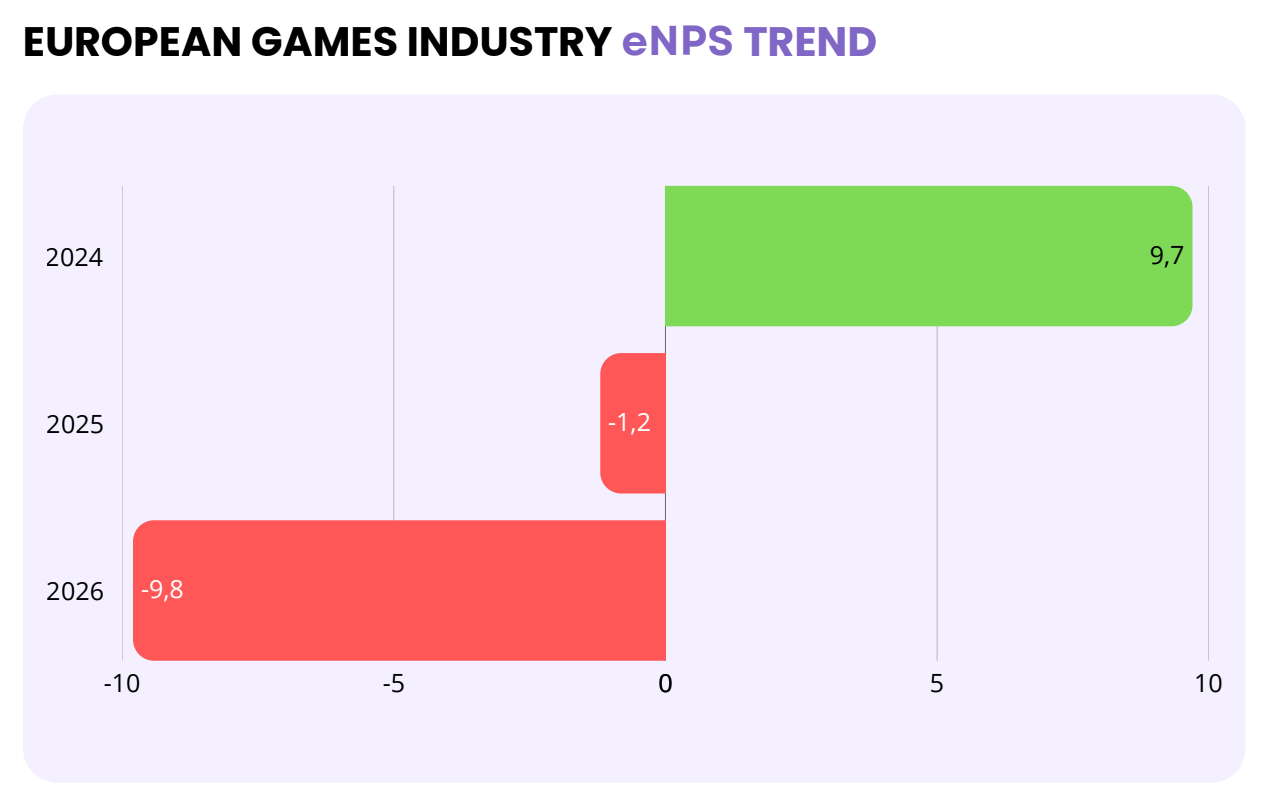
eNPS in the European games industry in 2026 is -9.8. In 2024 it was 9.7, and in 2025 it was -1.2. It stood at +30 in 2017, and it has been falling without a break since 2022.
❗️eNPS is the employee Net Promoter Score, a measure of employee loyalty. It is built on a single question: “How likely are you to recommend this company as a place to work?” on a scale from 0 to 10. Answers split into three groups: 9-10 are promoters, 7-8 are passives, and 0-6 are detractors. The share of detractors is then subtracted from the share of promoters, and passives are ignored. The scale runs from -100 to +100, and zero means there are as many promoters as detractors.
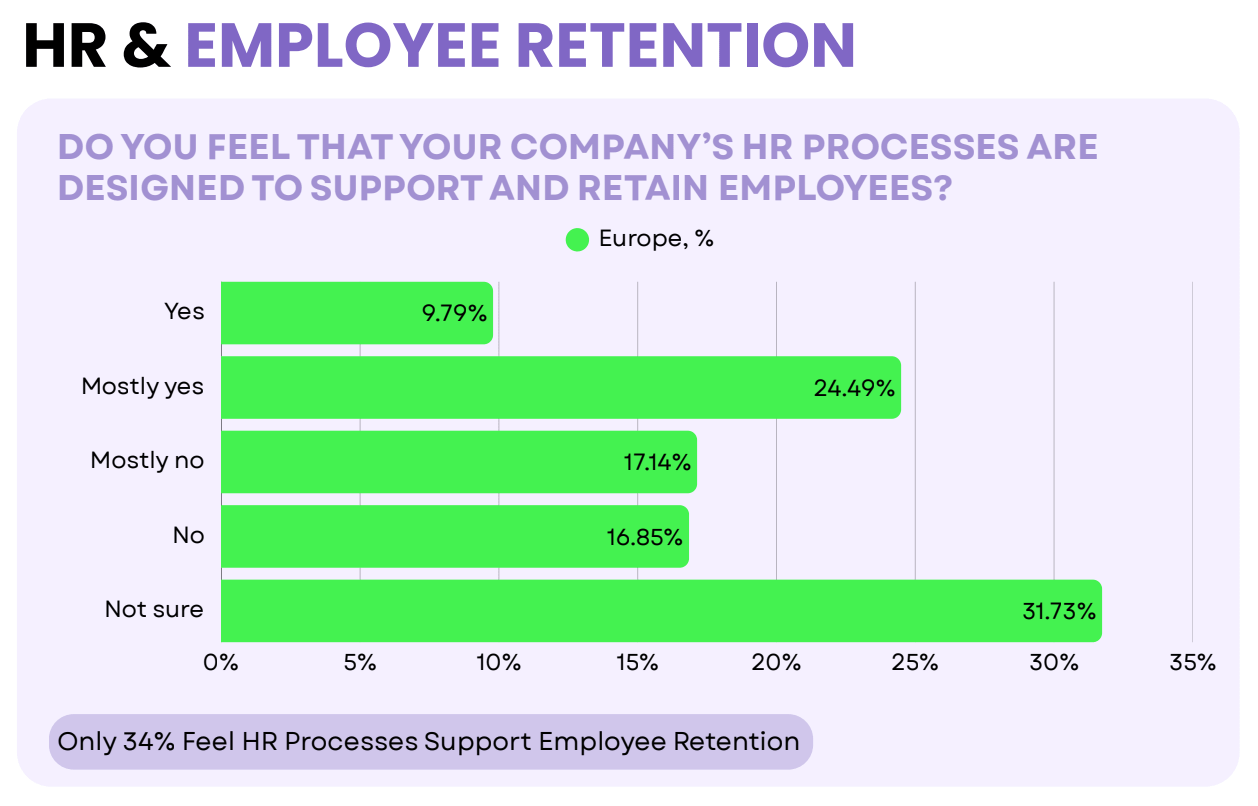
Only 34% of employees believe their company’s HR processes are built to retain people. Another 31.7% could not answer the question.
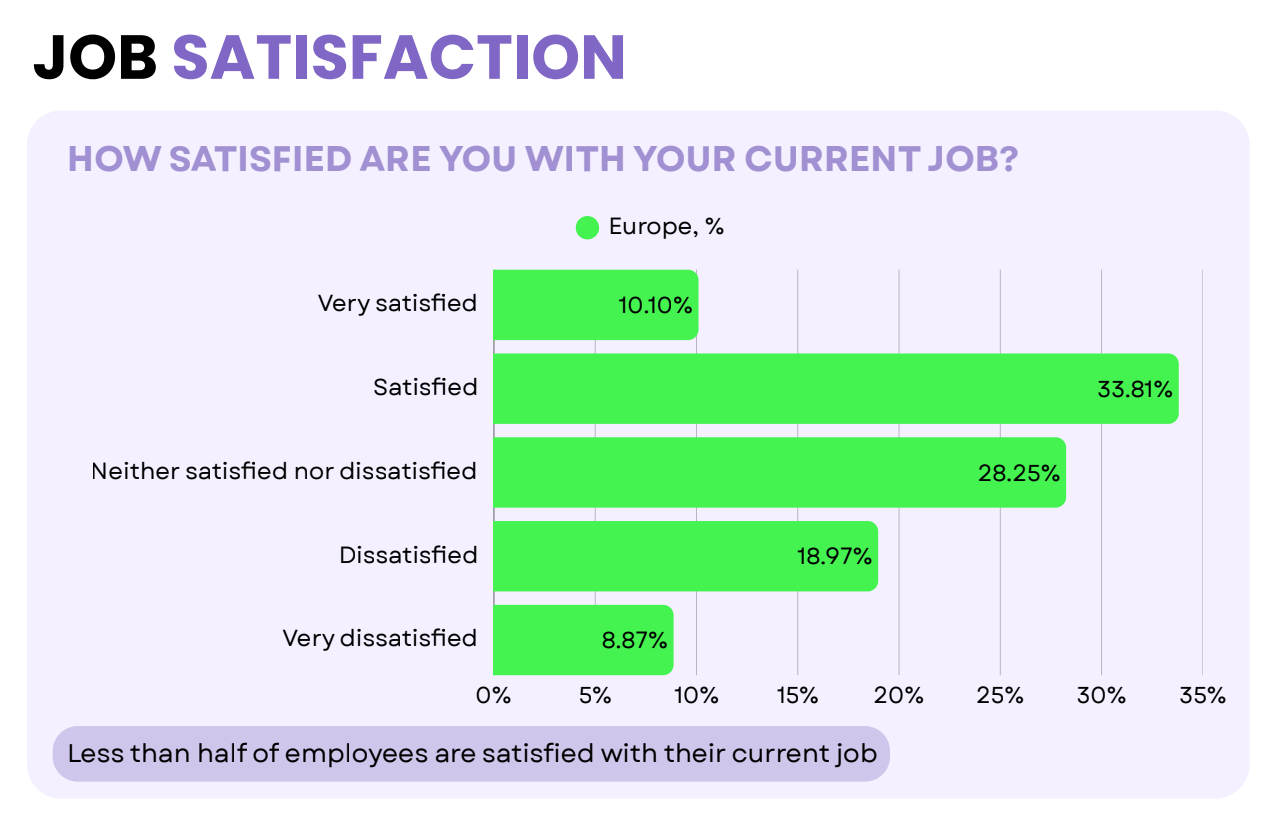
In Europe, 43.9% of respondents are satisfied with their job, and 27.8% are dissatisfied.
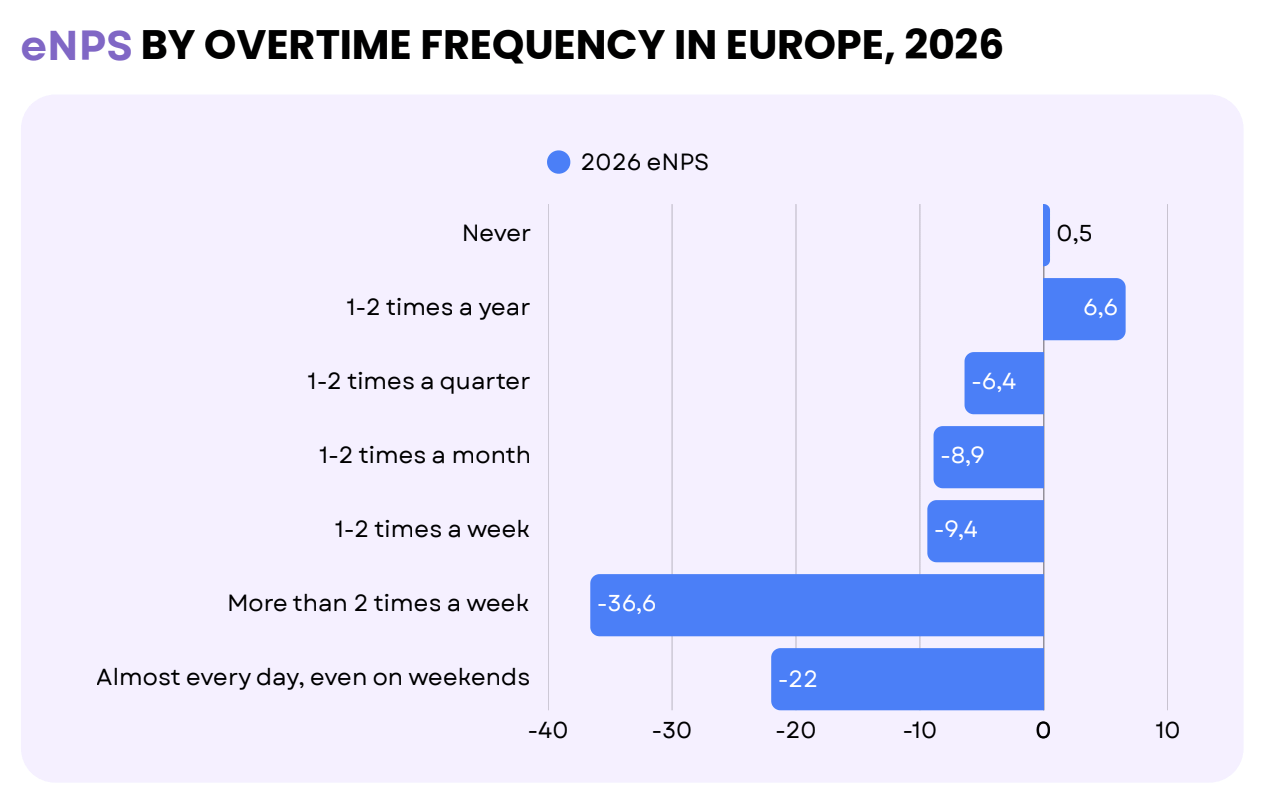
By overtime frequency, the people who feel the worst are those working overtime more than twice a week: their eNPS is -36.6. Surprisingly, for those working overtime almost every day, including weekends, the figure is higher at -22.
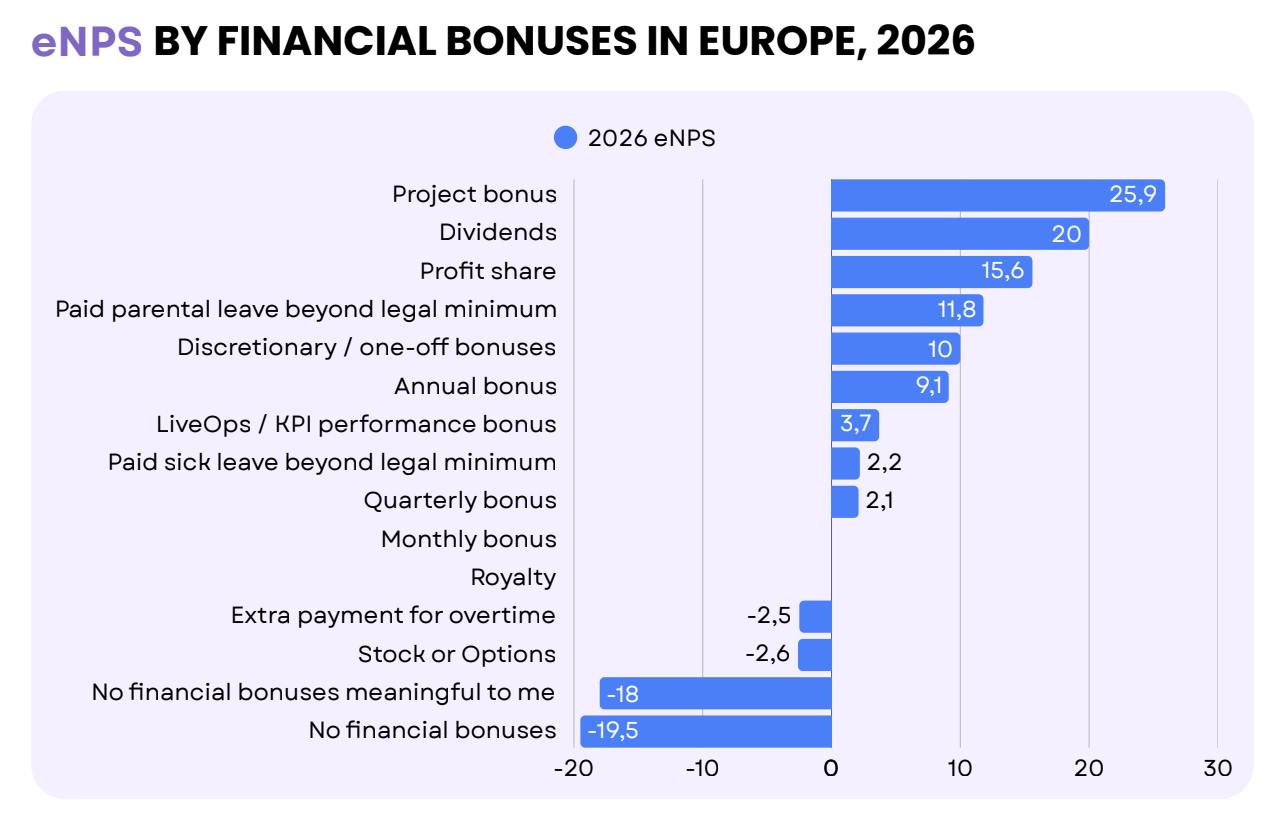
Loyalty is highest among employees who get project bonuses, dividends, or a share of profit. In short, there is a direct correlation between the ability to earn more than just a salary and an employee’s loyalty.
People rate their sense of security in the industry at 2 out of 5. 40% rate it 0 or 1.
The bigger hit to that sense of security comes not from being laid off yourself, but from your team shrinking. People whose team shrank noticeably rate their security at 1.17 out of 5, versus 2.61 for those on growing teams. Being laid off personally barely affects career optimism.
Job security feels lowest in North America, even though median salaries there are the highest in the world.
30% of respondents lost their job in the past 12 months.
Only 26% feel they are growing professionally. 36% report stagnation or a slowdown, and 55% received no training last year.
Half of respondents rate the likelihood of changing jobs in the next six months at 4 or 5 out of 5.
In Europe, only 1 in 8 employees received a full inflation adjustment last year.
AI and Hiring
78% say AI changed the way they work over the past year: 33% significantly, and 45% somewhat. 22% saw no change.
What worries people most is the pressure to work faster and produce more, cited by 61%. 53% point to a decline in work quality, and 46% to how much harder it has become to judge real skills. 35% named job loss or reduced demand for their role, and 29% named ethical concerns. 12% have no concerns at all.
35% of founders decided not to hire someone because AI tools cover the work. 60% deliberately keep their team small, and 48% say their company is currently operating at a loss.
New roles are emerging: AI Strategy, AI Ownership, and AI Management. AI fluency is no longer a nice addition to a resume; it's a required hard skill.
The report gives two unnamed examples. One match-3 giant plans to cut headcount from 3,000 to 500. The founders of another company, according to the report, vibecoded a game with 200% D0 ROAS in their own genre.
Job searches are dragging out. Six months to land a new role is now the norm, and a senior opening on LinkedIn draws more than 100 applications within 24 hours. A Senior Game Designer opening on InGame Job collected 296 applications and 5,141 views in two days.
Salaries
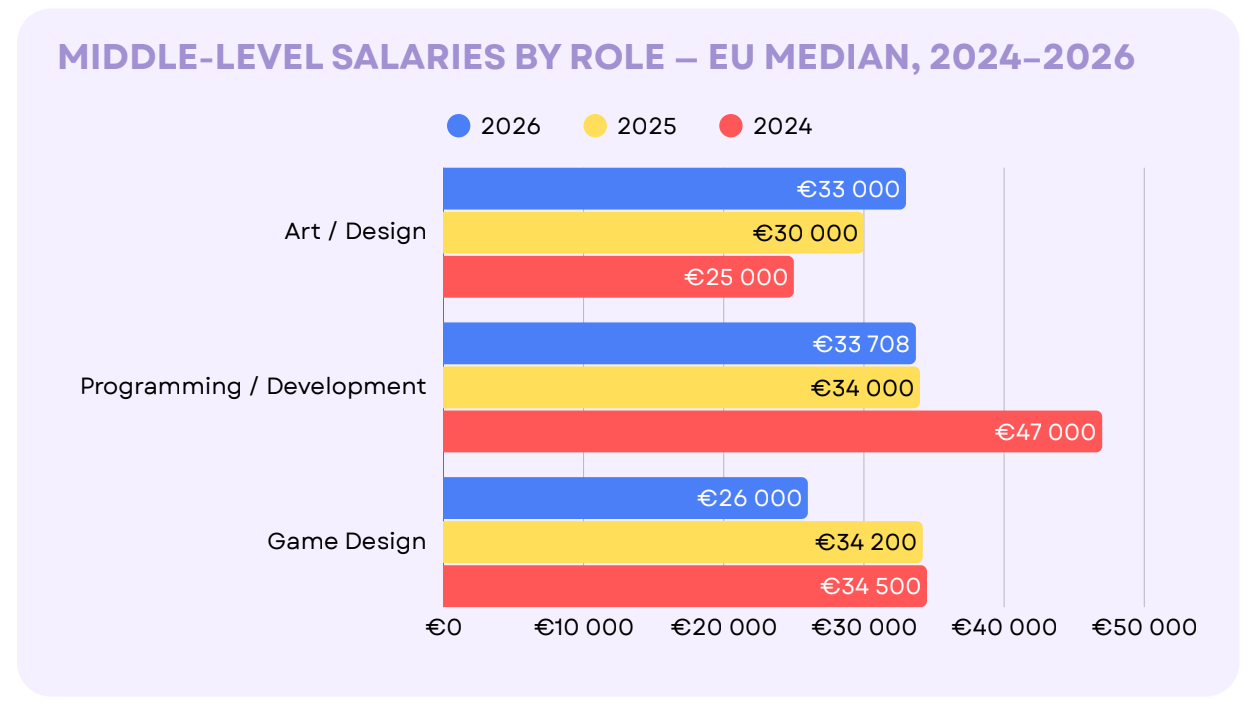
The median for mid-level artists and designers in 2026 is €33,000. In 2025 it was €30,000, and in 2024 it was €25,000.
For mid-level programmers, though, the median fell from €47,000 in 2024 to €33,708 in 2026. For mid-level game designers, it fell from €34,500 to €26,000.
❗️The 2024 and 2025 figures come from earlier editions of the same survey, so some of the movement may reflect changes in the sample.
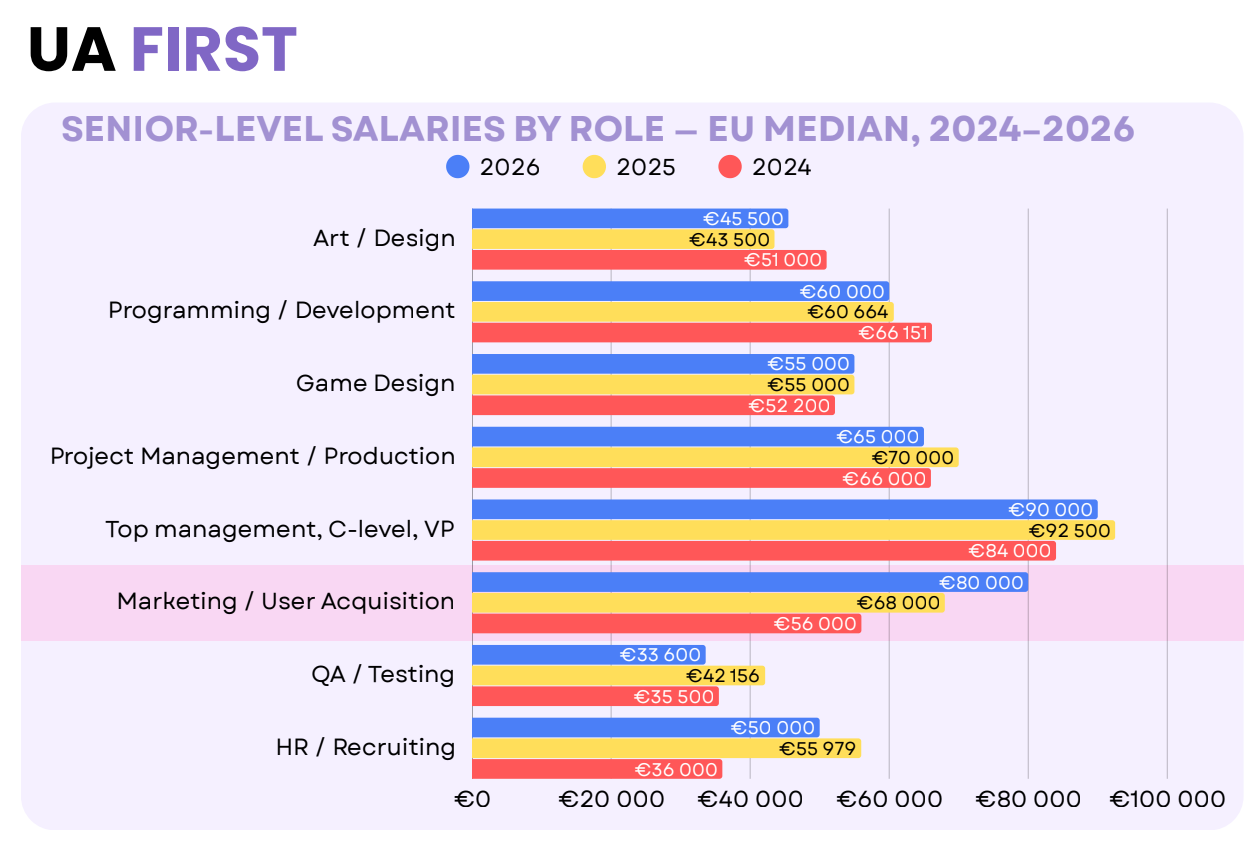
At the senior level, median salaries are growing only in marketing and UA: €56,000 in 2024, €68,000 in 2025, and €80,000 in 2026. That is the second-highest median after top management and C-level (€90,000).
The rest of the senior roles are either plateauing or declining. For programmers, the median fell from €66,151 in 2024 to €60,000 in 2026; for QA, from €42,156 in 2025 to €33,600; and for HR, from €55,979 to €50,000. For game designers, the median salary is €55,000 for the second year in a row.
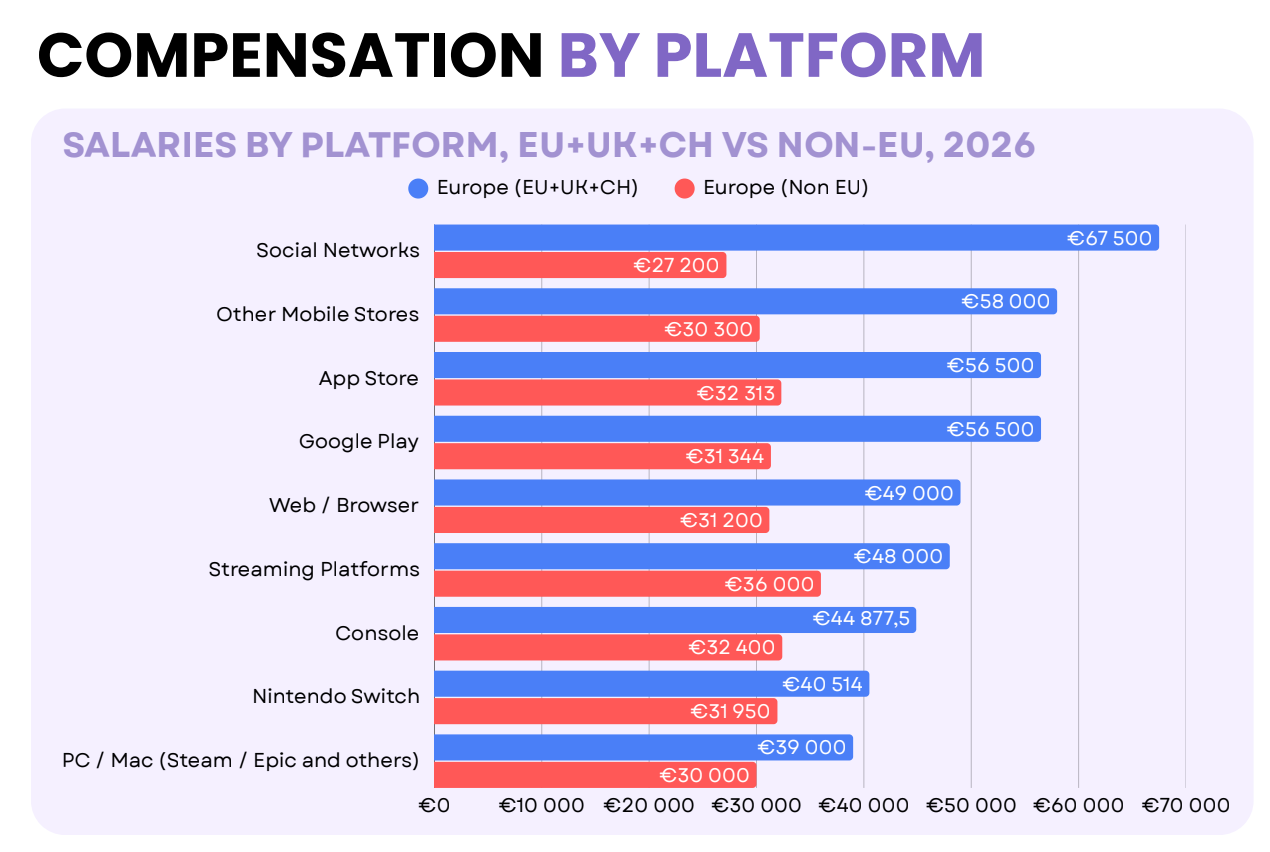
In the EU, the highest pay goes to people working on social network games: €67,500. The lowest goes to those making games for PC and Mac: €39,000. Outside the EU, the spread is much narrower: from €27,200 to €36,000.
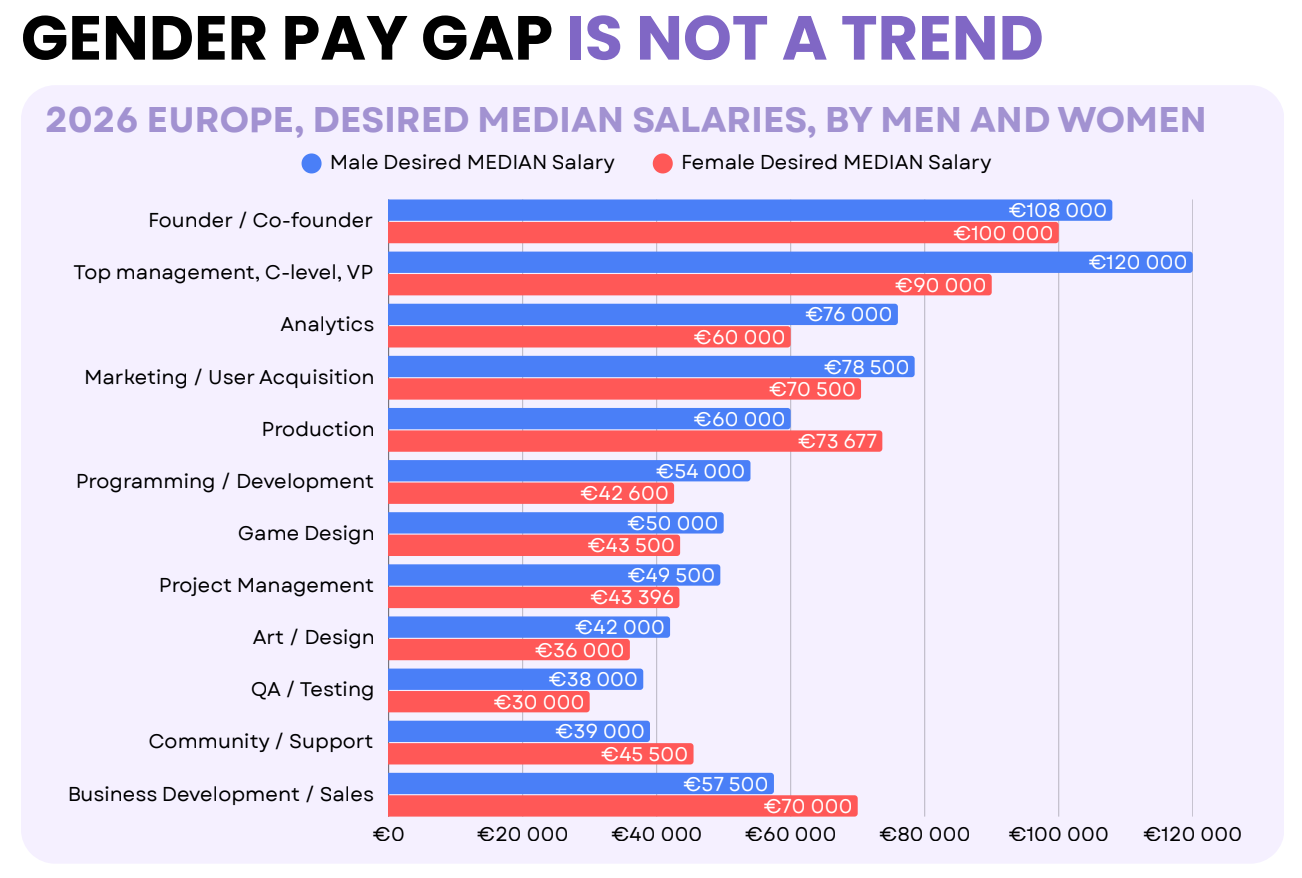
In Europe, women earn less than men in almost every discipline. For programmers, the median is €43,000 for men and €33,408 for women; for game designers, €40,000 and €34,300; and for QA, €27,200 and €21,805. The gap is largest among founders: €72,000 against €46,000.
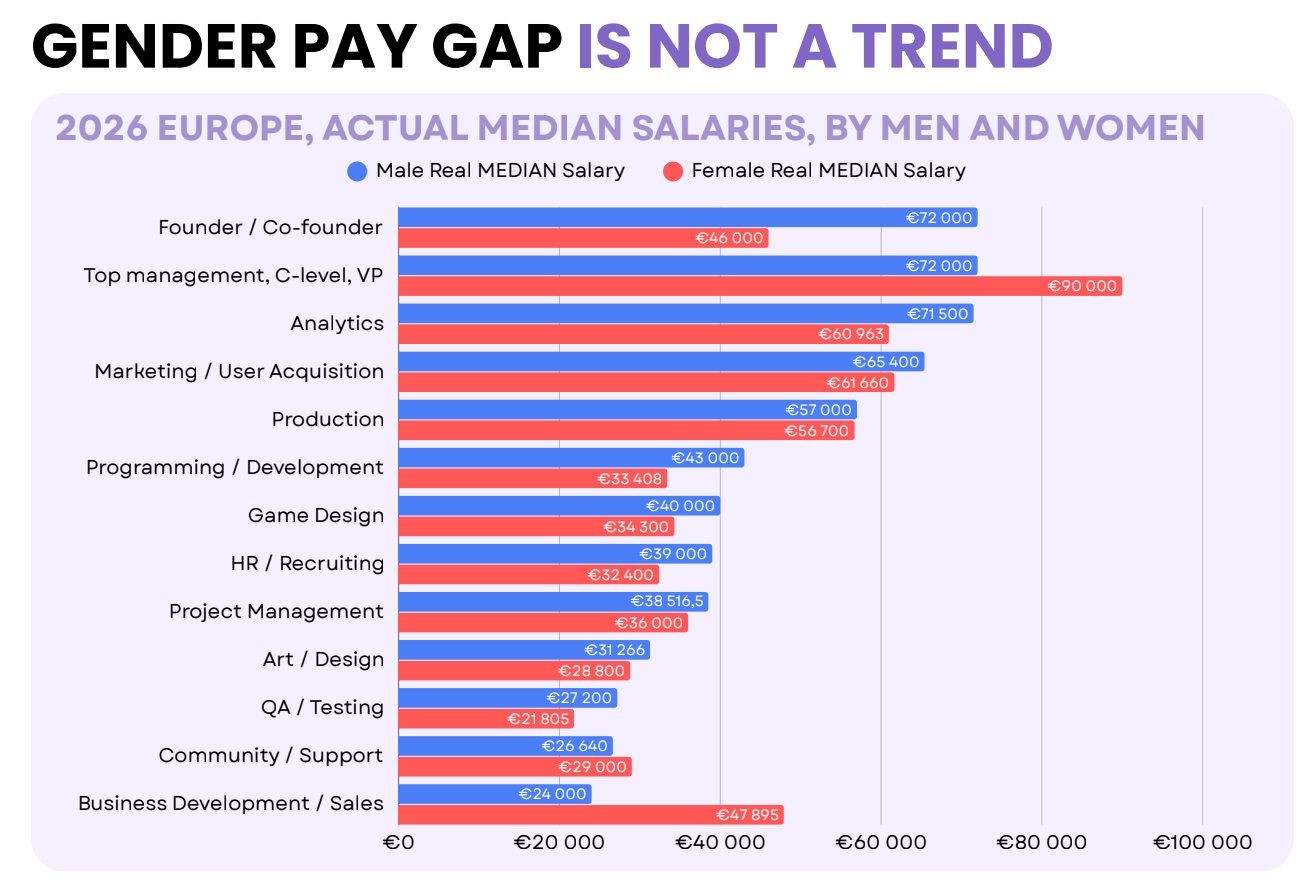
There are exceptions, though. At C-level, the median salary for women is €90,000, compared with €72,000 for men. In business development and sales, it is €47,895 against €24,000. In community and support, it is €29,000 against €26,640.
❗️A difference like that may also come down to the sample structure of this particular report.
Desired salaries show the opposite picture. Women at C-level want €90,000, and men want €120,000. Founders ask for €100,000 and €108,000. Women applying for business development roles ask for €70,000, and men ask for €57,500.
Freelance and Team Structure
European studio spending on external talent grew 63% in 2025 versus 2024. Globally, the growth was 55%.
The number of freelancers working with European studios grew 24%, and the average freelancer’s monthly income worldwide grew 19%. The average European studio works with 10 contractors.
A word from our sponsor
Game studios run on contractors — artists, composers, QA testers, translators — often spread across a dozen countries. That’s a lot of contracts, tax rules, and IP clauses to track. Mellow handles all of it: compliant contracts, automated payments, and IP protection built in, for contractors in 150+ countries.
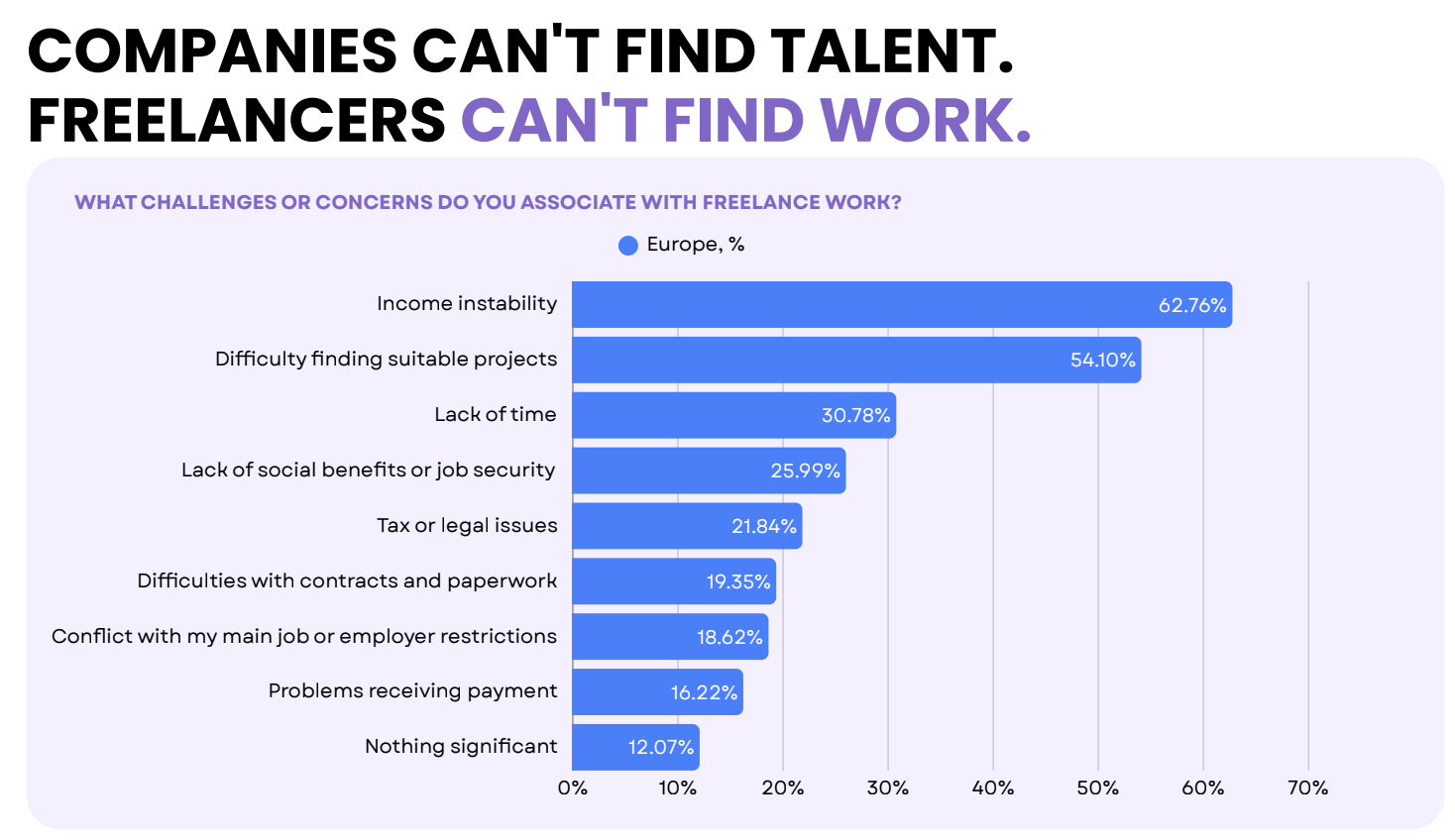
But there isn't enough work to go around. 62.8% of freelancers complain about unstable income, and 54.1% about how hard it is to find suitable projects.
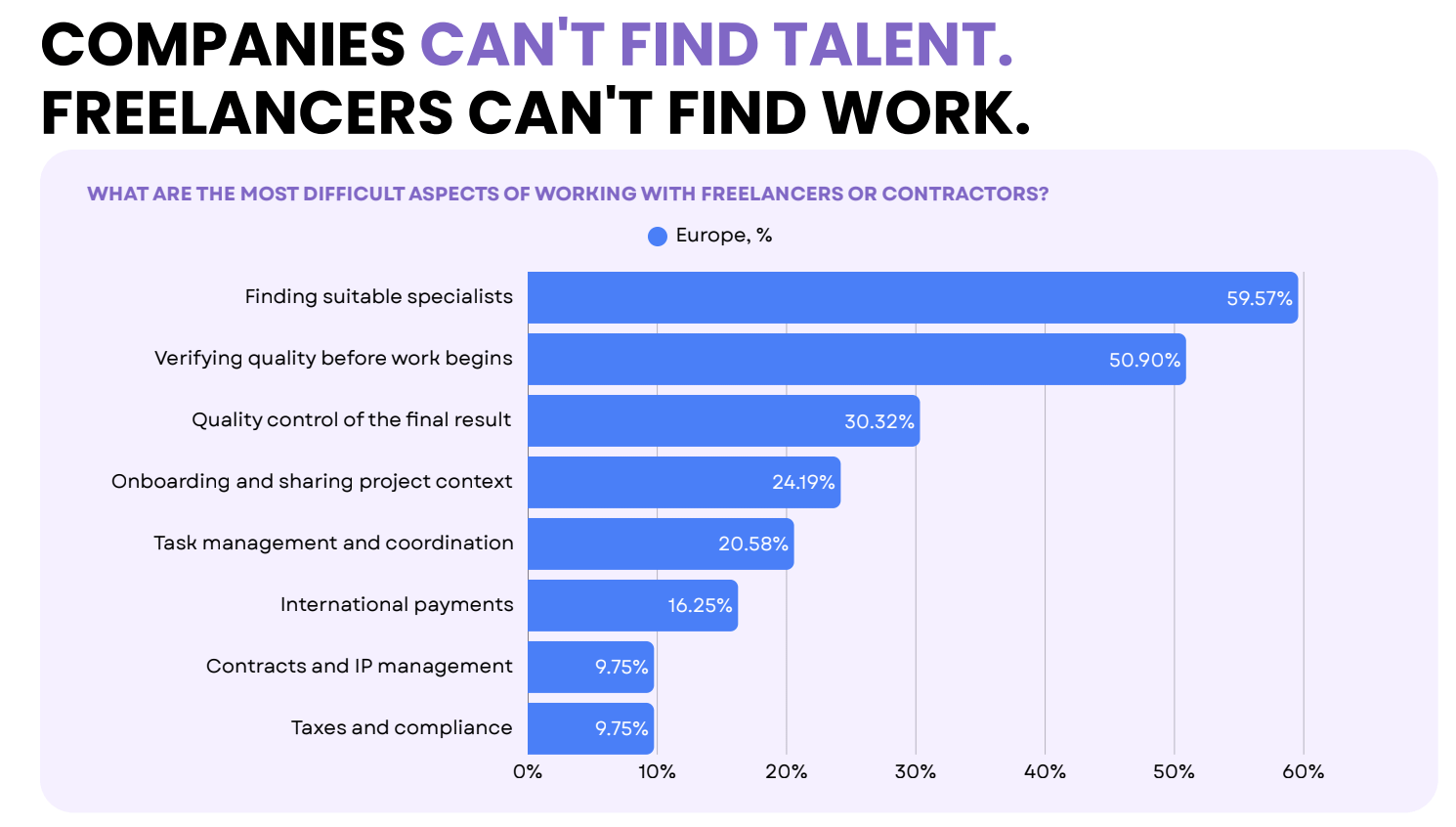
On the studio side, the main difficulty is exactly the same: 59.6% name finding suitable specialists as the hardest part, and another 50.9% name verifying quality before the work begins.
The report’s author notes a change in how work is structured. A small core stays on staff (directors and lead specialists) with options, insurance, and bonuses. Everyone else is hired for a specific sprint or development phase and leaves the moment it ends. In her words, full-time work in the industry is shifting from the default to a privilege.
Video Games Europe & EGDF: The European Gaming Market in 2025 - powered by Mellow
Ipsos collected the data on behalf of Video Games Europe. The report draws on GameTrack (39,371 respondents aged 6-75), actual GSD sales (physical and digital copies, as reported by publishers), and the EGDF industry report.
❗️In 2025, Video Games Europe expanded its coverage from five markets (EU5: the UK, France, Germany, Spain, and Italy) to sixteen (EU16). Some figures in the report cover only the EU5 and others only the EU16, so a direct comparison with last year’s numbers is not always meaningful.
The market
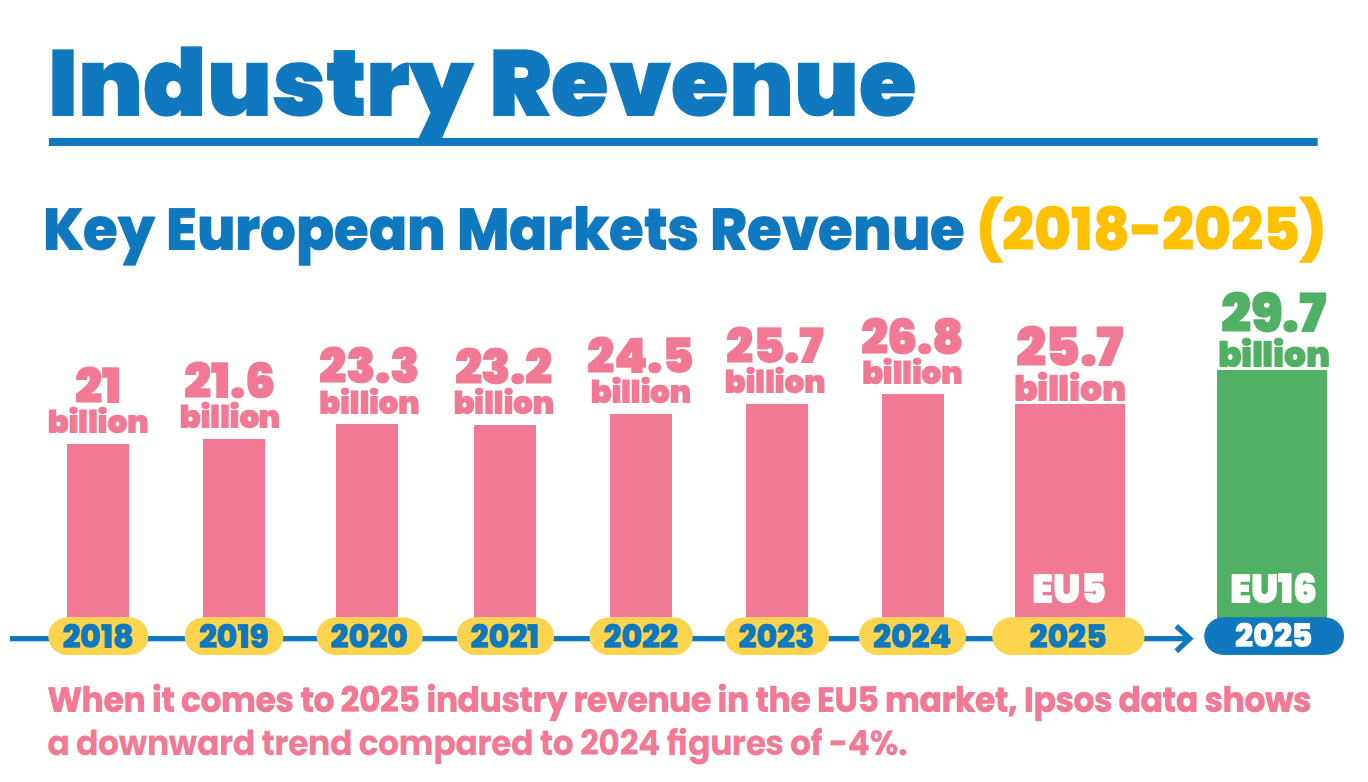
Sixteen European markets earned 29.7 billion euros in 2025.
A word from our sponsor

Need a freelance 3D artist, composer, or QA tester fast? Mellow’s AI Scout finds qualified talent in under 48 hours — free to try, no commitment. Describe the role, get a shortlist, hire when you’re ready.
The picture is worse for the five largest countries, which have been tracked since 2018. In 2025, the EU5 earned 25.7 billion euros (-4% YoY). That is the first meaningful decline in eight years of tracking, and a return to the 2023 level.
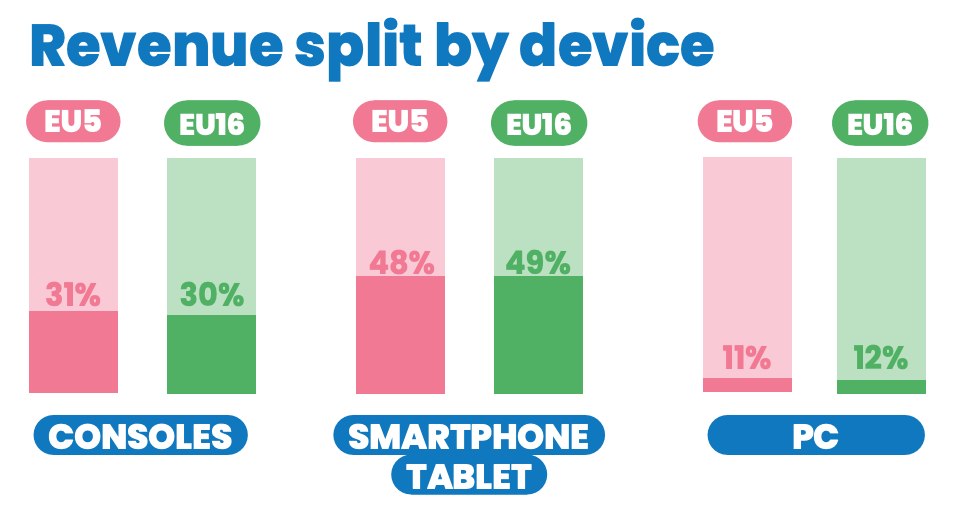
By device, smartphones and tablets account for 49% of EU16 revenue, consoles for 30%, and PC for 12%. The EU5 figures are similar.
❗️A year ago, consoles accounted for 38% of EU5 revenue and mobile for 44%. So in a single year, the console segment in Europe declined significantly. The 4% revenue drop across the EU5 is largely down to exactly that.
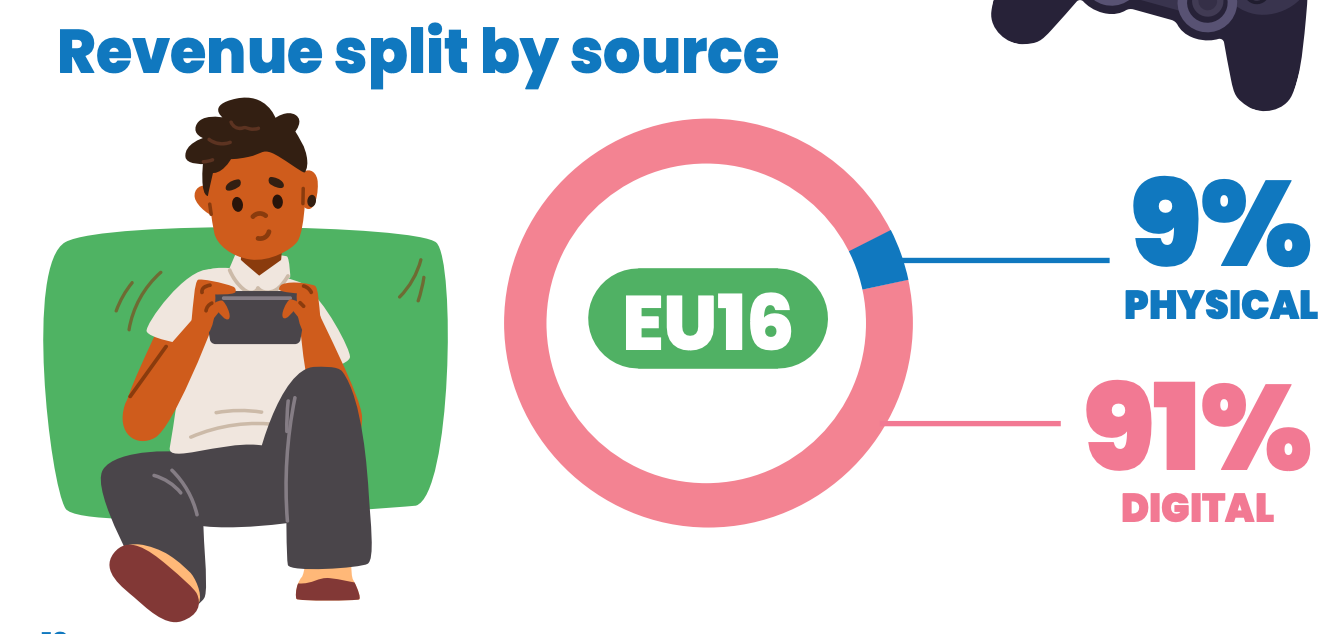
Digital distribution accounts for 91% of revenue, and physical copies for 9%. A year ago, the split was 90% and 10%.
The top three console releases of 2025 in Europe: EA SPORTS FC 26, EA SPORTS FC 25, and Battlefield 6. On PC, the best sellers are Battlefield 6, Red Dead Redemption II, and GTA V. On mobile, the top earners are Coin Master, Royal Match, and Candy Crush Saga.
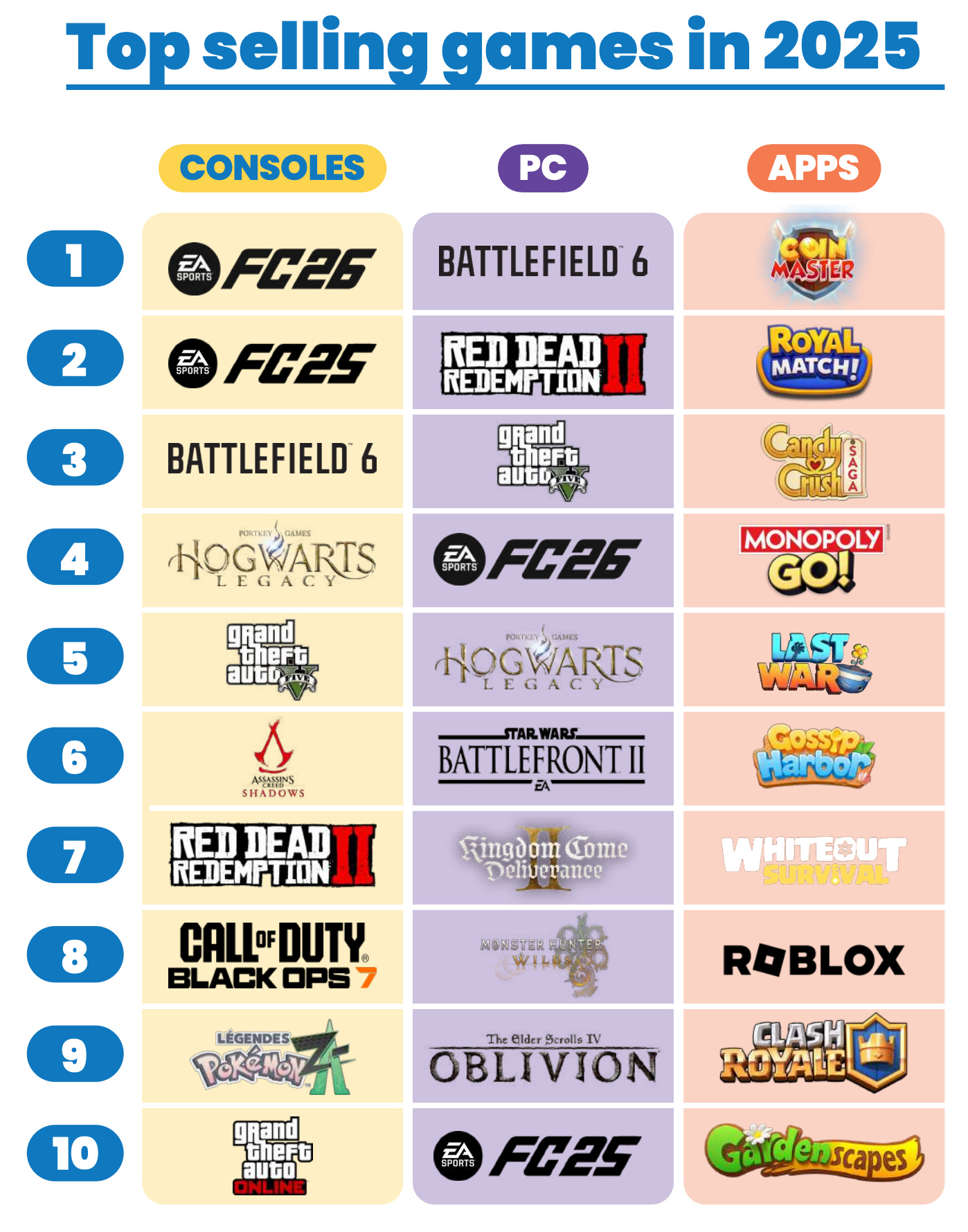
❗️The GSD charts only count publishers that submit their data. That is why the lists are missing Clair Obscur: Expedition 33, ARC Raiders, and Hollow Knight: Silksong.
Coin Master and Royal Match hold the top two spots in the European mobile chart for the second year running. Last year, Brawl Stars was third; Candy Crush Saga has taken its place.
❗️Forecasts for the direction of the European market differ sharply. Newzoo, in its latest forecast, expects the European market to reach 38.5 billion dollars in 2026 and grow 6.1%, while Ipsos reports a decline. Methodology matters, though, because Newzoo covers all of Europe and approximates the data, while Video Games Europe counts sixteen countries using actual figures (meaning VGE has more blind spots when sizing the market, but has higher precision).
The audience
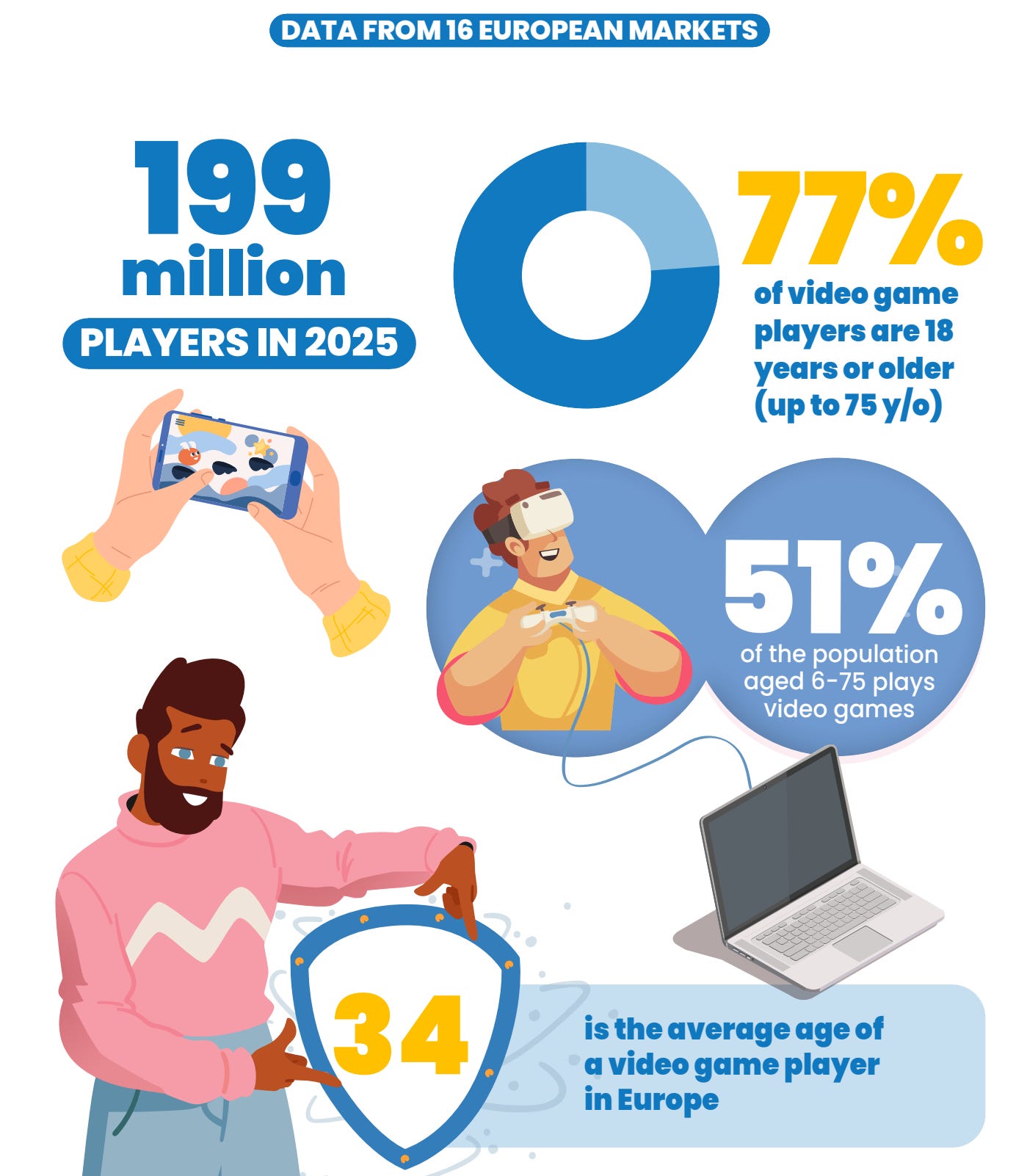
199 million people who play games live across the sixteen European countries. That is 51% of the population aged 6 to 75.
The average player in Europe is 34, and 77% of players are over 18.
Women make up 46% of European players, or roughly 91.5 million people. The average female gamer is 35, and women play 7 hours a week.
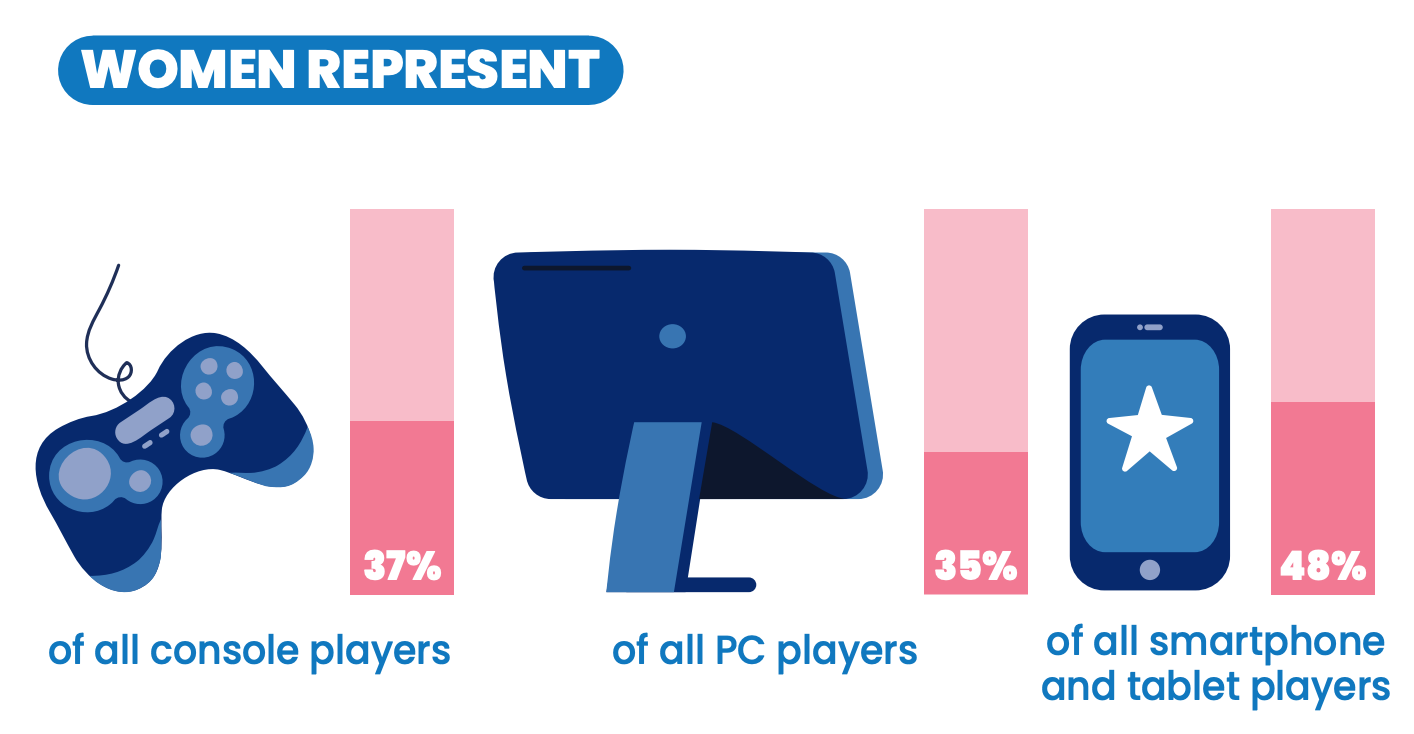
Women make up 48% of all mobile players, 37% of console players, and 35% of PC players.
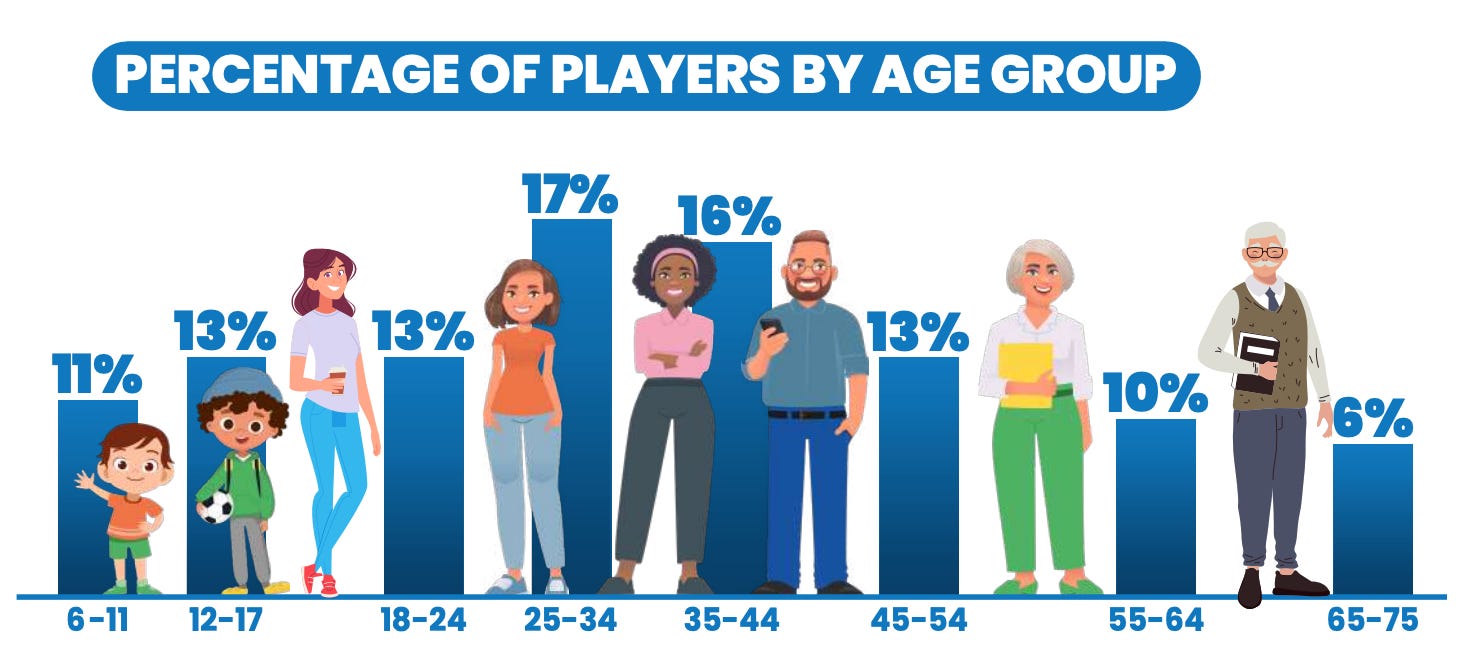
The audience is spread fairly evenly by age. The largest group is 25-34 (17% of all players), followed by 35-44 (16%). People aged 65-75 account for 6%.
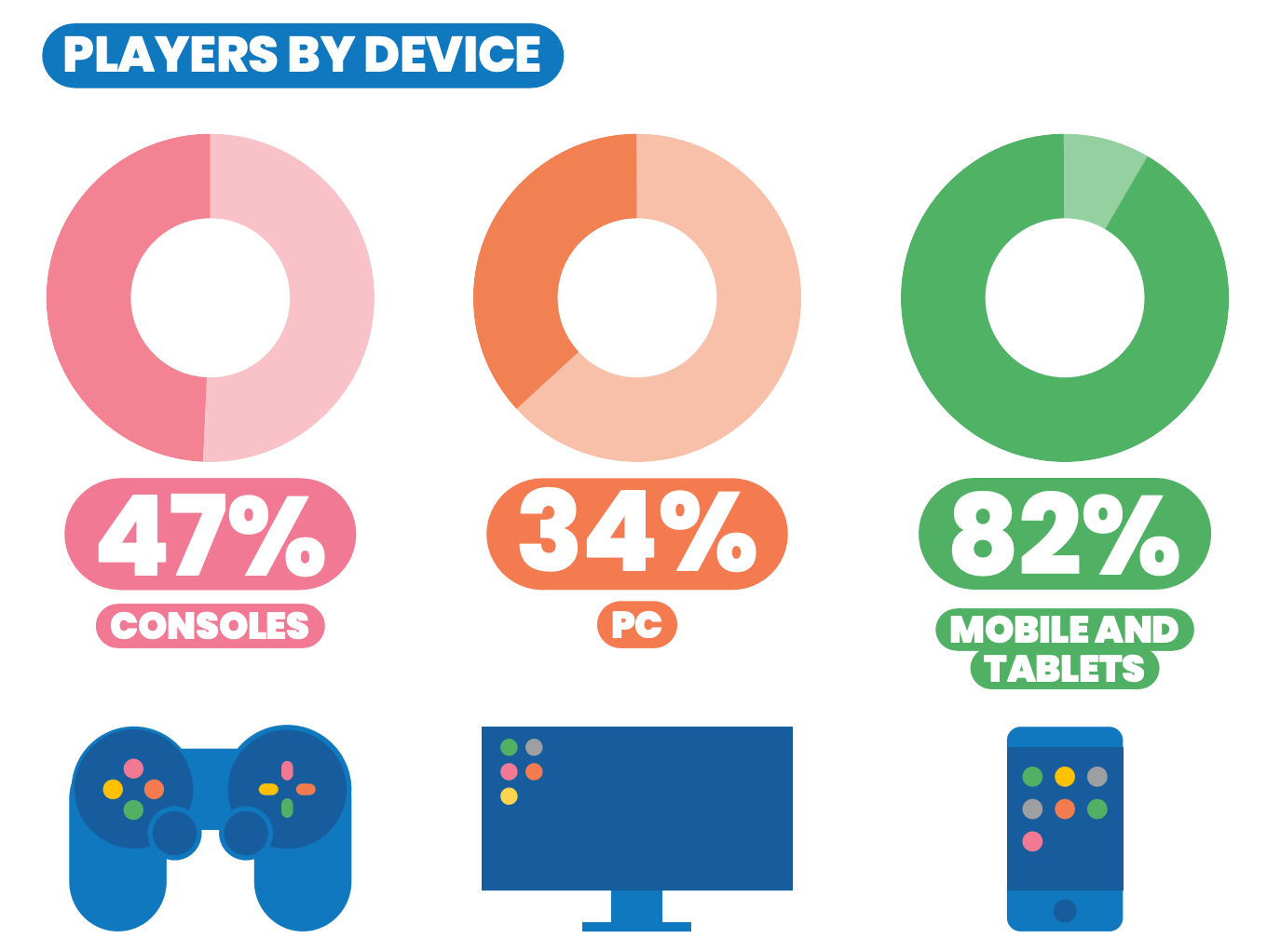
82% of players play on smartphones and tablets, 47% on consoles, and 34% on PC.
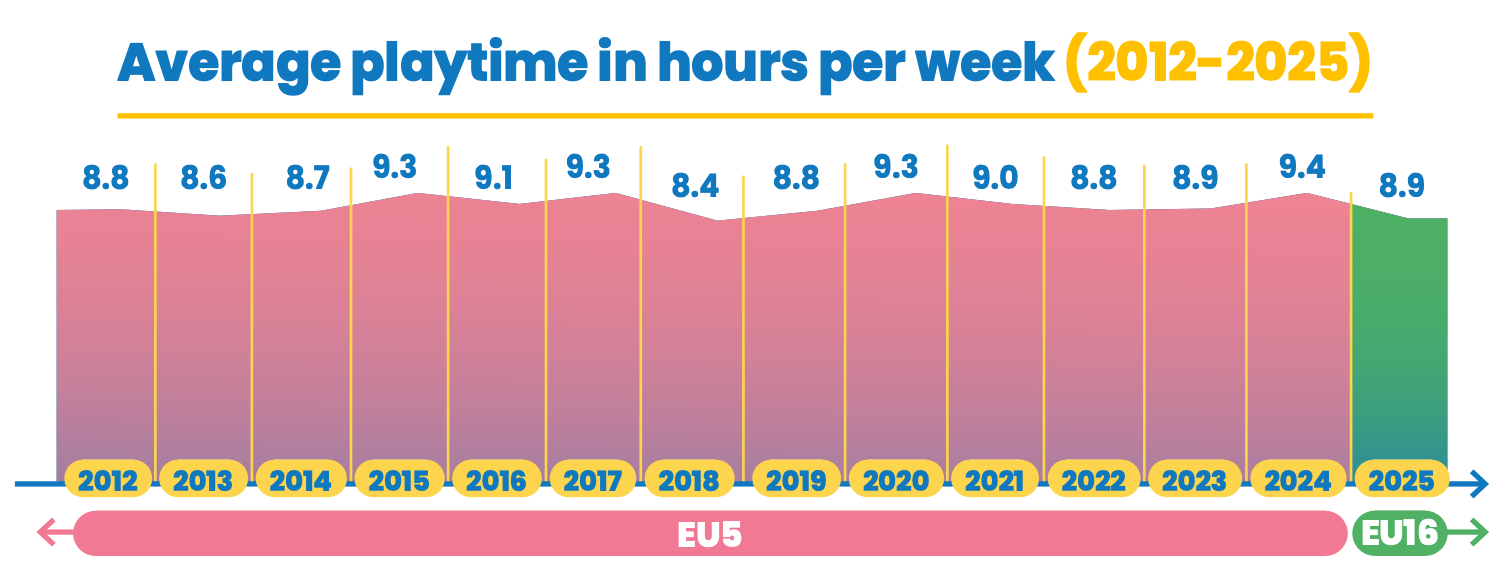
Europeans play an average of 8.9 hours a week. Last year’s report put the figure at 9.4 hours across five countries, a record since 2012. The figure now covers more countries.
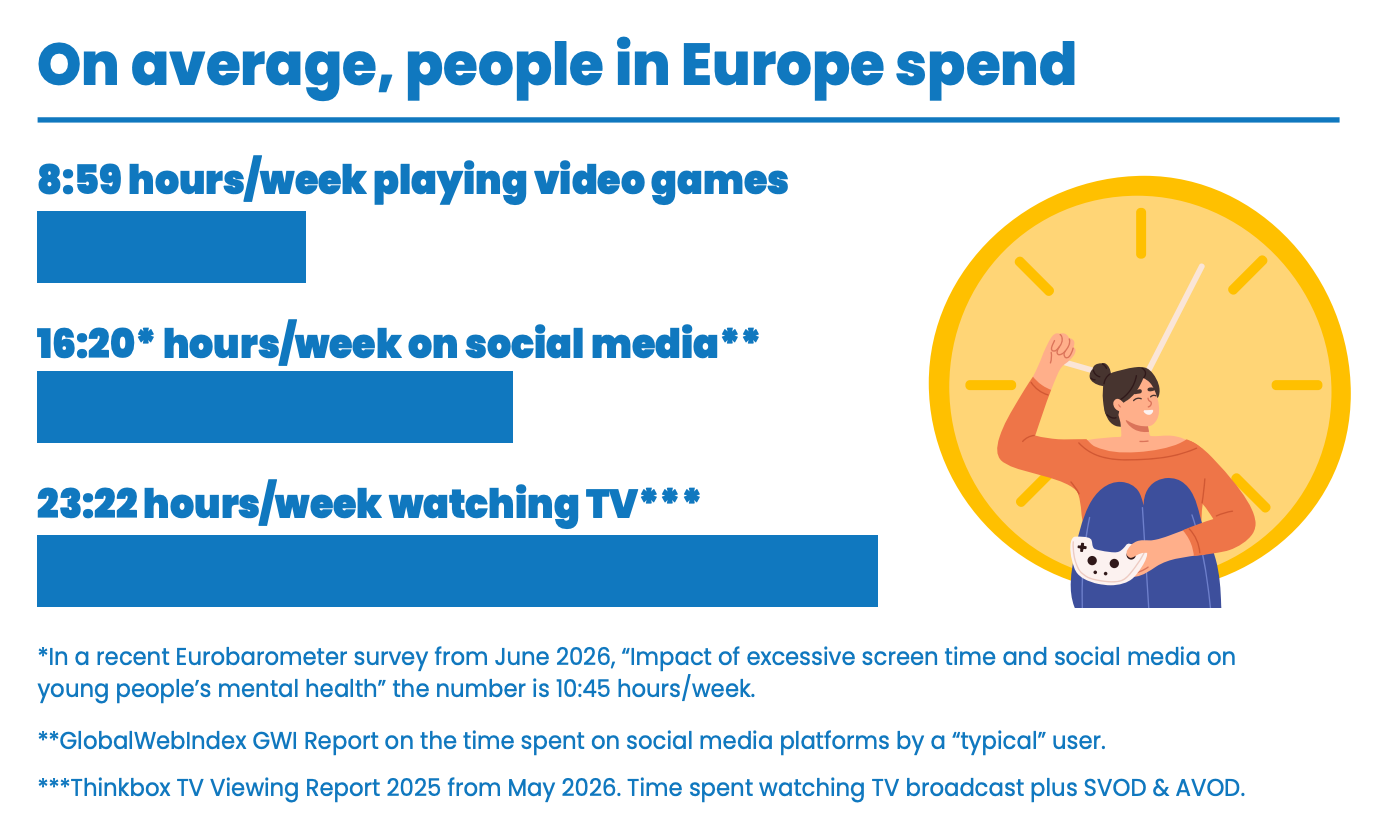
Games still trail other media in the time people spend on them. Europeans spend 16 hours 20 minutes a week on social media and 23 hours 22 minutes on television (including SVOD and AVOD).
Penetration is highest in Austria (78% of the population aged 6-75), Switzerland (74%), and the Netherlands (64%). It is lowest in Italy (29%) and the UK (44%).
❗️The UK is nonetheless Europe’s second-largest market, at 5.5 billion euros in revenue. Fewer than half its population plays, but that half spends noticeably more than its neighbors.
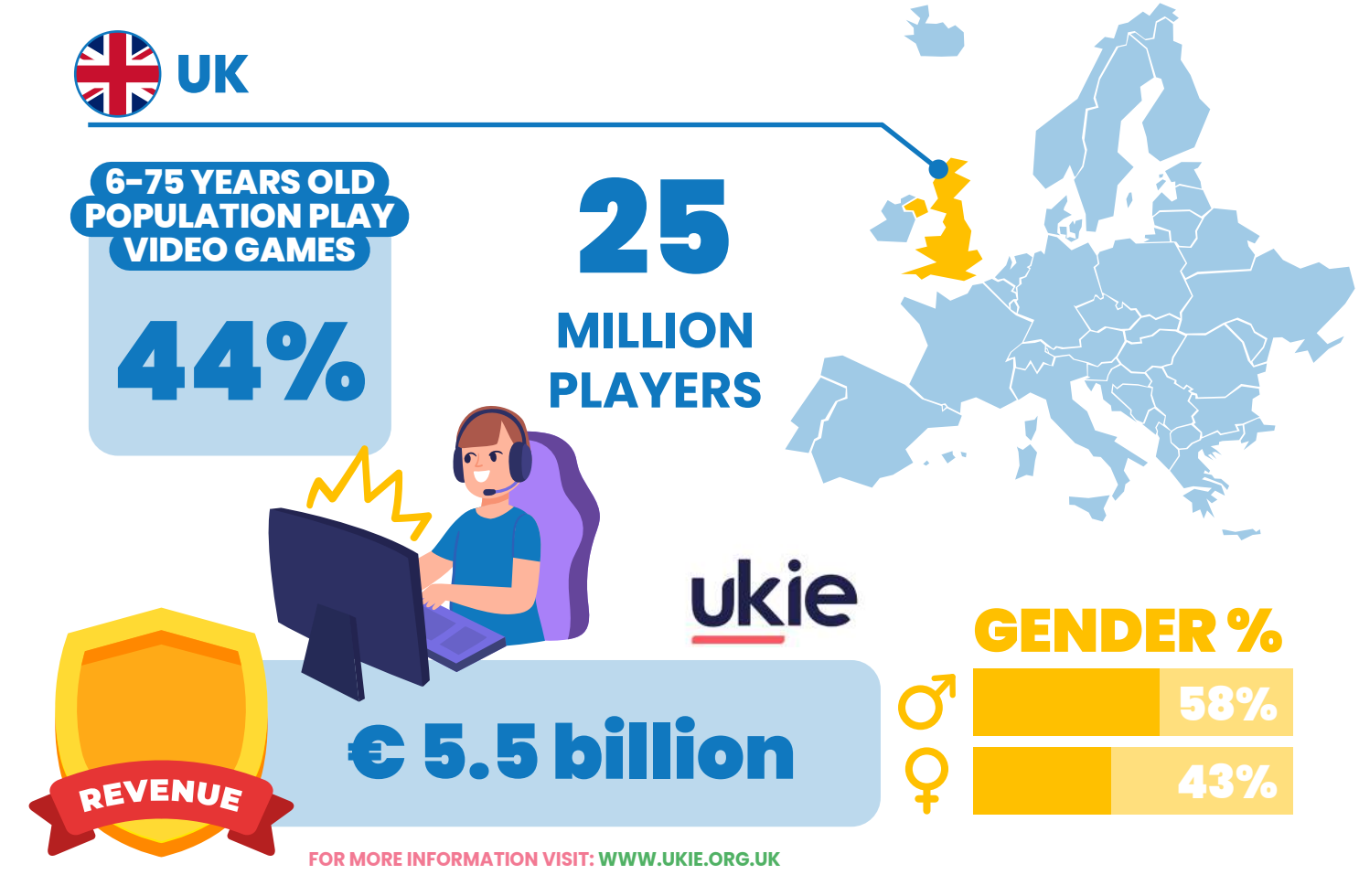
Germany leads on player count (37.7 million), followed by France (31.5 million) and the UK (25 million).
Revenue lines up as follows: Germany is first (6.5 billion euros), the UK second (5.5 billion euros), and France third (3.8 billion euros). Spain (2.29 billion euros) and Italy (1.8 billion euros) come next.
❗️The German association game, in its own report, counted 41.2 million players in the country and a market of 9.382 billion euros. The audience gap may come from different age brackets (6-69 versus 6-75) and counting methodology, while the revenue gap comes from the game also counting hardware, which is absent from the Video Games Europe figures.
The industry and employment
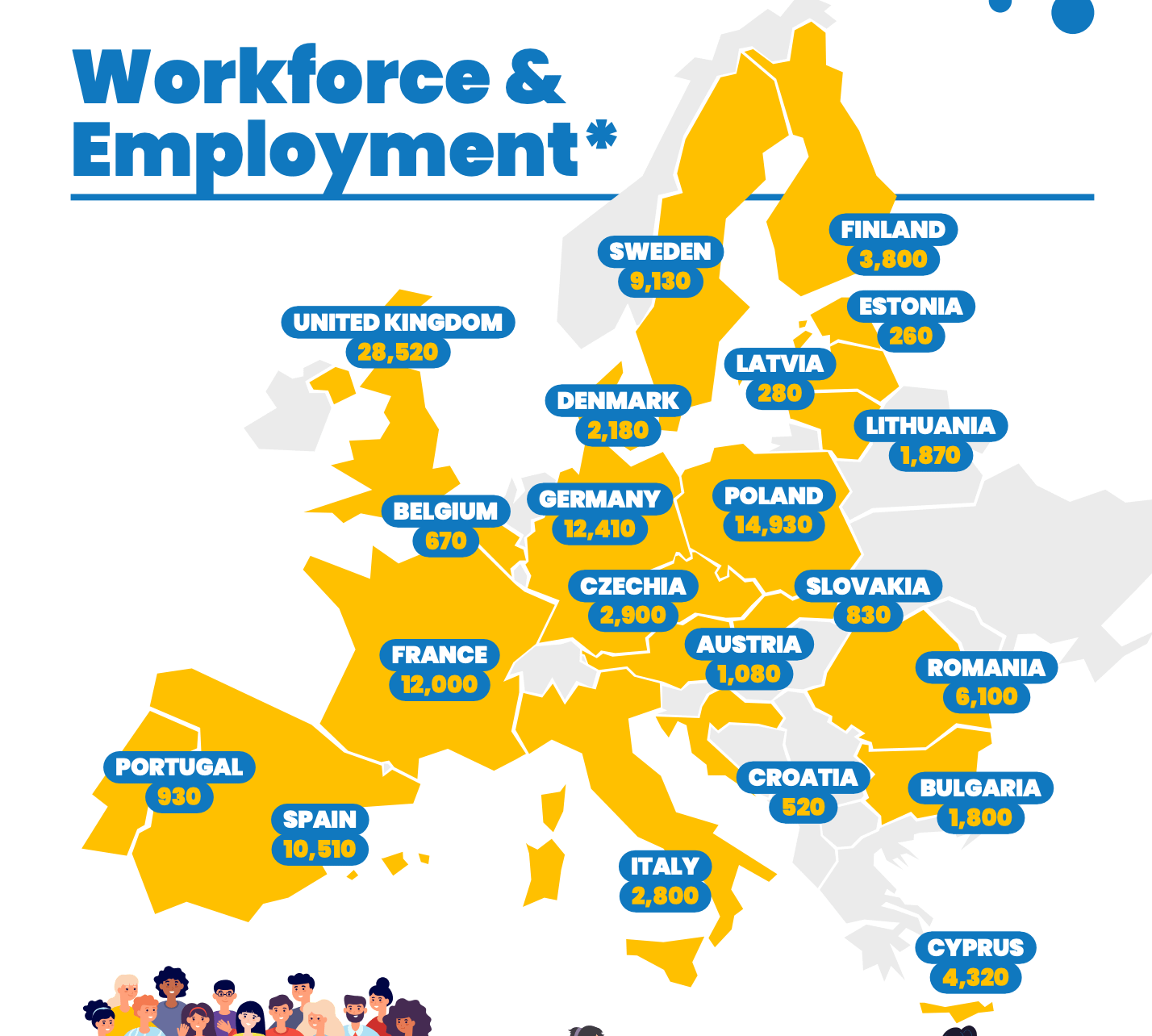
123,000 people work in the European games industry across 8,700 studios. Women make up 24% of them.
The largest workforces are in the UK (28,520 people), Poland (14,930), and Germany (12,410).
A word from our sponsor
Need a freelance 3D artist, composer, or QA tester fast? Mellow’s AI Scout finds qualified talent in under 48 hours — free to try, no commitment. Describe the role, get a shortlist, hire when you’re ready.
Last year’s report listed 116,419 people. This time, though, the sample added data from Cyprus (4,320 people), France (12,000 people), and Bulgaria (1,800 people). So the number of people employed in the games industry has fallen significantly over the past year.
Cyprus, with a population of about a million, accounts for 4,320 jobs in the industry. That is more than Finland (3,800), Italy (2,800), or Denmark (2,180).
PEGI: the biggest change since 2003
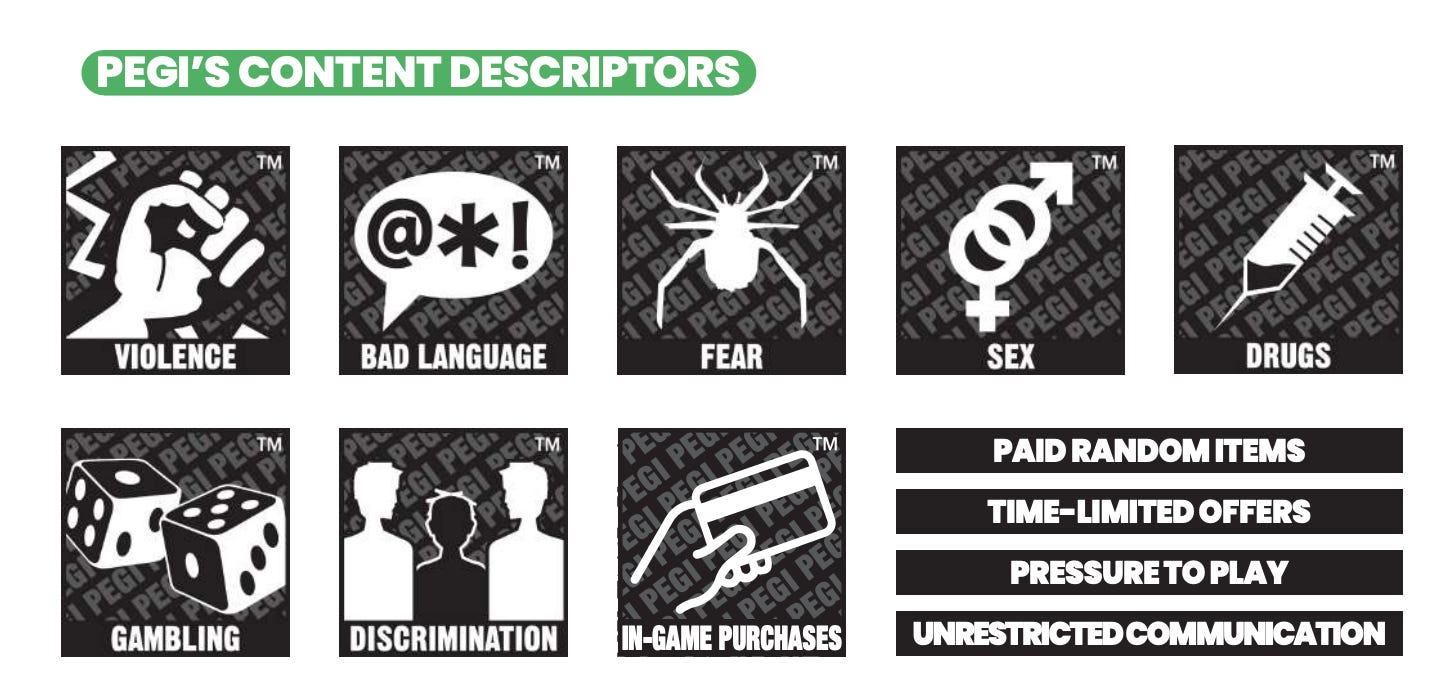
Starting in June 2026, PEGI classifies games by functionality as well as by content. The criteria now include in-game content purchases, paid random items, unrestricted communication, and mechanics that incentivize players to keep playing.
Games with paid random items get PEGI 16 by default, and PEGI 18 in some cases.
Games with time-limited or quantity-limited offers get PEGI 12. Games with NFT or blockchain mechanics get PEGI 18.
Mechanics that penalize a player for not returning (losing content or progress) get PEGI 12. Mechanics that simply reward engagement (daily quests) get PEGI 7.
Games with unrestricted communication, with no blocking or muting, get PEGI 18.
The rules are mandatory for new games from June 2026, and already-released titles have to comply by October.
❗️The new criteria cover practically every F2P project: loot boxes, time-limited offers, and daily quests are almost everywhere. PEGI itself calls this the biggest reform of the system since it was created in 2003.
There are new descriptors, too: Paid Random Items, Time-Limited Offers, Pressure to Play, and Unrestricted Communication.
Violating the PEGI Code of Conduct carries a fine of 5,000 to 500,000 euros, repackaging, or a product recall.
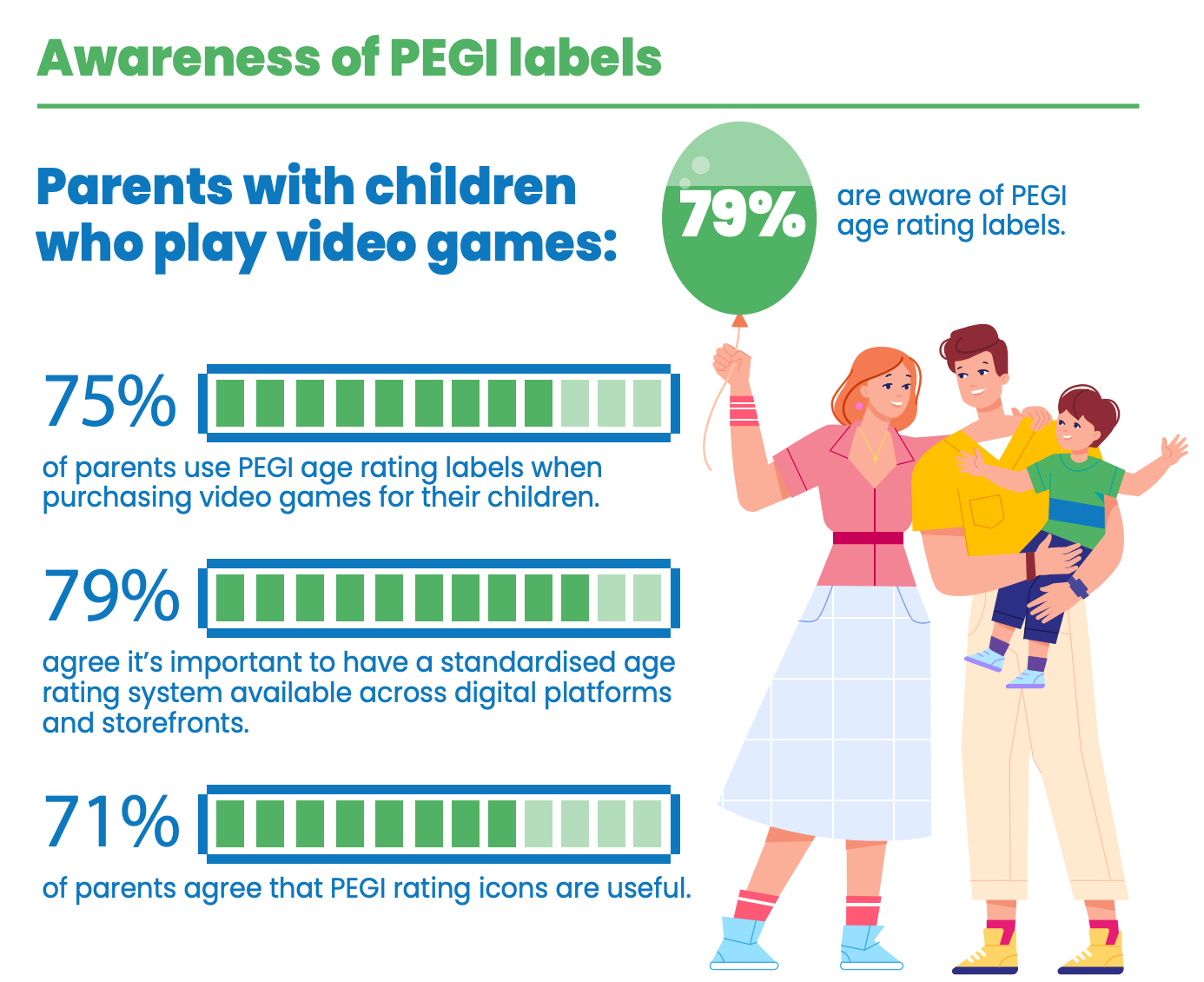
79% of parents with children know about PEGI ratings, and 75% use them when buying games for their children.
Children and parents
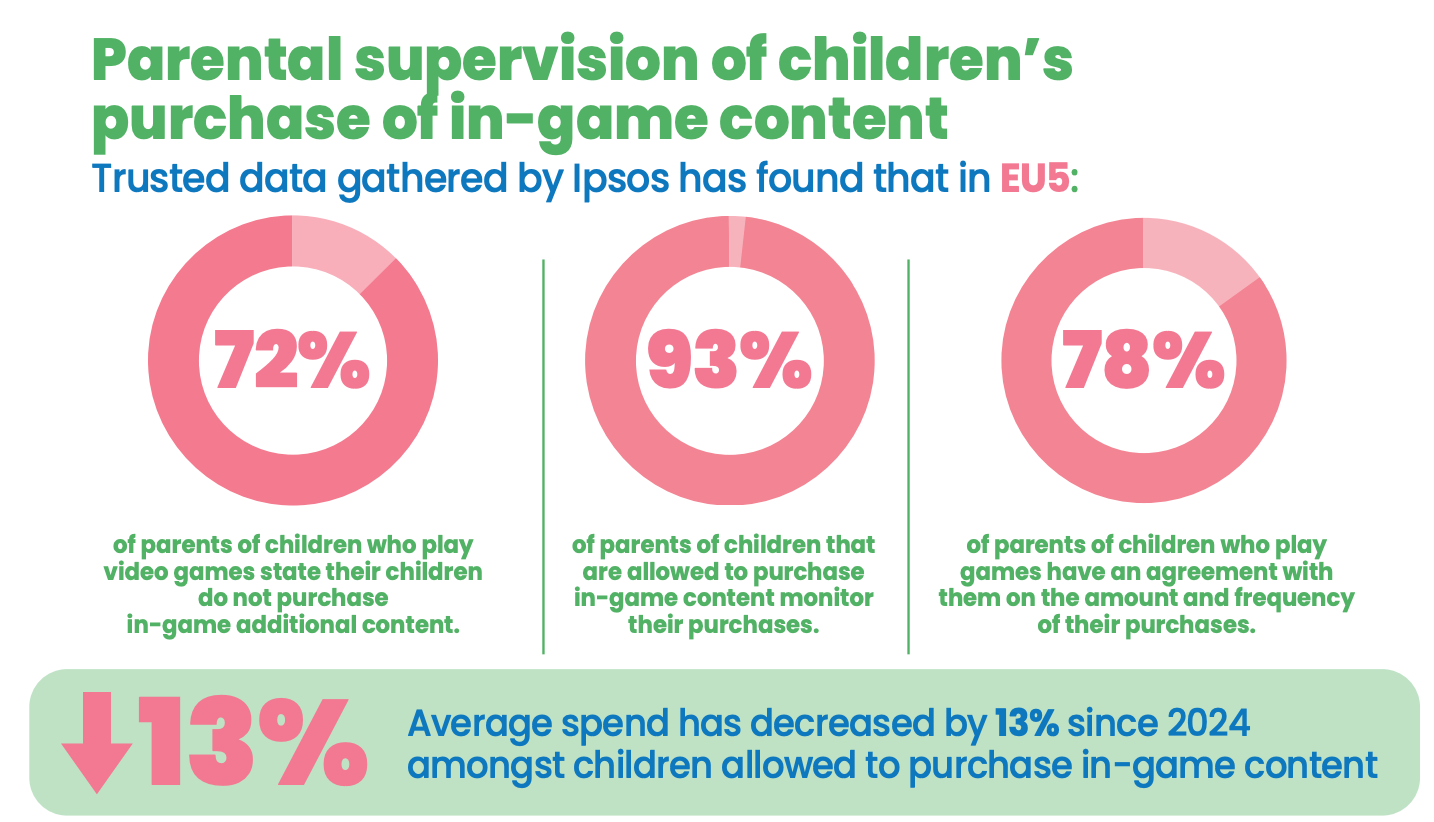
72% of parents say their children do not buy in-game content. A year ago the figure was 76%.
Among parents whose children are allowed to buy, 93% monitor those purchases. 78% have an agreement with their child on how much and how often they can spend.
Average spending by children who are allowed to buy fell 13% compared with 2024. The year before, the drop was 21%.
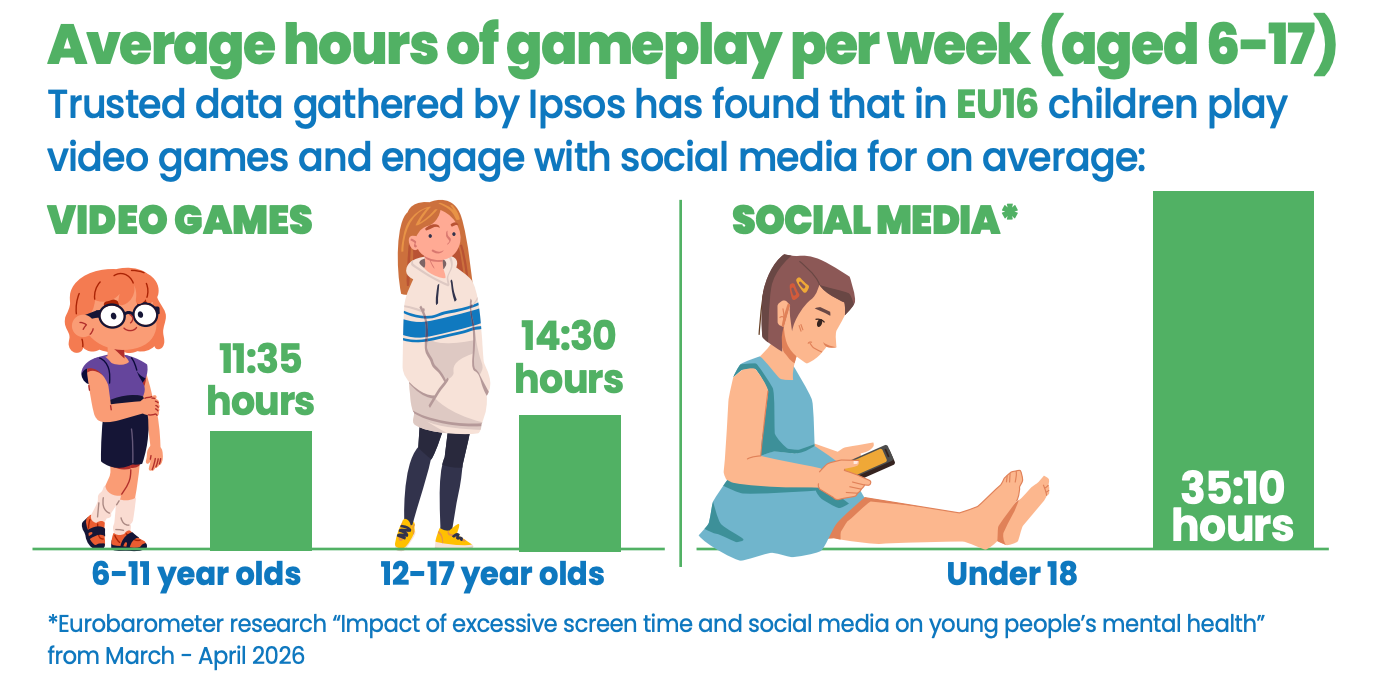
Children aged 6-11 play an average of 11 hours 35 minutes a week, and children aged 12-17 play 14 hours 30 minutes. Under-18s spend 35 hours 10 minutes a week on social media.
79% of parents use at least one parental control tool, and 74% monitor their child’s online communication in games in some form.